Why the Ori Crusade Nearly Defeated the Milky Way
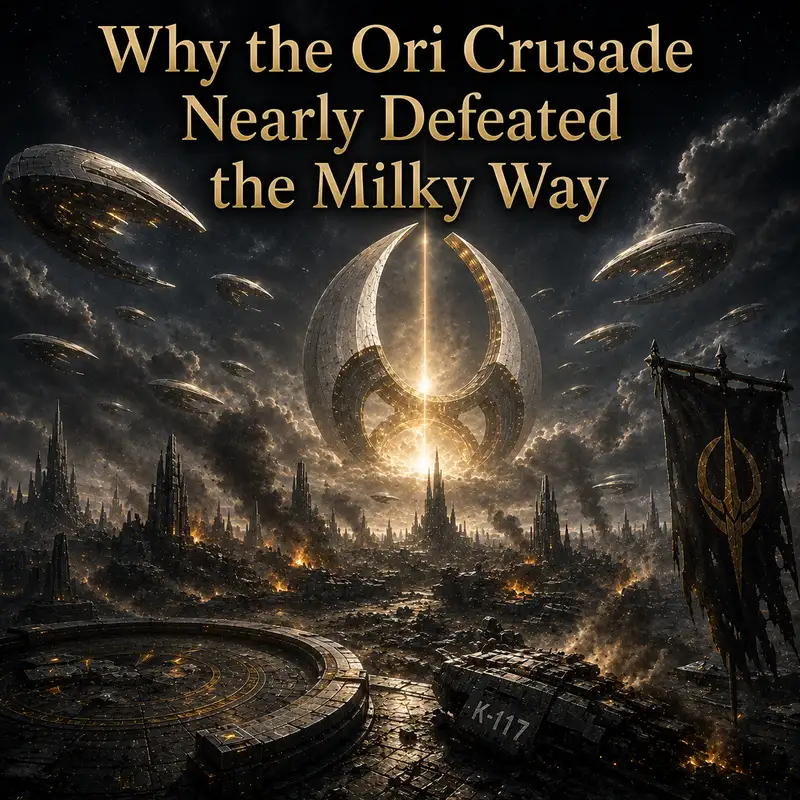
Seven Ori warships entered Earth’s solar system and stopped beyond the reach of any defense certain to defeat them. The Antarctic weapons platform could not be expected to destroy that concentration. The Apollo could observe, maneuver, and prepare to fight. It could not promise victory. At Stargate Command, one captured Prior waited for the order that would begin the assault. Earth’s survival depended on an expedition that had crossed into another galaxy, lost contact, and might already have failed. The Ori crusade had not conquered the Milky Way, but it had reached the point where the principal organized resistance had no reliable conventional answer.
That is why the crusade came so close to success. The Ori did not rely on one fleet, one weapon, or one spectacular battle. They combined religion, intelligence, biological warfare, political subversion, industrial mobilization, gate access, capital ships, and ascended power into one campaign. Their opponents possessed courageous personnel and remarkable technology. They did not possess one government, one command structure, one doctrine, or one industrial base. The Ori attacked a divided galaxy with an integrated system.
Their timing was nearly perfect. The Goa’uld System Lords had collapsed, the Replicators had been destroyed in the Milky Way, and the Free Jaffa had won liberation. The galaxy had also lost the brutal political system that had organized much of its military power. Former Goa’uld territories were fragmented. New governments were untested. Captured warships had new owners but no unified maintenance, production, or command structure behind them.
The Free Jaffa Nation demonstrated the difference between liberation and state power. Its first council reflected the armed coalitions that had overthrown the Goa’uld, and leaders derived influence from the warriors and Ha’taks they controlled. That arrangement could assemble resistance. It was poorly suited to a religious crisis involving the strongest council leader and an enemy offering genuine ascended power. The Jaffa had defeated their gods before building institutions capable of resisting the next claim of divinity.
Earth was stronger than it had ever been and still lacked strategic depth. Prometheus had been destroyed. Daedalus was committed to the Pegasus galaxy. Odyssey was available, while the Russian Korolev entered service early because the Supergate crisis left no time for a normal workup. Earth had begun producing interstellar warships, but a few hulls are not a mature fleet. Every loss removed a major portion of planetary power.
The other regional powers could not fill that gap. The Tok’ra remained an intelligence service rather than a mass naval power. The Lucian Alliance controlled ships but pursued its own interests. The Asgard provided extraordinary technology and limited military support, not a fleet large enough to decide the war. The coalition had capable pieces without one system for using them.
The Ori learned about this vulnerable galaxy by accident. Daniel Jackson and Vala Mal Doran activated an Ancient communications device without knowing its destination. Their consciousnesses reached the Ori home galaxy and exposed the existence of human populations the ascended Ancients had concealed for millions of years. Earth did not merely open a diplomatic channel. It disclosed a new theater containing worshippers, Stargates, divided governments, and the descendants of the Ori’s ancient opponents.
The Ori’s objective made every population strategically valuable. Worship transferred power to ascended beings when massive numbers of people surrendered their will. Origin promised enlightenment and eventual ascension while concealing that the Ori intended to keep that power for themselves. Conversion was therefore not only a political end state. It was resource acquisition. A village that accepted Origin strengthened the enemy above the battlefield. A world that refused denied the Ori power and became an example that could influence the next world.
This gave the crusade a unity the defenders lacked. The ascended Ori defined the strategic purpose. The Doci translated that purpose into sacred authority. Priors carried doctrine and orders through the gate network. Adria later served as the Orici, joining religious legitimacy, military command, intelligence collection, and extraordinary personal power in one human body. Warship commanders and soldiers operated beneath that hierarchy. The same system that explained why the war was necessary also decided who would fight it.
Priors were the first operational wave because they could reach worlds long before capital ships. One altered human could enter through an ordinary Stargate carrying a staff and the Book of Origin. He could assess the local government, identify influential families, heal the sick, recruit collaborators, and determine whether the population would resist. If persuasion failed, the same individual could spread disease, destroy a settlement, or prepare an engineering site for the fleet that followed.
Reports of Priors on forty-three worlds appeared before the Ori’s first capital ships entered the Milky Way. That number represented only the planets known to Earth and its partners. The gate network gave the Ori immediate access to communities that did not share one warning system or one defensive policy. Stargate Command could send teams to selected worlds. It could not place a counter-Prior unit beside every gate in the galaxy. Strategic mobility favored the side with one standardized message and thousands of possible destinations.
The Priors also selected populations shaped by the fall of the Goa’uld. Many worlds had been ruled through religious authority, technological monopoly, and fear. Rejecting the System Lords did not automatically produce hospitals, schools, stable governments, or confidence that no higher beings deserved worship. A Prior could arrive after liberation, heal an injury Earth medicine could not reach in time, improve a harvest, and present the Ori as the true power the Goa’uld had only imitated. The claim was false. The evidence surrounding it was carefully real.
Origin reduced occupation costs. A converted ruler could remain in office. Local institutions could continue collecting food, organizing labor, and enforcing order. Public worship identified dissenters. Priors supplied the highest authority, while human commanders supplied troops when persuasion failed. The Ori did not need a permanent garrison in every village if believers and frightened officials governed one another in their name. Faith became an administrative system that traveled through the same gate as the missionary.
Biological warfare made refusal immediately expensive. On isolated worlds, Priors created disease and later removed it after submission, making the cure appear to prove the religion. On Earth, a Prior used Lieutenant Fisher as an apparently healthy carrier. Fisher passed through Stargate Command, cleared screening, entered civilian spaces, and spread a rapidly mutating plague through a modern transportation network. The attack bypassed the iris, the fleet, and secrecy itself. Earth could not explain the true source publicly without revealing the Stargate Program during a widening emergency.
The campaign against Gerak nearly captured the Free Jaffa Nation without a fleet engagement. Gerak controlled the largest military bloc in the High Council and distrusted continued dependence on Earth. A Prior offered him ascension, certainty, and transformation into visible proof of Ori power. Gerak then proposed making Origin the law of the Jaffa. If the council had accepted, the Ori could have used Jaffa institutions and Jaffa warships to enforce conversion against the people who had just won their freedom.
Gerak reversed course only when Teal’c forced him to confront what compulsory belief required. His defection helped cure the plague on Earth and prevented immediate Jaffa civil war, but the episode revealed the state’s vulnerability. The Ori had identified one leader whose personal conversion could redirect national military power. They did not need to infiltrate every command when political authority was already concentrated in the commander of the largest faction.
Kallana showed the same economy in engineering. One Prior entered through an ordinary gate, raised a protected field, and began turning an inhabited Jaffa world into the power source for a Supergate. The defenders responded with staff weapons, ship fire, and Earth’s Mark Nine warhead. The field absorbed the energy. The strongest attack brought by the coalition supplied much of what the Ori system still needed. The battlefield had been designed so that predictable resistance completed the enemy’s construction program.
The Supergate solved the crusade’s greatest logistical problem. Priors and small components could pass through ordinary Stargates, but capital ships could not. The enormous ring created a direct corridor from the Ori industrial base into the Milky Way. Warships did not need to cross intergalactic space, maintain a chain of bases, or arrive dispersed after a long transit. They could enter the theater in formation, armed, supplied, and ready to fight beside the strategic objective.
The first completed gate near P three Y two twenty-nine became the site of the alliance’s worst fleet defeat. Earth, Jaffa, Tok’ra, Asgard, and Lucian Alliance vessels gathered to stop the invasion. Four Ori warships emerged. The coalition opened fire with missiles, railguns, Goa’uld energy weapons, and advanced alien systems. The Ori shields showed no meaningful damage. Their return fire destroyed Ha’taks, shattered the Korolev, and left the Odyssey crippled.
The numerical comparison obscures the real imbalance. The allies possessed more hulls. The Ori possessed ships designed as parts of one doctrine. Their shields allowed them to choose targets without accepting equal risk. Their main weapons could remove vessels that had once dominated Goa’uld warfare. Their crews arrived through a secure corridor with one purpose and one chain of authority. The defenders had gathered what was available, which is not the same thing as forming a force designed for the mission.
Coalition command made the technological problem worse. The allied ships did not share one commander, common procedures, rehearsed fire plans, or a reliable method for concentrating every weapon on one vulnerable point. The Lucian Alliance arrived through separate negotiation. Jaffa and Earth officers carried unresolved distrust from Kallana and the Gerak crisis. The force had more flags than common doctrine. Bravery could keep individual ships in the fight. It could not make incompatible systems behave like one fleet.
The Ori exploited the victory immediately. They moved on Chulak, a world associated with Teal’c, Bra’tac, and the beginning of modern Jaffa resistance. Capturing it had operational value and enormous symbolic effect. Local death gliders fought. Bra’tac assembled three Ha’taks for a relief effort. The Jaffa could not break Ori control of orbit, and their improvised attempt to place an explosive inside an enemy ship failed. Chulak fell because the new nation could not defend its most important worlds simultaneously.
Dakara revealed the political damage caused by those defeats. Se’tak turned the Ancient device beneath the Jaffa capital into a weapon against organic life, hoping to kill Ori crews and capture their ships intact. The first strike destroyed an entire converted population along with its occupiers and failed to kill Adria. The surviving Orici learned where the attack originated, flew the abandoned warship to Dakara, and destroyed the device and the capital. The Jaffa lost their strongest strategic weapon, three Ha’taks, and the symbolic center holding the nation together.
Adria made every Ori advantage more coherent. She carried the knowledge of the Ori that a human brain could contain and operated below the boundary that restricted direct ascended intervention. She could command fleets, control Priors, extract intelligence, manipulate minds, restore ship systems, and destroy opposition personally. The Ori had turned strategic leadership into a living weapon. When the original ascended Ori were later destroyed, Adria continued the war and concealed their loss.
Behind the invasion force stood a mobilized home galaxy. Human labor built the warships. Soldiers trained under religious authority. Priors prepared populations before the fleet arrived. The exact size of the Ori industrial system was never established, but Vala’s intelligence confirmed that construction and mobilization extended beyond one city or one shipyard. The first four ships were an opening force, not the limit of what the crusade could produce.
The defenders could not strike that system easily. The ascended Ancients prevented the Ori from acting directly in the Milky Way at first, yet their noninterference policy left Priors, soldiers, and warships classified as lower-plane actors. The Ori designed their campaign around that distinction. The beings benefiting from worship remained beyond conventional attack while human agents conducted the conquest below. Earth and its allies were expected to defend themselves against a war whose strategic leadership occupied another plane of existence.
This explains why conventional military improvement alone could not end the conflict. Earth could build another B C three-oh-four, install stronger weapons, or destroy an isolated Ori ship. None of those actions stopped Priors from converting worlds or prevented worship from strengthening the ascended enemy. The coalition was fighting fleets, biological agents, political movements, and higher beings with separate tools that did not automatically affect one another.
Earth survived by developing narrow countermeasures rather than achieving general superiority. The anti-Prior device disrupted the advanced neural functions behind a Prior’s abilities. It allowed teams to capture a missionary, collect biological samples, challenge his authority, or keep him alive for intelligence. It did not stop a warship or erase Origin. Its value came from turning an apparently divine opponent into a temporary human security problem.
The Supergate was blocked through an even more exceptional operation. Earth used Stargates, nuclear detonations, and a black hole in the Pegasus galaxy to force an outgoing wormhole into the Ori ring. The connection denied incoming traffic while it remained active. The result was an effective interdiction of the enemy’s principal reinforcement route, but it depended on rare conditions and could not be treated as routine fleet logistics. It was a barricade built from a dangerous anomaly.
Merlin’s Sangraal attacked the ascended level of the campaign. Daniel Jackson carried Merlin’s knowledge, completed the weapon, and helped send it through the Supergate into the Ori home galaxy. The device appears to have destroyed the ascended Ori. Delivering it required opening the blocked Supergate, which allowed additional enemy ships into the Milky Way. The operation won a strategic victory above the war while worsening the immediate balance below it.
The crusade continued because institutions outlived their founders. Priors still believed. Warship commanders still had orders. Converted populations had no independent method for confirming that the Ori were gone. Adria ascended and inherited the worship once distributed among the collective. Removing the leadership did not remove the command language, the fleet, or the political structure created in its name.
The International Oversight Advisory’s Replicator gambit showed how desperate the defenders had become. An undisclosed program aboard the Odyssey manufactured a modified Replicator intended to spread through the Ori fleet. It never reached an enemy ship. It seized the vessel’s systems, stranded half of S G One in the Ori galaxy, and nearly delivered the Asgard core to a machine swarm. The shortcut selected Earth’s ship as its first target.
By the time seven Ori warships reached the solar system, the Milky Way had no dependable conventional solution left. Earth possessed stronger Asgard-derived weapons than it had carried at P three Y two twenty-nine, but the concentration remained beyond what its available defenses could confidently defeat. The Free Jaffa Nation was fractured. Dakara was gone. Many worlds had accepted Origin or suffered for refusing it. The crusade had not occupied every planet. It had neutralized or destabilized the principal powers capable of organizing resistance.
The same system that made the Ori formidable also made them brittle. Their authority depended on one central claim: the Ori were divine beings guiding followers toward ascension. Priors were not generally informed partners in a known fraud. They were sincere agents whose obedience depended on belief. Soldiers such as Tomin could compare the Book’s moral language with the executions ordered in its name. Gerak could discover that enlightenment required him to murder fellow Jaffa. Coercion produced compliance, but it did not eliminate conscience.
Origin also centralized command through the Doci and the Prior network. That reduced the need for large bureaucracies and allowed doctrine to spread quickly. It created a decisive vulnerability. The Ark of Truth could expose one central figure to the fact that the Ori were not gods, then use the staffs linking the Priors to distribute that conclusion through the hierarchy. The empire’s communications system became the route by which its legitimacy collapsed.
The Ark did not destroy the four ships attacking the Odyssey in the Ori galaxy. It changed the people directing them. A second exposure through the captured Prior at Stargate Command reached the Milky Way network. The seven warships near Earth withdrew with engines, shields, and weapons still operational. The crusade ended because the command structure no longer accepted the sacred reason for continuing it.
The final victory depended on the kind of coalition the Ori had nearly dismantled. Earth supplied ships, scientists, and improvised technology. Jaffa resistance produced Gerak’s reversal and Tomin’s defection. Vala supplied intelligence from inside the enemy’s society. Daniel reconstructed Alteran history. Morgan Le Fay provided limited ascended assistance. None could have ended the war alone.
The Ori nearly defeated the Milky Way because they attacked its transition from empire to fragmented freedom. They met unstable governments with centralized authority, scarce fleets with intergalactic logistics, uncertain populations with visible miracles, and conventional defenses with missionaries who could arrive through the nearest gate. Four ships were enough to break the first fleet because the real invasion had begun long before those ships appeared.
They failed because their unity depended on obedience to a lie concentrated in a small number of connected officials. Once that belief changed, superior warships could no longer produce coordinated conquest. The Milky Way did not survive by becoming stronger than the Ori at every level. It survived by identifying the few points where the Ori system could not absorb failure.
The cost remained across the galaxy. Kallana and Dakara were destroyed. Chulak was occupied. Earth endured a manufactured plague. Jaffa political unity fractured, allied fleets were lost, and unknown numbers of civilians died or submitted under coercion. Victory stopped the crusade. It did not restore every world or absolve every participant.
The clearest image of how close the Ori came remains those seven warships holding position in Earth’s solar system. Their weapons were ready. Earth’s defenses were insufficient. The attack depended on one Prior’s authority, and that authority depended on a belief carried through a network designed to prevent doubt. The Ori had built an empire capable of crossing galaxies. It nearly won because every part worked together. It lost when the people operating those parts no longer believed they were serving gods.