Wraith Biology: Feeding, Hibernation, and Immortality
John Sheppard was already an old man when the Wraith stopped feeding. His hair had turned white, his skin had collapsed into deep lines, and his strength was nearly gone. The Wraith prisoner beside him had taken decades of life in minutes, not to satisfy himself, but because a Genii commander was using Sheppard’s body as an interrogation device. Then the balance changed. Sheppard helped the prisoner escape, and the Wraith placed the same hand against his chest. This time, the process ran in reverse. The years returned. His wounds closed. By the time the rescue team found him, Sheppard was not merely alive. He was physically restored.
That reversal is the most important clue to Wraith feeding. The victim is not simply drained of blood, deprived of oxygen, or poisoned into looking old. The process removes something the Wraith recognize as life, produces rapid physical aging, and can sometimes be reversed by the same organism that caused it. Atlantis physicians could observe the effects and identify some of the biochemistry involved. They never produced a complete scientific explanation. The surviving evidence therefore supports a biological process with effects far beyond ordinary metabolism, but not a precise accounting of what energy, cellular information, or physiological reserve is actually transferred.
The origin of that ability appears to lie in the Iratus bug, a predator native to the Pegasus galaxy. The creature attaches itself to a victim, draws upon the victim’s life, and uses that energy to heal. Carson Beckett’s examination of Wraith tissue and Ancient records led him to a disturbing theory. After the Lanteans introduced human life to worlds across Pegasus, Iratus bugs fed upon those humans and somehow incorporated human genetic material. Over an immense period, the combination produced the humanoid species later known as the Wraith. The theory is strongly supported within the screen record, although the exact evolutionary sequence was never reconstructed.
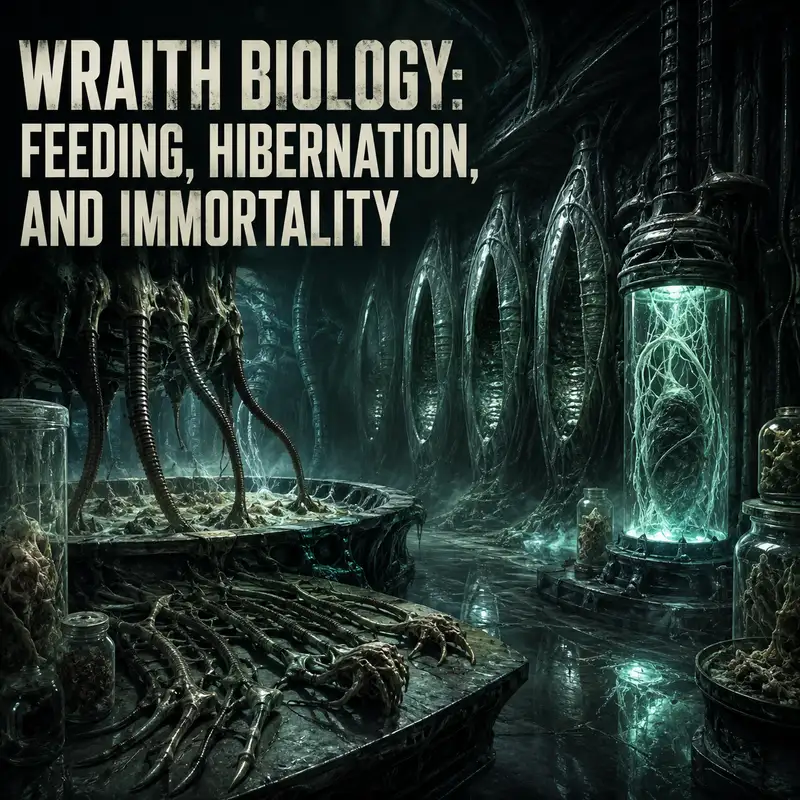
That mixed inheritance explains why Wraith biology is both familiar and alien. Wraith possess humanlike organs, intelligence, language, and social behavior. Their young can consume ordinary food. As they mature, however, conventional digestion no longer sustains them, and the feeding organ becomes essential. This is not merely a cultural preference for an unpleasant diet. An adult Wraith deprived of human life weakens, starves, and eventually dies. A meal may be ceremonial, cruel, or politically significant, but beneath those choices remains a genuine biological requirement.
The feeding organ is located in the palm. When a Wraith presses that hand against the upper chest, the tissue makes an invasive connection with the victim. The contact is usually held in place while the Wraith draws life through the arm. The victim remains conscious for much of the process unless already incapacitated. That is operationally useful to the Wraith because feeding can also support interrogation and psychological control. It is morally revealing because the victim’s awareness is not an accidental side effect. Wraith commanders often exploit it.
During feeding, the Wraith injects a specialized enzyme into the victim. The enzyme strengthens the body and prevents it from failing before the Wraith has taken what it wants. In a grim sense, it is a life-support drug administered so that the killing process can continue efficiently. It can increase strength, endurance, healing, and tolerance for injury. The normal dose is controlled and released gradually. A sudden uncontrolled dose can affect a human very differently, as the Atlantis expedition learned through Lieutenant Aiden Ford.
The visible result of feeding is accelerated aging. Hair whitens. Skin wrinkles and dries. Muscle strength disappears. The victim’s organs and nervous system lose function as though decades had passed in moments. A complete feeding leaves a desiccated body. An interrupted feeding may leave the person alive but severely weakened, with no guarantee that the damage will reverse on its own. Colonel Dillon Everett survived after a Wraith attack during the defense of Atlantis, but survival did not mean recovery. The victim can remain trapped in a body that has been pushed far beyond its natural age.
A Wraith can also stop before death. Some preserve a prisoner for later feeding, taking only enough to weaken or punish. Others keep human worshippers alive over extended periods by returning part of what they have taken. The practice known as the gift of life demonstrates that the process is controllable and not entirely one-directional. The Wraith who later became known as Todd restored Sheppard because he considered a debt repaid. He explained that such a gift was normally reserved for devoted followers and for those regarded as brothers.
The gift carries political meaning because it turns biology into patronage. A human collaborator may receive longer life, restored health, or protection from ordinary aging in exchange for service. That creates a powerful incentive structure around Wraith worshippers. Their loyalty cannot be explained only through fear. Some are chemically strengthened, psychologically conditioned, materially rewarded, and given access to a form of life extension no human society in Pegasus can reproduce. The Wraith need not govern every village when selected intermediaries can be made dependent on their favor.
For the Wraith themselves, feeding restores more than ordinary nutrition. A recently fed individual heals rapidly, survives trauma that would kill a human, and can recover from severe physical damage. This regenerative capacity is one reason conventional small-arms fire often appears inconsistent against them. An underfed Wraith may be vulnerable. A well-fed Wraith can absorb multiple wounds, remain mobile, and heal while the opponent is still deciding whether the first magazine was insufficient. The biological state of the target matters as much as the weapon used against it.
One isolated Wraith demonstrated that endurance on a scale the first expedition was not prepared to accept. He survived for roughly ten thousand years after a supply ship crashed on a barren world during the war with the Lanteans. He remained alive by feeding on the human cargo carried aboard the vessel and by conserving energy between feedings. When awakened by the expedition, he endured repeated gunfire, an explosion, and injuries that would have ended almost any normal opponent. His age did not make him frail. Feeding had allowed him to preserve combat effectiveness across the entire recorded history of human civilization on Earth.
A trapped queen offered even clearer evidence. Her cruiser had crashed beneath Lantea’s ocean during the ancient siege of Atlantis. Unable to reach the surface, she fed upon her own crew and entered hibernation between centuries. One by one, the crew became the reserve that sustained her until she was alone. Ten thousand years later, she sensed Teyla’s presence, awakened, swam from the wreck, and attacked an Ancient drilling platform. Her survival required both predation and dormancy. Neither feeding alone nor hibernation alone would have been sufficient.
Calling the Wraith immortal is therefore useful only with qualifications. They do not appear to die from normal aging when adequately fed, and some can survive for millennia. They can still be shot, burned, poisoned, dismembered, starved, or destroyed with their ships. Severe injury may exceed their ability to regenerate. Hunger reduces their strength and healing. Their longevity is conditional on access to living humans and on avoiding violence in a civilization where violence is common. Wraith immortality is not freedom from death. It is freedom from ordinary aging purchased through repeated feeding.
Hibernation makes that arrangement possible on a galactic scale. The human population of Pegasus cannot sustain the entire Wraith species in continuous activity. Most Wraith therefore sleep for long periods while human societies recover from previous cullings. Sometimes centuries pass between major awakenings. Smaller groups remain active, conduct limited raids, monitor feeding grounds, and preserve the sleeping hives. This is not an incidental habit. It is the central logistical system supporting Wraith civilization.
The cycle converts time into supply. A hive that has fed can withdraw, lower its consumption, and wait while human communities rebuild their numbers. Farms are replanted. Children are born. Villages reappear. Trade resumes. The Wraith then return when the available population is large enough to justify a major culling. From the Wraith perspective, hibernation prevents the food base from collapsing. From the human perspective, it turns every period of peace into the interval before another harvest.
Keepers helped manage that dormant system. The female Wraith encountered during the expedition’s first rescue mission watched over sleeping forces and maintained control of the feeding ground. Her death triggered a much wider awakening. That response may have functioned as an alarm, a succession mechanism, or both. The expedition could not know the full network design when Sheppard killed her. It only knew that prisoners were being fed upon. The rescue was tactically justified and strategically disastrous, because thousands of dormant enemies began waking before Pegasus had produced enough humans to feed them.
Premature awakening created a biological supply crisis. The Wraith population suddenly exceeded the sustainable food available across the galaxy. Returning every hive to sleep would have required trust and coordination among rivals with no central government. Any faction that remained awake while others hibernated could seize territory, feeding grounds, ships, and political advantage. The individually rational decision was to remain active. The collective result was competition, hunger, and eventually open conflict among hives.
This is why Wraith biology cannot be separated from Wraith strategy. Hunger influences fleet movement, alliances, raiding patterns, and the value assigned to human worlds. Hives do not merely conquer territory for prestige. They compete for access to populations capable of sustaining crews and restoring warriors. A planet with millions of humans is fuel, medical support, recruitment leverage, and strategic depth combined. Earth represented a prize beyond anything available in Pegasus because its population could support Wraith numbers that the local galaxy could not.
Biological necessity does not remove choice or responsibility. The Wraith are intelligent beings capable of negotiation, deception, restraint, scientific research, and political calculation. Individual Wraith have returned life, protected allies, cooperated with humans, and sought alternatives to feeding. Others have treated suffering as entertainment and built institutions around human captivity. Hunger explains why the conflict exists. It does not excuse culling, torture, experimentation, or the deliberate reduction of civilizations to livestock.
Culling technology turned feeding from individual predation into an industrial operation. Darts swept over settlements and transported people into storage rather than requiring ground forces to capture each victim. Hive ships maintained chambers where humans could be cocooned and preserved until needed. A Wraith force could therefore harvest a community, move the population across space, and distribute captives according to command priorities. Feeding biology shaped ship design, air operations, detention systems, and the strategic purpose of raids.
The same biology shaped Wraith reproduction. Queens occupy a central place within hives and provide the genetic material from which warriors can be produced. A hidden cloning facility multiplied a queen’s output by reproducing each new warrior thousands of times. Powered by captured zero-point modules, that system allowed Wraith forces to expand fast enough to overwhelm the Lanteans. It was an extraordinary wartime advantage and a dangerous peacetime burden. Every new warrior was another organism that eventually had to feed.
The cloning facility reveals the contradiction at the heart of Wraith power. They could generate military personnel faster than their human food base could replace itself. During the ancient war, captured energy allowed them to turn biological reproduction into strategic mass. After the expedition caused an early awakening, the same kind of expansion threatened to deepen the shortage driving Wraith civil conflict. A species can possess an excellent mobilization system and still discover that the quartermaster is biology.
Telepathy provides another biological advantage. Wraith can communicate mentally, sense one another, impose images, and exert influence over vulnerable minds. Queens often demonstrate especially powerful control. The ability supports command, interrogation, deception, and coordination inside living ships. It is not perfect collective consciousness. Hives retain separate interests, individuals can resist influence, and distance or interference can limit contact. The network strengthens cohesion without creating one unified Wraith state.
Teyla’s connection to that network came from Wraith genetic material inherited through her ancestors. A Wraith scientist had experimented on humans, attempting to make feeding more efficient by increasing biological compatibility. Some test subjects survived and returned to their communities. Their descendants carried enough Wraith traits to sense nearby hives and, in rare cases, enter the telepathic network. This made Teyla an important intelligence asset and a potential channel for enemy influence. Wraith biology could cross generations and turn a past medical crime into a present operational capability.
Ford’s transformation showed what happened when one part of the feeding system entered a human body without Wraith control. During the battle for Atlantis, a Wraith began feeding on him and was killed while still attached. Ford remained in the ocean with the corpse for an extended period, and his bloodstream received an unusually large dose of the feeding enzyme. He recovered with increased strength, faster healing, and sharpened physical performance. He also developed dependence, paranoia, aggression, and impaired judgment.
The expedition tried to withdraw him from the enzyme gradually. Ford escaped, obtained more, and built a group of human fighters around the drug. They believed enhanced strength could let them hunt Wraith on equal terms. For brief periods, the enzyme made them formidable. Withdrawal made them weak, unstable, and desperate for another supply that could only be taken from the enemy. The proposed super-soldier program had created personnel whose combat effectiveness depended on raiding Wraith for an addictive biochemical. Even by Pegasus procurement standards, the sustainment plan required further review.
Human scientists also tried to attack the feeding process directly. The Hoffans developed a treatment that made their people poisonous to Wraith. When a Wraith fed on a treated subject, the interaction between the treatment and the feeding enzyme killed the attacker. The defense worked, but the early version also killed roughly half of the humans who received it. Hoffan leaders accepted that cost because they believed the alternative was eventual culling. Later distribution of a modified Hoffan agent contaminated feeding grounds across Pegasus and made every meal a possible biological ambush.
The Hoffan strategy weaponized Wraith dependence rather than defeating Wraith fleets. It also invited retaliation against populations suspected of carrying the treatment. A successful biological defense could make one village unprofitable while encouraging the enemy to destroy it from the air. The medical problem and the military problem were inseparable. Immunity to feeding did not provide immunity to orbital weapons, Darts, or collective punishment.
Beckett pursued a different solution through a retrovirus intended to suppress the Iratus elements of Wraith genetics and leave the human characteristics dominant. The treatment could temporarily transform a Wraith into a humanlike form and remove the need to feed. It also altered memory, identity, strength, and behavior. The expedition used it without meaningful consent on the prisoner later called Michael, then concealed what had been done. When the treatment failed and his memories returned, the result was not reconciliation. It was an enemy created by a medical program that had treated personhood as an adjustable variable.
Jennifer Keller later developed a gene therapy intended to restore ordinary digestion without erasing Wraith identity. Todd’s faction saw it as a possible way to survive the spreading Hoffan contamination and escape dependence on humans. The Wraith attempted to administer an incomplete version without Atlantis supervision. The treatment removed feeding organs and activated digestive functions, but it also produced a destructive disease that affected both crew and hive ship. The attempt proved that Wraith physiology, reproduction, feeding, and organic technology were connected more deeply than the available model had predicted.
Those failures do not mean an alternative was impossible. They show why one was difficult. Removing the need to feed might also reduce regeneration, strength, longevity, and the biological features around which Wraith society had developed. For some Wraith, that would be liberation from hunger. For others, it would be forced mortality and the surrender of species identity. A cure designed by humans could therefore appear to the Wraith as both a peace proposal and a biological disarmament program.
For Atlantis commanders, understanding Wraith biology changed doctrine. Starved prisoners were not equivalent to recently fed warriors. Captured humans were not merely hostages, but stored logistics. A sleeping hive was not destroyed, only at low readiness. A culling was resupply, medical regeneration, and population control conducted in one operation. A queen was a commander, telepathic center, and source of force generation. A feeding ground was not just territory. It was the resource without which ships, armies, and political coalitions could not remain active.
The Wraith endured because feeding, hibernation, reproduction, and warfare formed one system. Feeding repaired the individual. Hibernation preserved the species when supply was low. Cullings replenished the hives. Queens and cloning generated military mass. Telepathy linked command to biology. Extreme longevity allowed leaders and grudges to survive across human generations. Each advantage carried the same dependency. The Wraith could live for thousands of years, but only while other people lost the years they would never receive.
Their immortality was therefore neither a miracle nor a simple evolutionary gift. It was a strategic economy built from human lives. Hibernation hid the full cost by spreading it across centuries. Feeding made the cost visible in minutes. The hand against the chest, the victim aging beneath it, and the Wraith rising healed were not separate horrors. They were the smallest possible version of the political order that ruled Pegasus.