Wraith Society: Queens, Hives, and Factional Warfare
Todd killed the Primary Queen with one movement, then placed the weapon in Teyla Emmagan’s hand. To the Wraith watching from the chamber, the evidence appeared simple. A newly arrived queen had challenged the ruler of an alliance and won. Teyla was human, surgically altered and relying on inherited Wraith traits to maintain the deception. Yet the hierarchy around her began to adjust almost immediately. Officers who had obeyed one sovereign now waited for commands from another. The scene exposed the political machinery beneath Wraith terror. A hive was not merely a ship full of predators. It was a mobile state organized around a queen, enforced through biology, loyalty, fear, and the constant possibility of a coup.
Human observers initially described the Wraith as one enemy civilization acting under one plan. Their ships shared the same organic design, their warriors used the same weapons, and every hive depended on human prey. The resemblance suggested unity. The reality was closer to a collection of armed houses, each centered on its own hive ship and leadership. They could cooperate, exchange intelligence, divide territory, and form alliances. They could also raid one another, betray agreements, seize ships, and fight over feeding grounds. There was no permanent Wraith emperor, fixed galactic capital, or central government capable of issuing orders to every hive.
The queen stood at the center of the hive. Core screen continuity presents female Wraith as queens above male commanders, technicians, and warriors. A queen exercised political authority, influenced subordinates telepathically, and provided the hive’s reproductive foundation. Killing one could remove the sovereign, disrupt command, and threaten the ability to replace soldiers. It did not automatically destroy the ship or everyone aboard it. Senior males could continue operating, negotiate, or seek another arrangement, but from a weakened position.
The full Wraith reproductive system is not explained. The record does not establish exactly how new queens or intelligent male commanders are produced, or justify treating every masked warrior as mindless. What is established is that a queen can begin the production of new soldiers and that cloning technology can multiply her output. During the ancient war, a facility powered by captured zero-point modules reproduced warriors on an enormous scale. Much later, a commander admitted that ships without queens faced a replacement problem if their forces were lost. A queen was not only a ruler. She was part of the mobilization base.
Below the queen stood intelligent male Wraith who served as commanders, scientists, negotiators, and ship officers. Human personnel rarely learned their own names. The individuals called Michael and Todd received those names from Atlantis personnel, which says as much about the expedition’s need to categorize recurring adversaries as it does about Wraith identity. These commanders displayed independent judgment, long-term planning, personal ambition, and the ability to betray both humans and other Wraith. They were not extensions of a single collective mind. Todd could bargain with Atlantis, repay a personal debt, conspire against a queen, and later lose control of his own faction to a subordinate.
Masked Wraith soldiers formed the most visible lower tier. They guarded prisoners, boarded ships, fought on the ground, and enforced hive leadership. Their masks and limited speech encouraged humans to treat them as interchangeable drones. The record supports a highly obedient warrior caste, but does not explain their intelligence, training, or social life. Their value came from numbers, strength, resilience, and integration with Wraith command. Darts and transport beams placed them where a raid required force. They were the infantry of a society whose headquarters could move between stars.
Telepathy connected these levels without erasing individuality. Wraith could sense one another, communicate mentally, influence human perception, and share information across their biological network. Queens appeared especially capable of imposing authority. Teyla’s success while disguised as a queen depended partly on her ability to enter that mental environment and project the presence expected from a ruler. Yet rebellion, deception, rivalry, and private negotiation remained common. A true hive mind would not need coups or counterintelligence. The Wraith network was better understood as a biological command-and-control system, powerful enough to coordinate a hive but not powerful enough to eliminate politics.
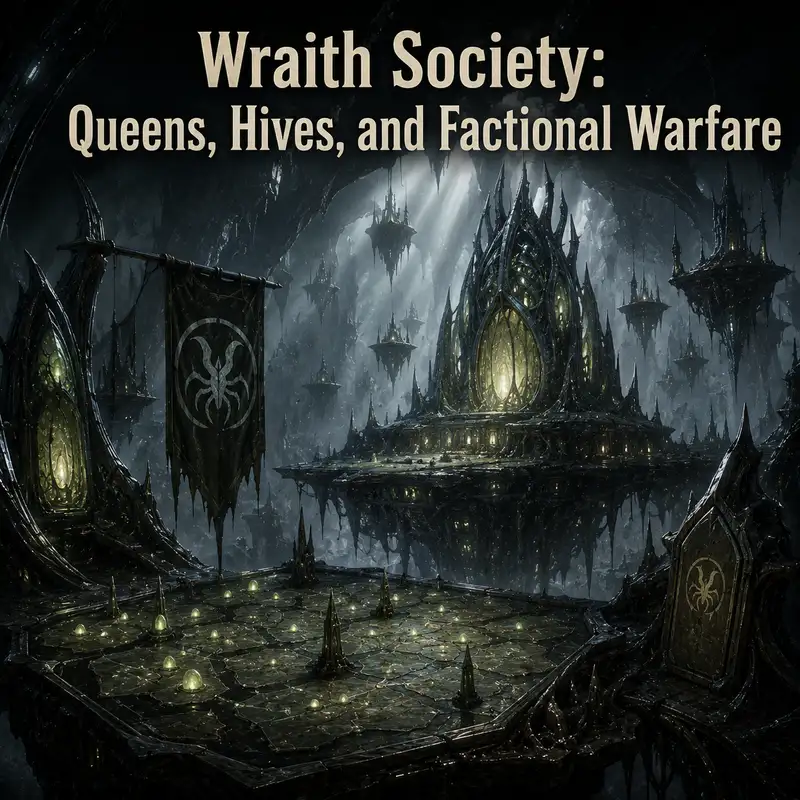
The hive ship itself completed the political unit. It was warship, capital, barracks, nursery, storage site, detention center, and home. Its organic systems were grown rather than assembled in the manner of an Earth vessel. The crew did not merely serve aboard a platform. Their society lived inside a biological structure that traveled with them. This made Wraith power unusually mobile. A queen did not require a palace on a defended planet when her palace could enter hyperspace, deploy cruisers and Darts, carry captured humans, and relocate before an enemy fleet arrived. Territory mattered, but the state’s core could move.
That mobility shaped Wraith sovereignty. A hive’s real territory consisted less of borders on a map than of feeding grounds, known populations, culling routes, hidden facilities, and the space its rivals believed it could defend. Human planets were not incorporated as provinces with courts and tax offices. They were resources visited according to need and opportunity. Some worlds were culled heavily. Others were allowed time to recover. A hive could abandon one region, enter another, or contest a rival’s access without occupying every system between them. Wraith political geography was therefore a network of claims enforced by ships rather than a continuous empire.
Human worshippers operated along the edges of that system as informants, guards, intermediaries, or local agents. They could identify settlements and perform tasks that attracted less attention than a Wraith patrol. Selected followers might receive protection, status, the feeding enzyme, or the gift of life that restored stolen years. They were useful because they could enter human communities and understand local behavior. They were not equal partners. Their rewards depended on continued service to a predator that could withdraw them with one hand.
The Wraith also recognized obligation. Todd restored Sheppard’s stolen years after Sheppard helped him escape captivity, treating the act as repayment of a debt. He later cooperated with Atlantis when mutual survival required it, while concealing information and pursuing his own advantage. This does not make Wraith society honorable in a human sense. It shows that debt, reciprocity, reputation, and personal loyalty existed alongside coercion. A commander known to betray every agreement would eventually find fewer partners, even among other Wraith.
For most of the ten thousand years after the Lantean withdrawal, hibernation reduced the pressure that might otherwise have forced constant civil war. The human population of Pegasus could not feed every Wraith continuously. Large numbers slept while smaller caretaker forces monitored territory and conducted limited cullings. Human societies recovered between major awakenings, and the hives returned when the available population justified the effort. This cycle was monstrous for the people being harvested, but it imposed a form of strategic discipline on the Wraith. Scarcity was managed through time rather than through a central rationing authority.
The cycle also reduced contact among rival queens. A hibernating hive consumed little and had fewer reasons to challenge another hive’s claims. Caretakers preserved local control while the broader political order remained dormant. This was not peace. It was a balance created by low activity, dispersed populations, and the shared understanding that destroying the food base would damage every hive. No galactic council was needed while biology and long sleep produced the same result.
The war against the Lanteans had demonstrated that the Wraith could cooperate on a much larger scale when confronted by an existential enemy. Separate hives combined fleets, shared objectives, and exploited captured Ancient technology. The cloning facility gave them enough warriors to sustain losses that would have destroyed a smaller force. Their coalition did not require permanent political unification. It required agreement that the Lanteans threatened every queen, every feeding ground, and the survival of the species. Once the Lanteans withdrew, the reason for extraordinary unity disappeared. The Wraith returned to decentralized rule because decentralization had never prevented them from winning.
That structure made the species difficult to defeat. Destroying one queen removed one leadership center. Destroying one hive removed one mobile state. Other hives retained their ships, territories, knowledge, and command. There was no capital whose capture would force a general surrender and no single ruler whose death would end the war. The Lanteans faced this resilience during their century-long campaign. Atlantis encountered it again every time a successful operation eliminated a local threat without changing the behavior of the remaining hives. Decentralization limited coordination, but it also prevented decapitation.
The expedition’s arrival disrupted the balance by helping awaken the Wraith before the surrounding human worlds had replenished enough people to support them. The death of the Keeper at the first hibernation facility triggered a broader response, and the news of Atlantis offered both threat and opportunity. Hives awakened into a galaxy with too little food, a technologically capable enemy, and rumors of a route to Earth. There was no central authority capable of ordering most of them back into hibernation. Any queen who slept while rivals remained active risked losing territory, ships, intelligence, and the chance to reach a vastly richer feeding ground.
The predictable result was factional warfare. Stronger hives attacked weaker ones. Temporary alliances formed for protection or expansion. Feeding grounds became strategic objectives rather than merely inherited hunting areas. A hive that lost ships or soldiers could not assume another queen would share replacements. A queen that discovered a new human population had every reason to conceal it. Scarcity turned cooperation into a calculation. The Wraith had defeated the Lanteans by generating mass under common pressure. They now began consuming that advantage through competition among themselves.
Michael’s faction approached Atlantis because the civil war had made an otherwise unthinkable alliance useful. His hive proposed using Carson Beckett’s retrovirus to transform rival Wraith into humans. The converted enemies could then become food for the faction that had attacked them. The plan was presented as a shared attack on hostile hives, not as a moral rejection of culling. Michael’s queen wanted a weapon that would solve two problems at once: eliminate competitors and create a new food source. The alliance failed when the Wraith stole Atlantis data and resumed their own operation, but the proposal revealed how quickly biological science could become an instrument of internal war.
Michael’s later independence showed that a commander could operate outside the normal hive structure. Rejected by humans and Wraith after his transformation, he built forces, conducted genetic experiments, captured Athosians, and created hybrid soldiers. His organization was not a normal hive. It was a breakaway military project centered on one commander’s grievance and ambition. His rise demonstrated both the flexibility and danger of Wraith society. A commander with knowledge, a ship, and laboratories could become a regional power without approval from any wider institution.
Todd followed a different path through the fractured order. He worked through hive politics and treated alliances as tools for preserving his faction. During the campaign against the Asurans, he helped Atlantis recruit Wraith ships for a combined attack. Seven hives joined, fewer than hoped. Some queens doubted the plan. Some ships lacked queens and risked losing the ability to replace their forces. Even under threat from a machine civilization programmed to exterminate them, the Wraith did not automatically unite. Coalition building required persuasion, secrecy, and an acceptable distribution of risk.
The coalition succeeded in destroying the Asuran homeworld, but victory did not create a stable Wraith alliance. Hive ships immediately competed for the surviving zero-point modules. Those power sources could strengthen vessels, support research, or reactivate strategic facilities. The same battle that saved the Wraith from extermination released prizes valuable enough to intensify rivalry. This was a recurring feature of Wraith politics. A common enemy could bring hives together for an operation. The spoils of success encouraged them to separate before one faction became too strong.
A hidden cloning facility became one such prize. A queen had begun using it to generate an army, powered by stolen Ancient technology. Other hives understood that control of the installation could overturn the balance of power. Todd’s forces became entangled in the contest, and Atlantis eventually destroyed the facility rather than allow any queen to recreate the numerical expansion that had defeated the Lanteans. The installation was not simply a factory. It was the means by which one hive might dominate the others. Wraith civil war was therefore fought not only over humans, but over the ability to manufacture future military strength.
The negotiations over Jennifer Keller’s proposed gene therapy exposed the hierarchy more directly. The treatment promised to let Wraith survive on ordinary food, but testing it required support beyond one commander’s private agreement. Todd’s faction lacked a queen able to speak with the necessary legitimacy, so Teyla was altered to impersonate one. She then met the Primary Queen who led a broader alliance. The title did not make that ruler sovereign over all Wraith. It made her the dominant queen inside that coalition, the figure whose support could move several hives toward a shared policy.
Todd’s murder of the Primary Queen was a coup disguised as a challenge. By placing the weapon in Teyla’s hand, he used Wraith expectations of dominance to transfer authority before the surrounding officers could organize resistance. Teyla then had to behave as a queen, issue orders, and use the hierarchy she had entered to protect Todd’s threatened hive. The deception worked because Wraith society recognized personal rule, telepathic presence, and demonstrated strength. It also exposed the system’s vulnerability. If legitimacy can pass through a successful killing, political succession becomes fast, decisive, and extremely difficult to insure.
The incident did not prove that any person wearing the right appearance could command a hive. Teyla possessed Wraith genetic material, telepathic ability, detailed preparation, and Todd’s insider support. Even then, exposure remained likely. The operation worked under exceptional conditions and could not become routine Atlantis tradecraft. Its historical value lies in what it revealed. Queens negotiated with queens. Male commanders could manipulate policy but often required a queen’s authority. A Primary could dominate an alliance without ruling the species. The entire structure depended on relationships that were powerful inside the hive and limited beyond it.
Wraith ships without queens illustrate the difference between operational control and political continuity. A male commander could fly the ship, fight battles, make bargains, and direct warriors. What he could not easily replace was the biological and symbolic role of a queen. This gave senior commanders considerable freedom and a persistent ceiling. Todd could become the architect of alliances and the expedition’s most consequential Wraith contact, yet he repeatedly had to work around queens, find queens, or manipulate the succession around them. His intelligence made him influential. It did not automatically make him sovereign.
The spread of the Hoffan drug increased pressure for cooperation without creating trust. Human populations treated with the agent became dangerous to feed upon, and contaminated victims could kill Wraith during culling. Todd supported research into Keller’s therapy because his faction needed an alternative before more feeding grounds became unusable. Other hives had reasons to resist. A treatment that removed feeding might also reduce regeneration, longevity, and the advantages around which Wraith identity was built. Adopting it would require every queen to accept biological change while trusting rivals not to remain stronger in the old form.
No central government could enforce that transition. One hive might accept treatment and become less dependent on humans. Another might refuse, seize the weakened faction’s territory, and continue feeding. The collective benefit of ending the food crisis conflicted with the individual queen’s need to survive the next campaign. Wraith politics therefore turned a possible species-level solution into a security dilemma. The problem was not that the Wraith lacked intelligence. It was that no faction could safely disarm first.
Todd’s own faction eventually attempted an incomplete version of the therapy. The experiment went wrong, damaged Wraith bodies, and infected the living hive ship. Todd recovered and returned to leadership, but the crisis had shown how quickly biological failure could threaten command. A subordinate later attacked him, seized a zero-point module-enhanced hive, and pursued Earth. The exact internal process is only partly visible, but the strategic pattern is familiar. Wraith loyalty endured while leadership could protect the hive and deliver resources. Another ambitious figure could redirect the ship and its power when the opportunity appeared.
The organic nature of Wraith technology reinforced the connection between politics and survival. A hive ship could heal, but disease or experimental failure could spread through crew and vessel. Decisions about feeding, research, and combat therefore affected the physical health of the state. An Earth commander can lose a ship while the government remains intact elsewhere. A queen who loses her hive may lose home, army, prisoners, laboratories, and political identity in one event. This encouraged caution at times and ruthless preemption at others.
Wraith society was neither an anarchic swarm nor a unified empire. It was a decentralized order of queen-led hives, each capable of diplomacy, war, reproduction, and long-range movement. Telepathy provided cohesion inside the hive. Shared biology created common interests across the species. Hunger created competition. Alliances existed, but usually around a specific threat or opportunity. Primary queens could coordinate coalitions, but their authority depended on the participating hives and could be ended by assassination. Male commanders exercised broad power, while the queen remained the principal source of legitimacy and continuity.
That structure explains both Wraith endurance and Wraith civil war. It allowed them to survive the loss of ships, commanders, and entire factions because no single defeat could destroy the species. It also prevented them from imposing a common response when premature awakening produced a food shortage. No ruler could order equitable culling limits, compel hibernation, or guarantee that a faction accepting biological change would not be attacked. The political system that had made the Wraith impossible to decapitate made them equally difficult to reform.
The Wraith ruled Pegasus for ten thousand years without building one centralized state. Their hives slept, woke, culled, bargained, and fought according to local power and biological need. When Atlantis disturbed that balance, the queens did not unite behind a common policy. They formed factions and turned on one another while still threatening every human world around them. The defining image of Wraith society is therefore not a throne at the center of an empire. It is a hive ship in motion, carrying its queen, army, population, and hunger together, sovereign until a stronger hive arrives.