Wraith Warriors, Darts, and Ground-Assault Doctrine
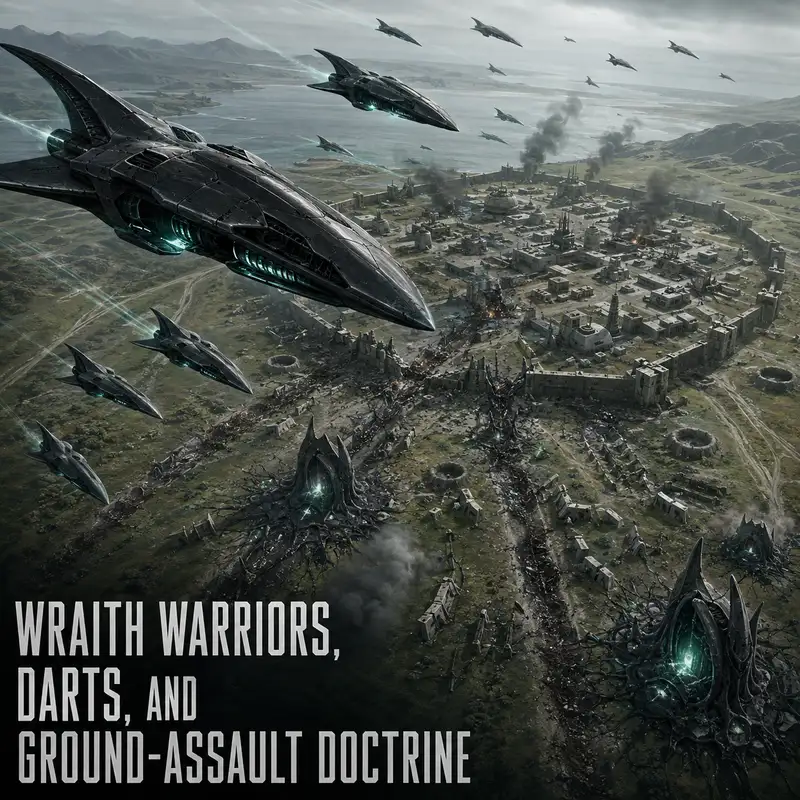
Three Wraith Darts burst from the Stargate on Athos and climbed into the sky before the people nearby understood that an attack had begun. They did not arrive beneath a visible hive ship. They did not land troops in formation or announce terms. The small craft swept low over fields and settlements, firing at resistance and passing culling beams across anyone caught in the open. Men, women, and children vanished into light. Within minutes, the aircraft departed with a population stored inside machines far too small to carry them in any ordinary sense.
That attack was not an improvised raid. It was the clearest expression of Wraith ground-assault doctrine. The Wraith normally did not fight to capture territory, administer cities, or hold a front line. They fought to collect living humans, destroy resistance that threatened the harvest, seize technology or intelligence, and withdraw before a conventional defense could organize. Their warriors and Darts were designed around that purpose. One element controlled the ground long enough to make people capturable. The other removed the people and carried them back to the hive.
No surviving Wraith field manual explains the system, and the screen record does not provide precise unit tables, ranks, or training cycles. What it shows repeatedly is a consistent combined-arms method. A queen or senior commander defines the objective. Hive ships and cruisers provide transport, command, sensors, and heavy firepower. Darts conduct reconnaissance, air attack, culling, and rapid insertion. Wraith warriors secure chambers, hunt survivors, suppress defenders, and protect the collection process. The result is less like a conventional occupation force and more like a carrier-based raiding system built around biological logistics.
The masked Wraith warrior is the infantry component of that system. These soldiers are stronger than most humans, move aggressively in close quarters, and can survive wounds that would immediately stop an ordinary combatant, especially when recently fed. They are not invulnerable. Earth automatic weapons, Ronon Dex’s energy pistols, grenades, Ancient drones, and sustained fire all kill them. Their advantage lies in resilience. A defender who assumes that one burst has ended the threat may discover that the target has recovered before the next room is cleared.
Their masks and armor create a uniform appearance, but the exact function of every component is not established. The masks may offer protection or sensory support. They also conceal individual expression and present victims with an impersonal force. This encouraged outsiders to call the soldiers drones, although the surviving record does not justify assuming that every warrior lacks intelligence or individual awareness.
The standard Wraith ground weapon reflects the objective of capture. Rifles and pistols fire energy pulses that usually stun rather than kill. A victim collapses quickly and can be transported, interrogated, imprisoned, or fed upon later. Repeated exposure and close-range hits can cause serious injury, but the normal tactical effect is incapacitation. A human army usually wants an enemy soldier permanently removed from the fight. The Wraith often want the same person alive afterward. Their weapons policy is therefore not restraint. It is inventory control.
That preference changes at close range. A Wraith warrior who reaches an isolated defender can use physical strength, claws, or the feeding hand itself. During the assault on Atlantis, Colonel Dillon Everett emptied his weapon into an attacker and still found himself trapped when the magazine ran dry. The Wraith began feeding on him in the middle of the battle. The act was nourishment, punishment, and psychological warfare at once. Every defender who saw the result understood that capture did not mean humane detention.
Wraith telepathy gives their infantry another advantage, although its exact tactical range is uncertain. Queens and commanders can influence subordinates, exchange impressions, and maintain cohesion without relying entirely on audible orders. This is not a perfect collective mind. Wraith betray one another, conceal information, and act independently. On the ground, however, even limited mental communication can shorten the time between detection and response. A warrior does not need a lengthy radio exchange when the commander can transmit urgency, direction, or intent through the same biological network that binds the hive.
The Dart is the system’s most important assault platform. It is a single-pilot craft capable of atmospheric and space flight, armed for air combat, and small enough to pass through a Stargate. That last feature changes the geography of every raid. A hive ship does not always have to sit in orbit above the target. Darts can launch from another world, remotely activate a gate, cross the network, and emerge directly into the threatened planet’s airspace. A village may receive almost no strategic warning because the enemy’s carrier is nowhere in the local sky.
The culling beam turns the Dart from a fighter into a collection vehicle. People caught in the beam are dematerialized and held as patterns in an internal storage buffer. They are not physically packed into the cockpit. When the Dart returns to a hive ship or Wraith facility, the captives can be rematerialized into holding areas. The exact capacity is not firmly established, but it is far greater than the craft’s visible interior would suggest. One pilot can therefore remove a substantial group without landing, loading, or exposing a ground crew.
The same transport system can operate in reverse. Darts have deposited Wraith warriors directly onto streets, defensive positions, and target installations. On Sateda, a Dart placed a hunter into the ruins to pursue Ronon. During the siege of Atlantis, warriors materialized among the defenders as Darts swarmed above the city. This dual use is doctrinally elegant. One pass can remove civilians. Another can insert infantry. The craft that collects the objective also delivers the force required to secure it.
The buffer is powerful, but it is not immune to damage. Atlantis personnel learned this after a Dart carrying Rodney McKay and Lieutenant Laura Cadman was shot down. The damaged systems failed to rematerialize the captives correctly, leaving both consciousnesses associated with one body until the error could be repaired. The incident was unusual, but it proved that culling is a technical process with failure modes. Shooting down a loaded Dart may save captives, kill them, corrupt their patterns, or leave their status uncertain. Air defense therefore carries a hostage problem with every target.
Darts also carry energy weapons for strafing, missile interception, and combat against Puddle Jumpers or other small craft. They can attack ground positions and buildings when the mission requires it. They are comparatively vulnerable to Ancient drones, Earth railguns, fighter weapons, and concentrated fire, which suggests that speed, numbers, and surprise matter more than heavy protection. A Dart is dangerous because it can appear quickly, cross the target at high speed, and perform several missions during the same pass. It is not a miniature hive ship.
A typical culling begins with intelligence. The Wraith identify an inhabited world, learn the gate address, and estimate resistance. Tracking devices, reconnaissance, human worshippers, prisoners, and previous cullings all contribute. Darts arrive through the gate or from orbit, strike exposed defenders, and sweep population centers with culling beams. Warriors clear shelters, guard prisoners, or hunt people who escaped the first pass. Once enough captives are collected, the force leaves.
This sequence explains why Wraith attacks can appear selective and indiscriminate at the same time. A Dart may avoid destroying a building because the people inside are valuable. It may also fire into the same building if armed resistance makes collection too costly. Wraith commanders prefer paralysis over rubble while the population remains useful. When resistance threatens the hive, the gate route, or the wider feeding system, that calculation changes. Precision is not mercy when the objective is to preserve the victim for later consumption.
Human communities adapted by dispersing, hiding, and limiting visible development. Forest settlements, underground shelters, concealed industry, and rapid evacuation reduced the number of people a single Dart sweep could capture. The Genii built much of their industrial society below ground, presenting the appearance of an agricultural population while hiding weapons laboratories and military facilities. This did not make them safe, but it denied the Wraith the easy reconnaissance picture that a large city would provide. Against culling doctrine, concealment could be more valuable than a parade ground full of soldiers.
Athos showed the standard model in its simplest form. The Wraith used the Stargate itself as the approach route, allowing Darts to strike before any hive ship appeared overhead. The craft culled Teyla, Halling, Colonel Marshall Sumner, and others while scattering the remaining population. Sheppard’s rescue team later found the captives inside a Wraith facility, proving that the air raid had been one stage in a larger collection system. The Wraith had no need to govern Athos afterward. The people were the objective, and the empty settlement required no occupation force.
The Athos raid also demonstrated the importance of target marking. A Wraith pendant carried by Teyla had functioned as a tracking device, and Sheppard’s Ancient genetic trait activated it without anyone understanding what it was. Later, similar devices helped the Wraith locate teams and communities. The lesson was uncomfortable. Wraith reconnaissance did not always require a visible scout or an informant who knew he was collaborating. A personal object could become a beacon, and the person carrying it could unknowingly lead the assault to the gate.
Before the first great attack on Atlantis, a Dart penetrated the city’s airspace and conducted a scanning pass. A Wraith was then discovered inside the city, moving through unused sections and attacking personnel. The exact mechanics of every moment were not fully visible to the expedition, but the operational result was clear. The Dart had combined reconnaissance with infiltration. It tested the defensive environment, gathered information, and placed a ground threat behind the perimeter before the main fleet arrived.
The siege expanded that method to full scale. Hive ships contested orbit and bombarded the city. Darts swarmed between the towers, attacked defensive positions, searched for targets, and delivered warriors into the fight. Wraith infantry appeared among teams defending exposed areas, forcing Earth personnel to fight in corridors, balconies, and open platforms while air attack continued overhead. Everett’s contingent could not establish a stable front because the enemy could cross walls and elevation through transport technology. Airspace and interior security became one battle.
Atlantis defenders answered with automatic weapons, grenades, overlapping fields of fire, railguns, biometric sensors, and rapid movement between threatened sectors. Those measures killed many Wraith, but the city was a research complex and capital, not a purpose-built modern fortress. Its towers created countless approaches, its internal transporters complicated movement, and much of its volume remained unexplored. The expedition could defend key rooms. It could not place a rifle team in every corridor of a city designed for a civilization vastly larger than its current garrison.
The Wraith accepted losses because the prize justified them. Capturing Atlantis meant obtaining Ancient technology, a vast database, and potentially the location of Earth. Warriors and Darts that might be conserved during an ordinary culling became expendable assault assets. This is a crucial distinction. Wraith doctrine was not always casualty-averse. It was value-conscious. A village worth feeding upon might be handled carefully. A strategic installation capable of changing the balance of power could be attacked with mass, bombardment, and repeated infantry waves.
Sateda demonstrates the punitive end of the spectrum. The Satedans had developed organized armed forces and resisted culling. The Wraith responded by destroying the civilization’s visible military and urban infrastructure. Darts bombarded streets, hive ships remained overhead, and warriors searched the ruins. The objective was no longer efficient harvesting alone. It was to break a society that had become dangerous and to leave an example for anyone considering the same course. Survivors could still be culled, but the city itself was treated as a threat to be erased.
Ronon’s experience after the fall of Sateda reveals another layer of ground combat. The Wraith implanted a tracker and turned him into a Runner, releasing him so individual hunters could pursue him across worlds. This was not an efficient military operation. It was ritualized violence, training, entertainment, and domination. When Ronon repeatedly survived, his value increased. A Wraith commander eventually returned him to Sateda and deployed hunters into the ruins, using the destroyed city as a controlled battlefield.
The hunt showed how Darts supported very small ground actions as effectively as mass cullings. One craft could beam a hunter onto a street, recover him, monitor the area, and remain linked to a hive in orbit. When Atlantis personnel intervened, the Wraith committed more warriors but still retained overwhelming firepower above the city. Ronon, Sheppard, and Teyla could win the firefight on the ground. They could not remain once the hive began striking from orbit. Tactical victory required immediate extraction because control of the streets did not equal control of the sky.
A separate village learned the same lesson after attempting to trade Ronon to the Wraith in exchange for protection. The Wraith accepted the signal, took Ronon, killed some residents, and culled most of the rest within roughly half an hour. The agreement had never been a treaty between equal parties. It was target acquisition assisted by frightened civilians. Wraith ground doctrine benefited from terror because terror encouraged communities to reveal fugitives, rivals, and hidden populations. The reward could be temporary survival, or merely a shorter search.
The assault on Midway Station showed that the same force package could serve an objective unrelated to feeding. Wraith forces obtained the programming used by the intergalactic gate bridge, entered Midway through the Pegasus gate, overwhelmed the station, and forced personnel to dial Earth. Warriors then moved through the Milky Way gate into Stargate Command. The target was a transportation network and access to a new galaxy. Stunners, rapid movement, and gate control mattered more than culling beams.
Midway also exposed the vulnerability of Wraith doctrine when the approach route became a chokepoint. Ronon and Teal’c fought the attackers inside confined corridors, while Stargate Command could bring its own defenses to bear once the incursion was recognized. The Wraith seized the station, but they could not expand the foothold into a sustainable invasion. Midway was destroyed, the bridge was lost, and the route closed. Strategic mobility had delivered the assault force farther than any Wraith ground unit had previously reached. It had not delivered the ships, logistics, or reinforcements required to hold the gain.
Darts could abandon the capture mission entirely when destruction became the priority. During the attack by the zero-point module-enhanced super-hive, a wave of Darts struck Area Fifty-One in deliberate suicide attacks and destroyed the Ancient control chair that could direct Earth’s drone weapons. The pilots and craft were spent to remove a specific defensive system. This was not normal culling behavior. It was a mission-tailored strike demonstrating that Wraith commanders understood sacrifice, target prioritization, and the difference between a food source and a weapon that might kill the hive.
These examples reveal four forms of Wraith ground action. The harvest raid collects humans quickly. The punitive assault destroys societies that threaten the feeding system. Seizure or infiltration targets technology, intelligence, or transportation nodes. Strategic destruction expends Darts and warriors to remove a critical defense. The equipment changes less than the purpose because the culling beam, stunner, and mobile hive can be combined in several ways.
Their logistical design is equally important. The hive ship is carrier, barracks, command post, prison, hospital, and supply base. Darts move between that base and the objective. Ground forces are expected to operate for short periods, not establish depots and govern provinces. This reduces the need for heavy land transport, artillery trains, and permanent garrisons. It also creates dependence. Separate the warriors from the hive, block the Stargate, or destroy the Darts, and the assault force loses extraction, reinforcement, prisoner movement, and much of its heavy fire support.
The Wraith therefore show little evidence of maintaining conventional armored formations or large occupation armies. Their heavy weapons remain in orbit or aboard aircraft. Warriors clear interiors, pursue fugitives, secure prisoners, and exploit the effects of bombardment. This is a doctrine optimized against scattered human populations and fixed settlements, not against a peer land army with integrated air defense, artillery, armor, and secure communications. The Wraith defeated advanced opponents through numbers, mobility, and strategic endurance, but their routine ground units were built for raids rather than continental campaigns.
Effective defense begins with warning and denial. Anti-air weapons can drive Darts higher or destroy them before a culling pass. Shields can block the beam while power lasts. Underground facilities and dispersed settlements reduce target density. Gate barriers, authentication, and guarded approaches can prevent a raid from entering through the network. Camouflage can conceal industrial capability. Rapid evacuation can preserve people when defense cannot hold. None is complete. A shield may fail, a hidden city may be discovered, and a blocked gate does nothing against a hive already in orbit.
The hardest problem is time. A Wraith raid can begin with a Stargate activation or the sudden appearance of Darts over a village and end before another world receives a warning. Captives vanish without leaving a conventional convoy to track. The attackers do not need to secure roads, fuel trucks, or landing zones. They need a few minutes of access to open ground. By the time defenders understand the direction of attack, the population may already exist as stored patterns moving toward a hive ship.
This is why the apparent precision of Wraith weapons should never be confused with restraint. Stunners preserve bodies. Culling beams remove civilians without destroying buildings. Darts can pass over a field and leave the crops untouched. The settlement may look almost intact after the raid. Its people are gone because the system was designed to separate population from place with the least delay. Wraith technology reduces collateral damage when collateral damage would reduce the available food supply.
Wraith warriors, Darts, and ground-assault doctrine formed one integrated answer to the biological problem at the center of their civilization. The Dart collapsed reconnaissance, air support, troop transport, and detention into a single platform. The warrior secured the spaces the beam could not safely reach and hunted anyone who escaped. The hive remained mobile, carrying command and logistics away from the vulnerable ground. The strength of the system was speed and purpose. Its weakness was dependence on air access, transport, and a nearby route home.
The Wraith did not need to plant a flag on a captured world. They did not need a governor in the capital or a garrison in every village. Their doctrine succeeded when the defenders were stunned, the survivors were stored, and the Darts climbed back toward the hive. The battlefield could remain standing. The people who gave it meaning had vanished.