Yu: The Last of the Old Guard
Ba’al’s representative offered the surviving System Lords a final bargain. They could surrender, retain their territories, and continue governing beneath Ba’al’s authority, or they could be destroyed. Yu was visibly frail, with his First Prime leaning close to hear whispered instructions, but the oldest ruler in the chamber still rejected submission. Then a prisoner who appeared to be Samantha Carter was brought before them. Yu stepped forward to question her. The human-form Replicator transformed an arm into a blade and drove it through his body. After countless centuries of dynastic warfare, the last representative of the old order died in seconds.
Yu’s importance rests on a contradiction. He was among the least impulsive of the major Goa’uld and one of the few capable of treating diplomacy, treaties, and balance-of-power politics as useful instruments rather than temporary inconveniences. He also ruled through the same system of slavery, false divinity, Jaffa dependence, and personal ownership used by every System Lord. His long survival did not make him humane. It made him experienced. The central question is why that experience allowed Yu to outlast so many rivals, and why it could not preserve either his mind or the political order he represented.
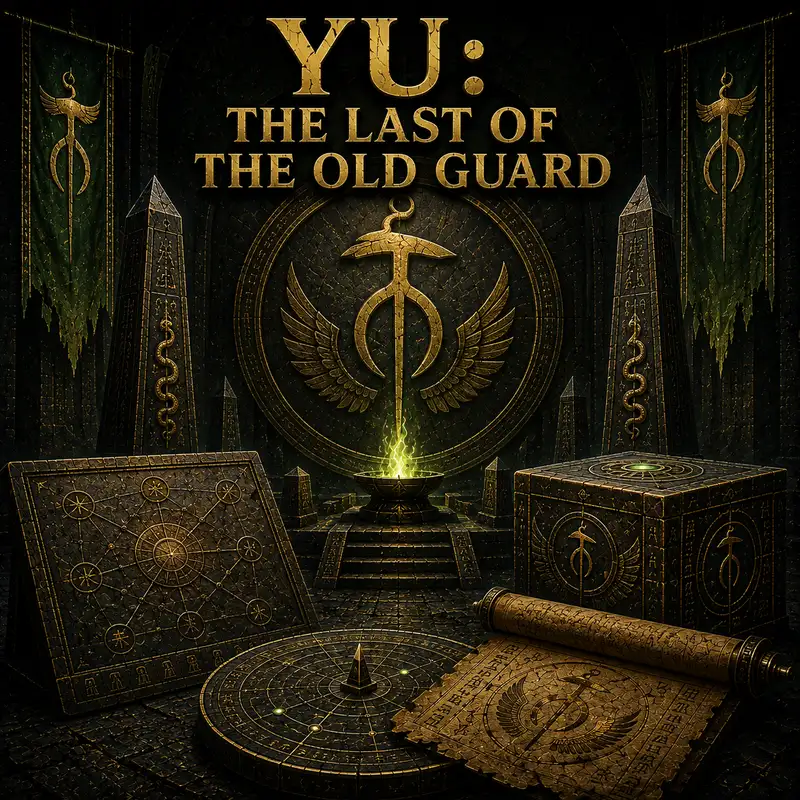
Earth’s records identified him as Yu the Great, also called Yu-huang Shang Ti, the Jade Emperor. The television continuity does not provide a complete account of when he took that identity, where his original domain began, or whose body he occupied. It does establish that he was the oldest surviving System Lord of the modern era. His court drew on Chinese imperial imagery rather than the Egyptian forms favored by many rivals. The distinction was political as well as visual. Yu presented himself as an ancient sovereign and civilizing ruler, though the civilization beneath that image remained coercive and organized around Goa’uld control.
The phrase old guard describes more than age. Yu belonged to the generation that remembered Ra’s supremacy, the collective defeat and banishment of Sokar, the Asgard deterrent, and centuries of shifting alliances among rulers who were never truly united. Younger or more aggressive Goa’uld often treated every crisis as an opportunity for immediate conquest. Yu tended to think in terms of preservation. Territory mattered, but so did the balance preventing any rival from becoming strong enough to eliminate the rest. That strategic patience became his greatest advantage.
Longevity gave him an intelligence asset no sensor could replace. Yu had watched rivals rise, betray allies, lose fleets, and return under new arrangements. He understood that a System Lord’s public claim of permanent supremacy was usually temporary, while ships, Jaffa, and conquered worlds could survive the ruler and be absorbed by someone else. He also understood the value of procedure. A treaty, council vote, or diplomatic rule was not sacred. It was a mechanism for managing danger when direct war threatened everyone’s position.
Earth first encountered this side of Yu during negotiations over the Protected Planets Treaty. The System Lords were preparing an attack far larger than the fleet Apophis had sent against Earth, while most Asgard warships were unavailable. Thor arranged a diplomatic conference at Stargate Command. Cronus, Nirrti, and Yu arrived as representatives of the Goa’uld collective. Of the three, Yu was considered the most likely to favor an agreement because his immediate interests lay elsewhere in the galaxy. That did not make him an ally. It made Earth a problem he preferred to contain without spending a fleet.
The initial Goa’uld terms required Earth to give up its Stargates. From Yu’s perspective, the demand was logical. Earth’s danger came from its ability to move through the network, form alliances, recover technology, and interfere in Goa’uld domains. Protecting the planet while removing its strategic mobility would preserve human life and neutralize the emerging Tau’ri threat. The bargain also preserved the System Lords’ larger monopoly. Earth could survive, but only by returning to isolation.
The conference nearly collapsed when Nirrti used phase-shifting technology to attack Cronus and Teal’c, then arranged the evidence to make Teal’c appear responsible. Yu reacted as a representative of the old order. He invoked the codes governing the negotiation, demanded release, and warned that Earth would face collective retaliation. Once Stargate Command exposed Nirrti, he accepted the evidence and joined Cronus in taking her prisoner. The episode showed a ruler willing to enforce rules when those rules protected the System Lords from internal assassination.
That willingness should not be mistaken for fairness in the modern sense. Yu supported a treaty structure designed by stronger powers to regulate weaker worlds. He accepted Earth’s protected status because the Asgard made the alternative costly, not because humanity possessed an inherent right to independence. His restraint remained imperial. Still, among Goa’uld rulers, the ability to distinguish between personal irritation and strategic interest was unusual enough that Stargate Command repeatedly found ways to work with him.
Yu’s clearest political judgment came during the summit of the seven leading System Lords. Years of war, assassination, and Tau’ri interference had weakened the old balance. Anubis, long banished and believed dead, sought readmission through Osiris. The offer was simple. Restore his status, and he would help the System Lords crush Earth and stabilize their rule. Six delegates accepted. Yu alone refused.
His opposition was not sentimental. Yu remembered why Anubis had been expelled and recognized that a ruler returning with unknown resources would not remain an equal member for long. He also understood the Protected Planets Treaty more carefully than some of his colleagues. When Osiris proposed destroying Earth before Anubis formally rejoined the council, Yu pointed out that the System Lords were obligated to enforce the treaty against other Goa’uld. Osiris answered with a loophole. Anubis, officially dead and outside their ranks, could attack without violating an agreement binding recognized System Lords.
Yu saw the legal trick for what it was: an admission that Anubis intended to use the council rather than obey it. His refusal placed him in direct danger. Daniel Jackson, disguised as Yu’s personal servant, had infiltrated the summit for the Tok’ra. Osiris discovered the deception, stabbed Yu, and attempted to frame Daniel as a slave who had attacked his master. Yu fought back long enough for Daniel to escape, but the injury was mortal without technological intervention. A sarcophagus restored him.
That recovery preserved Yu’s political position and accelerated the physical problem that would later destroy his command. Repeated sarcophagus use repaired tissue but carried psychological costs, and Yu was already older than any other active System Lord. The device returned him to duty. It did not return him to youth. His rivals saw a survivor. His First Prime, Oshu, eventually saw a ruler whose body and judgment were beginning to fail.
Before that decline became obvious, Yu demonstrated why he remained dangerous. A charismatic Jaffa leader named K’tano had gathered rebels from several Goa’uld armies and claimed to be the former First Prime of a minor ruler named Imhotep. In reality, K’tano was Imhotep himself, using Jaffa hopes for freedom to build a personal army. He sent Teal’c on an assassination mission against Yu, describing the System Lord as weakened and vulnerable after the summit attack.
Yu anticipated the attempt. His guards captured Teal’c and brought him before the throne. Instead of executing the most famous Jaffa rebel in the galaxy, Yu revealed K’tano’s true identity and released him. The decision was not mercy. It was counterintelligence. Teal’c was the one person likely to expose and kill Imhotep while retaining enough credibility to fracture the false rebellion. Yu used one enemy against another, then sent a Ha’tak to bombard the rebel sanctuary at Cal Mah.
The operation captures Yu’s entire strategic character. He understood deception, identified the greater immediate threat, and chose an indirect solution requiring fewer resources than a prolonged campaign. He also attacked a settlement filled with Jaffa seeking freedom once the deception had been exposed. Yu could be pragmatic without being benevolent. His restraint ended when independent Jaffa organization threatened Goa’uld control.
Stargate Command later exploited the same predictability. When Ba’al imprisoned and repeatedly tortured Jack O’Neill inside a secret fortress, Earth lacked a ship capable of reaching the installation. The Tok’ra and S G One instead sent Yu the base plans and proof that Ba’al had concealed the outpost from the other System Lords. Yu attacked. The assault disrupted the fortress power systems and gave O’Neill a path to escape. Earth did not persuade Yu to rescue a human officer. It gave him an opportunity to punish a rival and trusted that he would act in his own interest.
By then, Yu had become the principal conventional counterweight to Anubis. The returning exile attacked the territories of the System Lords with technologies they could not match. Yu persisted when others submitted or lost their domains. His seniority, surviving fleet, and opposition to Anubis made him the natural leader of the remaining coalition. That was not unity in the modern military sense. Each ruler still controlled private ships and Jaffa. Yu’s authority depended on persuasion, reputation, and the belief that his experience offered the best chance of survival.
The confrontation over Abydos exposed the limits of that coalition. Anubis recovered the Eye of Ra and combined it with five related artifacts, increasing the power available to his flagship weapon. Yu brought the collective fleet to challenge him. The System Lords possessed numbers and conventional Ha’tak firepower. Anubis possessed shields and weapons derived from knowledge beyond the normal Goa’uld technological base. When he fired, ships were destroyed and the survivors withdrew. Abydos was then devastated.
This was more than a lost battle. The old order had always assumed that internal balance would prevent any one System Lord from gaining a permanent technical advantage. Anubis broke that assumption. Yu could assemble fleets, but he could not manufacture an answer to partially ascended knowledge or the combined Eyes. Seniority could organize resistance. It could not close a technological gap created outside the institutions of the System Lords.
By the next major campaign, Yu’s dependence on the sarcophagus had become impossible to hide. Oshu later explained that his master spent most of his time inside it and had reached the point where he could no longer take another host. The screen record does not fully explain whether the limitation came from the age of the symbiote, accumulated damage, or both. The operational result was clear. Yu could no longer renew himself through the normal Goa’uld solution of abandoning one human body for another, and the device preserving his current host was losing effectiveness.
An empire based on an immortal ruler had no safe procedure for senility. Yu could not retire without admitting that the god was mortal. He could not appoint a normal successor without inviting every subordinate and rival to contest the transfer. Oshu could not publicly declare him incompetent without destroying the authority through which Oshu commanded the fleet. The old order had detailed customs for betrayal, conquest, and absorption of defeated armies. It had no professional process for replacing a ruler whose body remained alive while his judgment deteriorated.
That institutional failure became a battlefield crisis at Vis Uban. Stargate Command planned to lure Anubis to an abandoned Ancient city, infiltrate his flagship, disable the weapon’s power system, and use a short hyperspace burst to slip an F three-oh-two through the shields. The plan depended on Yu bringing the combined System Lord fleet once the weapon was neutralized. He agreed, and Oshu moved the ships into ambush positions.
At the decisive moment, Yu ordered the fleet to Chodawwa, a system across the galaxy. Oshu reminded him that they were already positioned to strike Anubis. Yu interpreted the reminder as insubordination, declared his divinity, and repeated the order. Teal’c protested and was taken into custody. The fleet withdrew, leaving Earth’s small attack force to complete the mission without the conventional weight that was supposed to finish it.
The failure was not a planned betrayal. Oshu admitted that Yu was unwell and confused Anubis’s location with another system. That distinction mattered strategically but offered little comfort to personnel under fire. A commander can fail through treachery or incapacity. The fighter facing enemy gliders experiences roughly the same ammunition problem either way.
Oshu then crossed the line between service and concealed regency. He told Teal’c that Yu could no longer lead the opposition. Yu’s Jaffa would obey Oshu when orders were issued in their master’s name, but the other System Lords would not accept a First Prime as coalition commander. Teal’c and Oshu contacted Ba’al, the remaining ruler with enough military strength to challenge Anubis. Oshu promised that Yu’s forces would follow his own commands while publicly preserving Yu’s authority.
The arrangement saved the campaign at Langara. Ba’al’s fleet attacked Anubis while his flagship was vulnerable inside the atmosphere, and S G One exploited the resulting disruption on the ground. Anubis escaped, but his immediate attempt to secure naquadria failed. Yu’s forces remained in the war, though their actual command had shifted to Oshu and their coalition leadership to Ba’al. The cure for Yu’s incapacity strengthened the ruler who would soon threaten every remaining System Lord.
That consequence became visible after Anubis’s apparent defeat over Antarctica. The System Lords tried to divide his territories and armies. Ba’al seized control of Kull warriors and used the authority he had gained during the anti-Anubis campaign to tip the balance in his favor. Yu, Amaterasu, and Camulus came to Earth seeking access to the Ancient weapon that had destroyed Anubis’s fleet. The rulers who had once demanded Earth surrender its Stargates were now asking Earth to preserve their domains.
Yu’s condition could no longer be fully hidden. He whispered through Oshu, became fatigued during negotiations, and confused Ba’al with Anubis. Yet his prestige remained useful enough that the System Lords still chose him as a representative. That was both tribute and concealment. The coalition needed the legitimacy of its oldest member even when his staff had to translate, correct, and cover for him.
The talks revealed how far the strategic relationship had changed. Earth was no longer merely requesting survival under an Asgard guarantee. Doctor Elizabeth Weir could bluff about the Antarctic defense system, demand Ba’al’s territories as the price of intervention, and detain the delegates when the System Lords sent a ship to test Earth’s defenses. Ba’al destroyed that ship before it arrived. Camulus requested asylum. Yu and Amaterasu eventually departed with no weapon and no reliable plan for stopping Ba’al.
Oshu’s loyalty deserves careful assessment. He disobeyed Yu in substance while preserving him in form. That was not simple ambition. If Oshu had seized the throne openly, many Jaffa would have rejected him, rival Goa’uld would have attacked, and the coalition would have lost one of its few remaining symbols of continuity. By governing through Yu’s name, Oshu kept ships, crews, and territory aligned. He also prolonged a political fiction that prevented honest succession. His solution was effective for the next operation and unsustainable for the next era.
Yu’s final council meeting occurred after Ba’al had reduced the remaining System Lords to a weakening coalition. Ba’al offered them survival as subordinate governors. Oshu still spoke for his master, and Yu still reacted with fury at the idea of bowing to a rival. The oldest System Lord had survived Ra, Sokar, Apophis, Cronus, Heru’ur, Anubis’s rise, and repeated defeats. He would not accept formal demotion beneath a ruler he considered an upstart.
The threat that killed him did not care about any of those distinctions. Replicator Carter entered the meeting under a familiar human appearance, bypassing assumptions shaped by years of interaction with Earth. Yu approached because he recognized Samantha Carter and expected an explanation. The Replicator killed him, Ba’al’s representative, and the other officials while a machine-controlled ship closed on the station. There was no time for a sarcophagus, succession agreement, or transfer of allegiance.
Yu was often described as more cooperative or honorable than other Goa’uld. The comparison is defensible only within narrow limits. He respected certain agreements, recognized strategic restraint, and sometimes chose negotiation over destruction. He also claimed divine authority, maintained Jaffa servitude, ruled human populations without consent, and used orbital bombardment against rebels. He was not a good ruler trapped inside an evil system. He was an effective ruler of that system whose methods were sometimes less self-defeating than those of his peers.
His competence came from memory, caution, and an ability to use institutions without believing himself bound by universal principle. He favored the Protected Planets Treaty when it protected his interests. He opposed Anubis because he understood the danger to the balance. He released Teal’c because Teal’c could destroy Imhotep. He attacked Ba’al’s fortress because secrecy among rivals was an invitation. These were disciplined decisions. They also depended on the assumption that Yu would remain capable of making them forever.
That assumption explains why he became the last of the old guard. He survived because he understood that the Goa’uld political order was a balance, not a brotherhood. He failed because the balance rested on immortal personalities rather than durable institutions. When his mind declined, the coalition could not replace him cleanly. When new technology altered the battlefield, experience could not compensate. When the Replicators arrived, dynastic legitimacy offered no protection at all.
Yu’s final image is not the spectacle of a god commanding a fleet. It is an exhausted ruler whispering to the First Prime who had quietly governed in his name, then standing to reject surrender one last time. His long reign preserved the old order because he understood its rules better than most. It ended because those rules had never answered the simplest problem facing any state: what happens when the ruler can no longer rule.