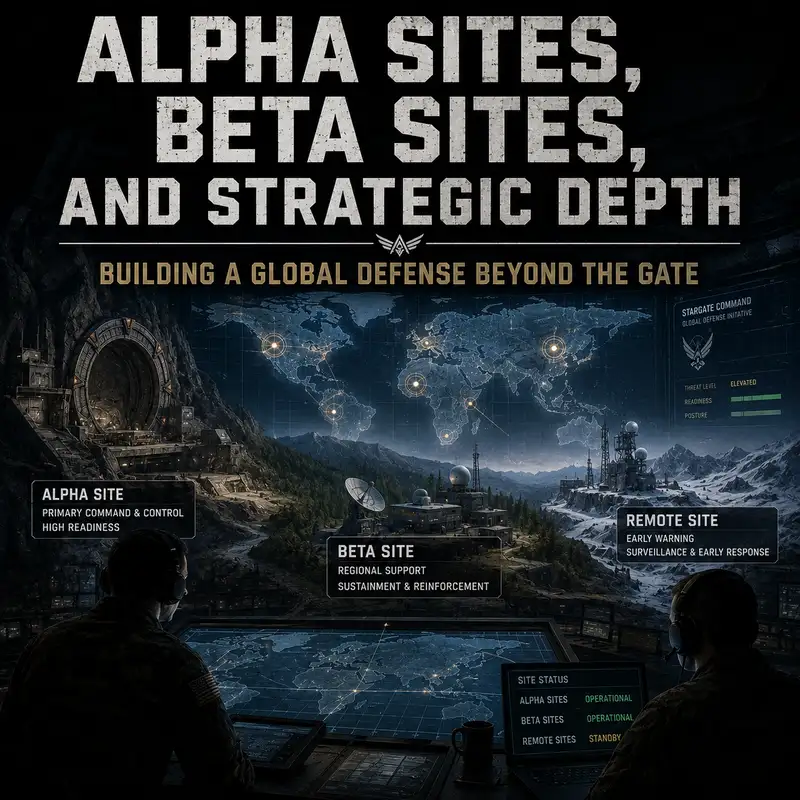
Alpha Sites, Beta Sites, and Strategic Depth
Colonel Riley had less than a minute to decide what the Alpha Site was worth. Goa’uld ships had entered the atmosphere, an Al’kesh bomber had knocked the Stargate onto its face, and Anubis’s armored soldiers were advancing through every weapon the defenders could bring to bear. Riley ordered the personnel who could still reach an evacuation route to fall back to the Beta Site. Then he remained with the self-destruct, denying the enemy the laboratories, records, and equipment his command could no longer protect.
That evacuation explains the purpose of Earth’s off-world fallback system better than any organizational chart. An Alpha Site was not merely a camp on another planet. It was a reserve command post, evacuation colony, allied sanctuary, research station, and alternate gateway for teams unable to return to Earth. A Beta Site existed because even the reserve could be discovered or destroyed. Strategic depth in the Stargate era did not mean hundreds of miles behind a front line. It meant preserving enough people, knowledge, communications, and gate access to continue after the primary base was lost.
The terminology was less orderly than the strategy. In the prime continuity, Alpha Site became a recurring functional designation applied to more than one location over time. The Beta Site is clearly referenced when the attacked Alpha Site evacuated, but the screen record provides almost no physical description of it. Alternate realities used the name Beta Site for the main evacuation world that the prime timeline called Alpha. The names were closer to contingency roles than permanent planetary titles.
The first major Alpha Site was P three X nine eight four, a remote world on the opposite side of the Milky Way. Its importance became clear when Apophis and Klorel approached Earth with two Goa’uld motherships. Stargate Command began moving selected civilians and personnel through the gate while the remaining defenders prepared for an attack they had almost no ability to stop. General George Hammond described the destination as a new colony. If Earth fell, the people sent there were expected to make it home.
The evacuation list favored individuals considered essential to preserving civilization and rebuilding organized society. Scientists, physicians, technical specialists, leaders, and other carefully selected people received places. Most of humanity did not. The Alpha Site was never capable of saving Earth’s population. Its purpose was continuity after catastrophe, which meant accepting that billions could be lost while a small group carried forward a fragment of human knowledge and institutions. The selection process remained morally uncomfortable.
The Stargate made the evacuation possible and constrained it at the same time. Only one wormhole could use Earth’s gate, and every person, supply case, medical kit, weapon, seed stock, computer, and power source had to pass through the same ring. The command moved people in organized groups because throughput and time were limited. A fleet approaching through space could take hours to arrive. A gate evacuation still required manifests, security, medical screening, and someone deciding whether another crate of equipment was more important than another passenger.
P three X nine eight four also proved its value as an alternate recovery point. Daniel Jackson escaped a Goa’uld ship by dialing the site when Earth was not the safest immediate destination. He arrived among the evacuees and delivered warning and intelligence while the rest of S G One continued its attack on the enemy vessels. The episode established a principle that later became formal procedure. When Earth could not be reached, should not be reached, or might have been compromised, off-world personnel needed another address that friendly forces controlled.
Several years later, an asteroid placed Earth under a different form of threat. The President again ordered Alpha personnel evacuated. Hammond directed Jack O’Neill to assume command of the site if S G One’s attempt to divert the asteroid failed. The group was deliberately limited because the colony had limited resources. Every survivor would have to contribute. The Alpha Site was therefore not a comfortable bunker with interstellar scenery. It was a small settlement expected to survive without Earth’s industrial economy, national infrastructure, or regular supply system.
That requirement reveals the difference between moving people and preserving civilization. The gate could deliver a physician in seconds. It could not replace a pharmaceutical industry. It could move engineers, but not every factory, machine tool, refinery, and parts warehouse supporting their work. The site needed water, food production, shelter, power, sanitation, medical facilities, and enough technical depth to repair what it depended upon. Emergency stores might cover months. Strategic continuity required planning for years.
The site also needed a legitimate chain of command. Hammond’s order placing O’Neill in charge was not simply recognition of seniority. If Earth disappeared, the Alpha Site would become the surviving center of the Stargate Program and perhaps the most capable organized human settlement beyond the home world. Military security, civilian governance, scientific priorities, rationing, and relations with off-world allies would all have to be managed under conditions no constitution or field manual had anticipated in detail.
As the program matured, Alpha Site protocol became part of routine operations. Teams receiving a do-not-proceed response from Earth could divert there rather than wait beside a hostile or exposed gate. During lockdowns, unexplained malfunctions, or the loss of Earth’s Stargate, the site became an alternate reporting point. This gave Stargate Command a limited form of command redundancy. Earth could lose direct contact without every off-world patrol becoming isolated and every intelligence source going silent.
The theft of Earth’s Stargate demonstrated that function clearly. Off-world teams dialed home, received a warning not to cross, and followed established procedure to the Alpha Site. Colonel Pierce maintained a control center there while Teal’c gathered intelligence from rebel Jaffa contacts. The site could establish wormholes, receive reports, treat personnel, and coordinate limited action even while Cheyenne Mountain had no working gate. It did not replace Stargate Command, but it prevented the disappearance of one machine from blinding the entire off-world system.
The first Alpha Site soon acquired a role its original evacuation planners had not emphasized. It became a sanctuary and operating base for rebel Jaffa. These warriors needed a location beyond the immediate reach of the System Lords where they could train, recover, organize, and maintain contact with Earth. Hosting them extended the site’s strategic value. It also made the address more important, increased the population requiring support, and brought an armed revolutionary movement into a facility meant to survive by remaining unknown.
The arrival of Tok’ra refugees magnified every pressure. Their base had been overrun by Anubis’s forces, and fewer than a quarter escaped. They dialed the Alpha Site because the Earth gate was already active and no safer route remained. The site suddenly had to receive wounded personnel, protect sensitive Tok’ra equipment, expand medical support, and house two allied groups with centuries of hostility between them. The location was secret from the Goa’uld. It was no longer simple.
Secrecy was the site’s main defense. Samantha Carter explained that the world had been chosen because the Goa’uld did not know its address. That statement described a powerful advantage and a fragile one. The Alpha Site did not need to defeat a fleet that could not locate it. Once the address escaped, galactic distance offered little protection from hyperdrives or gate assault.
The Tok’ra arrival showed how quickly a refuge could become a counterintelligence problem. An Ashrak assassin infiltrated the population, killed both Tok’ra and Jaffa, and encouraged each group to blame the other. The objective was not only murder. If the assassin escaped, the address of the Alpha Site could reach Anubis. O’Neill restricted access to the gate, questioned both allies, and treated every person on the base as a possible route by which the site might be compromised.
The crisis exposed the political weakness inside the perimeter. The Tok’ra remembered Jaffa as the soldiers who had hunted them. Rebel Jaffa remembered the Tok’ra as operatives willing to sacrifice warriors for long-term plans. Earth officials believed a shared enemy should make cooperation possible. Shared enemies are useful. They do not automatically erase institutional memory, cultural contempt, or disagreement over whose lives may be risked.
Bra’tac helped restore order by forcing the three groups to recognize that the assassin depended on their mistrust. The immediate threat was defeated, and the Alpha Site remained secret. The larger issue survived. The base could offer physical sanctuary, but it could not manufacture political unity. Its effectiveness depended on allied discipline, transparent enough coordination, and the willingness of each faction to accept Earth’s security procedures inside a facility Earth controlled.
The site continued to support the rebellion by receiving prisoners and liberated Jaffa from operations elsewhere. That turned it into more than a refuge. It became part of an irregular-warfare network connecting defectors, trainers, intelligence sources, and potential recruits. Strategic depth was serving Earth’s allies as well as Earth. Each new resident strengthened resistance to the Goa’uld and increased the number of people who knew where the reserve base was located.
The first Alpha Site eventually had to be abandoned after Anubis used a mind probe on Jonas Quinn. The address was compromised without an enemy battalion crossing the gate. This was a distinctly Stargate form of intelligence loss. A location could be protected by guards, encryption, and compartmentalization, then exposed because an enemy extracted it directly from the memory of someone who had visited.
Stargate Command responded by relocating the function rather than defending a known address indefinitely. A Stargate was transported by Tok’ra ship to a new planet, creating a completely new access point. Moving the ring allowed Earth to select a world outside familiar Goa’uld route information and rebuild its reserve infrastructure around a fresh coordinate. It was a practical answer, but not a cheap one. Buildings, generators, laboratories, communications, stores, defenses, and living quarters all had to be recreated.
The replacement Alpha Site became a joint operational base. Rebel Jaffa and Tok’ra personnel remained present, while Earth scientists used its laboratories for projects too sensitive to conduct in ordinary facilities. Carter and Jacob Carter worked there on a weapon intended to neutralize Anubis’s Kull warriors. The site offered distance, allied expertise, and room for testing. It also concentrated a coalition, a critical weapons program, and one practical escape route in the same target area.
Anubis found it. Goa’uld ships entered the atmosphere with little warning. An Al’kesh bomber struck the Stargate and knocked it flat, cutting the most direct evacuation route while Kull warriors landed and advanced on the base. The defenders fired weapons that would have stopped ordinary Jaffa. The armored soldiers continued moving. Strategic depth had bought Earth another position. It had not changed the technological imbalance confronting the garrison.
The base commander ordered an immediate evacuation to the Beta Site. Personnel who could leave moved before the gate was lost completely or used whatever alternate transport remained available. He then initiated the self-destruct to deny Anubis the research, computer records, and sensitive equipment left behind. Initial reports listed large numbers missing, and rescue teams returned to a devastated installation with the gate lying in the crater formed beneath its own event horizon.
The Beta Site is important partly because the surviving record says so little about it. In the prime timeline, this evacuation is the clearest direct reference. Its address, terrain, permanent staff, defenses, and long-term status are not established on screen. What is clear is its function. The Alpha Site had itself become a primary base, so the program maintained another location capable of receiving survivors when Alpha failed. A fallback without a fallback is simply another single point of failure with a more reassuring name.
At the Beta Site, casualty reporting and alliance management continued while rescue teams searched the destroyed Alpha facility. The site absorbed survivors, wounded personnel, Jaffa, and Tok’ra at the moment each group suspected the others had revealed the address. Physical depth preserved enough of the command to investigate. Political cohesion still deteriorated. The Tok’ra withdrew from the close alliance, and the rebel Jaffa chose greater independence rather than continued residence under Tau’ri protection.
That outcome matters because the Alpha system had been built partly to preserve the coalition. The attack did not destroy every allied force, but it helped fracture the arrangement supporting the base. The site survived as a concept while the alliance using it changed. Strategic depth can preserve organizations from immediate annihilation. It cannot prevent partners from reconsidering the relationship after losses expose incompatible doctrines and unresolved mistrust.
The next Alpha Site was more developed and more carefully hardened. It included a gate room, control facilities, laboratories, medical support, long-range sensors, and fighter operations. Much of the installation was protected within a mountain rather than spread across an exposed camp. Earth had learned that secrecy should be reinforced by concealment, warning systems, internal security, and the ability to move aircraft as well as teams.
This later site became a containment location for threats too dangerous to bring into Cheyenne Mountain. When a human-form Replicator based on Carter’s memories requested contact, O’Neill refused to admit her to Earth. Carter proposed the Alpha Site with a skeleton crew and security personnel. The decision protected Earth while allowing interrogation and possible development of a weapon against the approaching Replicators.
The containment plan nearly cost the base. Replicator Carter manipulated both Earth personnel and the Replicator known as Fifth, disabled systems, overpowered security forces, and escaped through the gate. The Alpha Site kept the operation out of Earth’s primary command center. It did not prevent deception, computer compromise, or defeat at the reserve installation. Isolation reduced the consequences of failure. It did not make failure unlikely.
The same facility could deploy an F three-oh-two and support an anti-Replicator satellite in orbit. This marked a significant change from the first emergency colony. The Alpha Site had become a forward operating base connected to Earth’s growing space capabilities. It could host technical programs, provide sensors, and support limited orbital activity. That made it more useful and more attractive to an enemy. Every improvement in resilience also increased the amount of capability concentrated at one secret address.
The Atlantis expedition independently adopted the same doctrine in the Pegasus galaxy. Facing an approaching Wraith armada and uncertain contact with Earth, the expedition selected an uninhabited world as an Alpha Site, conducted ground and aerial security sweeps, and prepared the Athosians and nonessential personnel for evacuation. The first choice was soon marked by the Wraith, forcing another search while the fleet continued approaching.
That failure reproduced the Milky Way lesson. The Alpha Site was safe only while its location remained unknown. Atlantis personnel suspected that Teyla’s involuntary connection with the Wraith may have exposed the site, although the exact mechanism was not proven. A secret address could be lost through a captured transmitter, a spy, an interrogation device, or a mental link no security officer knew how to screen.
The Pegasus evacuation plan also revealed what could not be saved. Atlantis contained an Ancient database far larger than the expedition could copy with the time and storage available. Scientists debated which small portion of the knowledge should be preserved before the city was destroyed. People could move through the gate. The city, power systems, laboratories, and most of the archive could not follow. Strategic depth preserved a force. It could still lose the civilization-changing infrastructure that made the force important.
An off-world fallback therefore had to balance several conflicting requirements. It needed a habitable environment but little or no local population whose security and sovereignty would be disrupted. It needed a working gate, reliable power, and a defensible area, yet normal gate traffic could reveal activity. It needed stores and technical facilities, but construction created emissions and signatures detectable from space. It needed enough personnel to operate independently, while every additional resident increased consumption and the risk of disclosure.
Address protection was the equivalent of camouflage, encryption, and operational security combined. Compartmentalization reduced the number of people who could reveal the site, but allies and evacuation planners still needed the route. Moving the Stargate could create a new coordinate, but rebuilding consumed time and transport capacity. Burying the gate could deny an enemy and strand friendly teams. No single measure created permanent safety. Strategic depth had to be renewed after every compromise.
The Alpha and Beta system also depended on industrial depth that no off-world camp could fully reproduce. Earth supplied ammunition, medicine, computers, generators, aircraft parts, trained replacements, and specialized knowledge. If Earth was destroyed, the survivors would inherit whatever had already crossed the gate and whatever they could produce locally. A stocked colony might preserve humanity, but not the modern economy or manufacturing base behind the Stargate Program.
For that reason, these sites were never substitutes for defending Earth. They were insurance against the failure of Earth’s defenses, command systems, or Stargate access. They bought continuity, an alternate route, and a place where survivors could reorganize. They could not stop a Goa’uld fleet in orbit, replace the population of the home world, or guarantee that the enemy would never learn another address.
Their greatest strategic contribution was psychological as well as practical. Commanders could order teams away from a compromised Earth gate without abandoning them. Scientists could test dangerous technology without placing it beneath Colorado. Allies could retreat without disappearing into isolated cells. The existence of another site created options, and options are the beginning of operational freedom.
The cost was that every fallback gradually became important enough to need its own fallback. The first Alpha Site grew from evacuation colony into allied headquarters. The second became a research and coalition base, then died under its self-destruct. The Beta Site received the survivors. A later Alpha Site became a hardened command and containment facility. Each layer restored depth after the previous layer had been exposed.
Strategic depth in Stargate warfare was therefore not a fixed distance from Earth. It was a moving relationship among secrecy, gate access, local resources, alternate command, allied trust, and the ability to destroy what could no longer be defended. An Alpha Site gave Earth somewhere to continue. A Beta Site acknowledged that continuation itself might come under attack. The system worked not because any refuge was permanent, but because losing one address did not have to mean losing the war, the program, or the people still trying to find a way home.