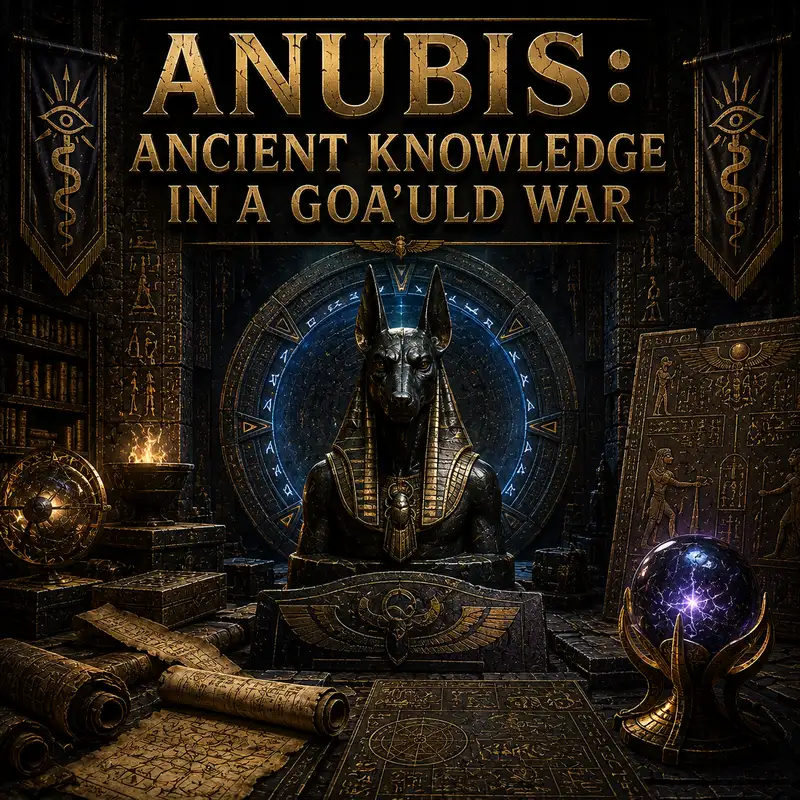
Anubis: Ancient Knowledge in a Goa’uld War
The Stargate at Cheyenne Mountain activated without an authentication signal. The iris remained closed, but no invading army was trying to cross it. On Dakara, Anubis had taken control of an Ancient device and was preparing to send its effect through every Stargate in the Milky Way at once. If it fired, the network connecting human worlds would deliver their extermination. Earth prepared to destroy its own gate. This was the final form of Anubis’s war: Ancient knowledge applied with Goa’uld intent.
Anubis did not become the most dangerous System Lord merely because he found a larger weapon. He changed the relationship between knowledge and power inside the Goa’uld empire. Traditional rulers stole technology and used it to preserve a balance none trusted. Anubis returned able to recognize Ancient systems and combine them with Goa’uld industry, captured expertise, and ruthless experimentation. The question is how a ruler forbidden from using the full power of ascension still came close to redesigning the galaxy.
Long before his return, Anubis had been one of the Goa’uld rulers competing for territory and authority. The surviving record does not provide a complete account of his early domain or every crime attributed to him. Tok’ra intelligence established that the other System Lords banished him because his conduct exceeded even what they would tolerate. That is a severe professional evaluation when issued by mass murderers and slave owners who regarded planetary bombardment as a negotiating aid.
Banishment did not remove Anubis from the strategic environment. He discovered enough about ascension to seek help from Oma Desala, an ascended being who guided lower life toward a higher plane. He concealed his nature and deceived her into assisting him. When the other ascended beings discovered the mistake, they tried to send him back. They did not restore him fully to mortal existence. Anubis remained an energy-based being trapped between corporeal life and ascension.
The punishment created one of the most destructive loopholes in Ancient policy. Anubis could not openly employ the powers of a fully ascended being against the lower planes. He was permitted to do anything an ordinary Goa’uld could theoretically accomplish. The rule restricted direct intervention, not the advantage created by knowledge. Anubis could not erase a fleet by thought. He could remember how advanced systems worked, order them built, and have a subordinate activate them.
His black robes and featureless mask concealed more than theatrical preference. The visible body was a containment field maintaining an unstable energy form. He could occupy living hosts, but no longer depended on one human body in the ordinary Goa’uld manner. Destroying the shell could disperse him without killing him. That made assassination difficult and allowed risks no normal System Lord could accept. It did not make him omnipotent. He still required ships, laboratories, technicians, resources, and soldiers.
He returned when the old order was already unstable. Ra was dead. Apophis and Cronus would soon be removed, leaving fleets and territories open to seizure. Rather than announce himself immediately, Anubis attacked the surviving System Lords from concealment. His forces included Jaffa bearing the markings of defeated or compromised rulers, which made the attacks appear to be betrayals from within. Each loss weakened a rival while increasing suspicion among the people who might otherwise have combined against him.
Anubis sought formal readmission to the System Lords through his emissary, Osiris. The council knew he had inflicted the losses under discussion. Most still voted to restore him, over Lord Yu’s objection, because his power was too large to dismiss and too dangerous to oppose without unity. He offered the destruction of the Tok’ra as evidence of service. While the rulers debated his status, his forces were already assaulting a major Tok’ra base. Diplomacy and military action formed one entry operation.
Daniel Jackson had infiltrated the summit carrying symbiote poison intended to kill the assembled leadership. He withheld it when he understood the balance. Removing the visible System Lords would not necessarily liberate their worlds. It could clear the field for Anubis, whose forces were organized and whose technical advantage remained unknown. The decision preserved several tyrants because one returning tyrant posed the greater immediate danger. Unpleasant strategic calculations do not become less real by refusing to record them.
Anubis’s early attacks on Earth favored strategic effects over ceremonial invasion. He sent a naquadah-rich asteroid toward the planet, disguising attack as natural disaster. No fleet had to enter Earth’s defenses and no Jaffa had to occupy the surface. If it struck, the impact and naquadah reaction would destroy civilization while concealing the attacker until concealment no longer mattered. S G One diverted it with an improvised hyperspace maneuver, saving Earth without damaging Anubis’s military structure.
His next attempt weaponized the Stargate itself. An Ancient device sent a continuous stream of energy through an open wormhole into Earth’s gate. The incoming energy accumulated inside the gate’s internal systems until the naquadah structure approached catastrophic overload. The iris could not stop it because the threat was not matter arriving through the event horizon. Earth’s scientists could measure the rising energy and estimate the destruction. They could not simply shut down a wormhole being sustained from the other side.
Earth survived by removing the gate from Cheyenne Mountain, lifting it into space, and allowing it to detonate far away. Teal’c, Bra’tac, Rya’c, and rebel Jaffa attacked the device at its source, but Earth still had to sacrifice its gate. Russia’s gate became the only operational one on the planet and was transferred to Stargate Command through an agreement involving money, aerospace technology, and Russian participation. One remote weapon had forced an international military reorganization.
The attack demonstrated the operational value of Ancient knowledge. Anubis understood that the gate network was more than transportation. It was a distributed energy system with predictable rules, internal safeguards, and failure modes. He did not need to overpower Earth’s gate room. He exploited the machinery beneath its defenses. This approach would return at Dakara on a vastly larger scale. The difference between a doorway and a weapons network is sometimes a commander who understands the technical manual better than the people guarding the doorway.
Anubis also acquired knowledge through conventional intelligence operations. He captured Thor and used a neural interface to download the Asgard commander’s mind into a shipboard computer. Thor had studied Ancient information for thousands of years, giving Anubis access to capabilities beyond normal Goa’uld engineering. The operation nearly cost him the vessel when Thor’s consciousness took control, but it revealed the method. Anubis combined ascended knowledge, stolen Ancient devices, Asgard data, and Goa’uld industrial labor.
Not every advanced system used by Anubis came directly from ascension. Some came from captured minds, subordinate scientists, or recovered machinery. Ancient knowledge helped him identify opportunities, understand principles, and shorten development. It did not manufacture components or test unstable reactors. Anubis still employed specialists, and when one failed to stabilize naquadria, the familiar Goa’uld quality-assurance process involved execution rather than a revised research schedule.
His most visible breakthrough began with six artifacts known as the Eyes. Anubis had collected five and needed the Eye of Ra, hidden beneath the pyramid on Abydos. Combined, the devices could supply far more power than any one Eye alone. He integrated them into a major weapon aboard his flagship. S G One found the Eye first and tried to use it as leverage, but the planet’s defenders could not resist the Jaffa and orbital forces surrounding them.
Daniel, then ascended, confronted Anubis and discovered what he had become. He could destroy the half-ascended Goa’uld, but direct intervention violated the rules imposed by the others. Oma pulled Daniel away before he could act. Anubis received the Eye, defeated the System Lord fleet that challenged him, and used the completed weapon against Abydos. The old home of Ra and first world liberated by the modern Stargate expedition became the demonstration target for a new imperial order.
The victory changed the Goa’uld balance. Anubis’s flagship could destroy conventional Ha’taks faster than their combined fire could penetrate his shields. He no longer needed the council’s approval because he could defeat the council’s fleets. Earth answered through sabotage rather than fleet combat. An F three-oh-two made a short hyperspace jump through the flagship’s shields, allowing an attack team to damage the weapon’s critical systems. The mission neutralized the immediate advantage but left Anubis, his ship, and his knowledge intact.
He turned next to Langara after a mind probe revealed naquadria, an unstable but powerful material. Anubis seized the stockpile, attacked the industrial district, took leaders hostage, and searched for research left by an earlier Goa’uld. His scientist tried to power a weapons array and nearly destroyed the ship. A coalition led in practice by Ba’al attacked while the vessel was vulnerable. The flagship was lost, but Anubis escaped, leaving another ruined laboratory and another rival holding more of the surviving fleet.
The loss pushed him toward a different solution to the manpower problem. Jaffa were strong and disciplined, but their loyalty was increasingly unreliable. Rebels were spreading the claim that the Goa’uld were false gods, and captured Jaffa could change masters after a defeat. Anubis created Kull warriors to replace belief with engineering. These troops were not recruited from families or trained through a warrior culture. They were manufactured as biological weapons and conditioned for obedience.
The bodies were grown artificially and animated through technology derived from the device that inspired the sarcophagus. Each carried a Goa’uld symbiote produced under controlled conditions, with inherited personality suppressed to reduce ambition. Heavy armor provided weapons, protection, and life support. A single Kull warrior could absorb fire that would destroy ordinary Jaffa and continue advancing. This was an attempt to build a soldier with no family to threaten, no faith to lose, and no political future beyond the mission.
Tartarus housed the production system. A queen generated the symbiotes. Laboratories created and sustained the bodies. Scientists such as Thoth monitored the conditioning process. Sensors covered the planet, and a force field protected the Stargate. Anubis concentrated the program because advanced production required specialized equipment and close supervision. That created a bottleneck. Tok’ra and Earth personnel infiltrated the base using captured Kull armor, destroyed the queen, and killed key technical staff. Thousands of existing warriors remained dangerous, but replacement had become harder.
Earth and the Tok’ra recovered the life-energy device associated with the sarcophagus and used it to develop a weapon that disrupted the energy sustaining Kull bodies. The countermeasure did not erase Anubis’s advantage. It gave smaller forces a practical way to kill troops previously treated as invulnerable. The pattern recurred throughout the war. Anubis created a capability by combining rare knowledge with a centralized system. His enemies survived by finding the physical dependency the system could not conceal.
He continued searching for the Lost City of the Ancients because Ancient infrastructure offered more than individual weapons. Osiris entered Daniel’s dreams to recover memories from his period of ascension. Anubis attacked Earth positions that might lead to repositories or outposts. Stargate Command understood that the same discovery could decide the war in either direction. If Earth found an Ancient defense first, it might survive. If Anubis found it, the System Lords and the Tau’ri would face another asymmetry they could not match.
Jack O’Neill accepted a second download from an Ancient repository to deny it to Anubis. The information overwhelmed his human brain, but guided S G One to an abandoned outpost where they recovered a power source. O’Neill then led the team back to Antarctica, where another Ancient installation remained beneath the ice. Earth had possessed the site for thousands of years without understanding it. Ancient knowledge arrived not as an industrial transfer, but inside one dying officer who could barely explain his actions.
Anubis attacked Earth with a fleet large enough to overwhelm the Prometheus, orbital defenses, and conventional air power. Kull warriors were prepared for ground operations if the fleet secured the planet. At the Antarctic outpost, O’Neill activated a control chair and launched Ancient drones. The weapons tore through fighters, motherships, shields, and the flagship. Earth won its first true planetary-defense battle by using a unique installation powered by a recovered energy source and operated by a man carrying knowledge his body could not survive.
The destruction of Anubis’s shell did not destroy him. His energy form escaped into orbit, reached human personnel, and moved through hosts inside Stargate Command. The base first treated the symptoms as disease because possession by a disembodied System Lord was not high on the medical checklist. Security trapped him inside Colonel Alexi Vaselov and redirected the outgoing gate to a frozen world. The immediate threat was contained. The later record shows that containment did not last.
Anubis returned from concealment and used Ba’al as his principal military instrument. Ba’al appeared to be consolidating the System Lord order while secretly serving the rival he hoped to betray. This arrangement gave Anubis fleets, Jaffa, gate expertise, and political reach without exposing his unstable form. It gave Ba’al advanced knowledge and time to study a master he intended to replace. Mutual treachery remained one of the more dependable institutions in Goa’uld government.
The final crisis combined three wars at Dakara. Rebel Jaffa seized the sacred site where their enslavement had begun. Replicators attacked Goa’uld fleets and occupied ships faster than either side could replace them. Anubis ordered Ba’al to recover an Ancient device hidden inside the temple. The machine emitted an energy wave that reduced matter to basic components and could send that wave through an active Stargate. Evidence suggested its original purpose involved reshaping or creating life on a vast scale.
Samantha Carter and Jacob Carter discovered that the device could be tuned to the specific energy pattern used by the anti-Replicator weapon. Ba’al provided the gate-programming knowledge required to dial every Stargate in the Milky Way simultaneously. The alliance was temporary, hostile, and technically indispensable. The wave passed through the network and destroyed the Replicators before they could adapt. Jacob and Selmak died soon afterward from injuries and age, leaving the victory with a human cost that no strategic diagram could simplify.
That success gave Anubis the final component of his own plan. Ba’al’s changes proved that the Stargate network could carry one synchronized wave everywhere. Anubis retook Dakara with Kull warriors and prepared to recalibrate the device for living matter. Because he lacked a normal corporeal form, he expected to survive the extermination. Time was no longer a meaningful constraint. He could erase every existing population and rebuild the galaxy according to his own design, turning imperial conquest into biological replacement.
Daniel learned the full history while again near ascension after Replicator Carter killed him. Appearing as a man called Jim, Anubis explained the rule protecting him. The ascended collective allowed him to do anything he could have done as an ordinary Goa’uld, even if retained knowledge made it easier. Daniel then understood that Oma had been deceived into helping Anubis ascend and that the others had left him in this condition partly as punishment for her interference.
The policy converted nonintervention into complicity. The ascended beings did not order Anubis to destroy Abydos, build Kull warriors, or seize Dakara. They established a rule under which none would stop him while he used physical instruments and subordinates. Their restraint protected the boundary between planes while billions of lower lives became evidence in an internal disciplinary dispute. Ancient philosophy remained technically consistent and strategically indefensible.
Oma finally accepted responsibility. She could not destroy Anubis permanently, and he could not defeat her outright. She could engage him continuously, forcing him to spend all of his effort resisting her. As the Dakara weapon approached activation, Oma attacked. Anubis disappeared from the physical war, his commands ceased, and his armies were left without the intelligence and will at their center. He was not executed or converted. He was contained through an endless struggle on the plane he had entered by deception.
Anubis’s record proves that knowledge alone was not the weapon. He needed Goa’uld ships, Jaffa, queens, scientists, mines, and captured specialists. His projects were vulnerable at those supporting points. The Eye weapon could be sabotaged. Naquadria could overload. Kull production depended on a queen and laboratories. The Antarctic fleet could be destroyed by an outpost he had failed to locate first.
He was also not omniscient. He misjudged Earth’s capacity for improvisation, underestimated rebel Jaffa, failed to control Thor’s downloaded consciousness, and depended on Ba’al despite knowing Ba’al intended betrayal. Ancient knowledge improved his technical options. It did not give him perfect intelligence, loyal institutions, or sound political judgment. The same personal command system that allowed rapid action left his empire unable to function coherently once Oma removed him from the board.
Anubis changed the Goa’uld war more than any conventional System Lord of the modern era. He broke the old balance with weapons traditional fleets could not survive. He turned Stargates into attack vectors and replaced unreliable warriors with engineered troops. He forced Earth to reveal the program to allied governments, accelerate planetary defense, search for Ancient installations, and cooperate temporarily with Ba’al. Every response made Earth stronger, but only after Anubis demonstrated how exposed the planet remained.
The cost was paid far from the laboratories where those advantages were developed. Abydos was destroyed. Langaran civilians died beneath weapons tests and coercive occupation. Jaffa were converted into raw material for shifting alliances, while synthetic bodies were built to die without the possibility of rebellion. Entire populations came within moments of being reduced to molecular components because an ascended political rule treated technical possibility as moral permission.
Anubis nearly won because he understood what the other System Lords did not. The Ancients left a connected technological environment: repositories, outposts, life-energy systems, planetary devices, and a gate network capable of distributing effects across the Milky Way. He used Goa’uld coercion to turn that inheritance into a war machine. He was stopped only when Earth, the Tok’ra, rebel Jaffa, rival Goa’uld, and Oma Desala attacked different parts of that machine at the same time.
The black mask made Anubis appear less human than the other Goa’uld, but his defining weapon was not the energy form beneath it. It was the gap between knowing how a civilization’s technology worked and possessing the wisdom to decide whether it should be used. Anubis inherited the first and rejected the second. His war ended only when the being who had opened that door accepted that no lower army could close it alone.