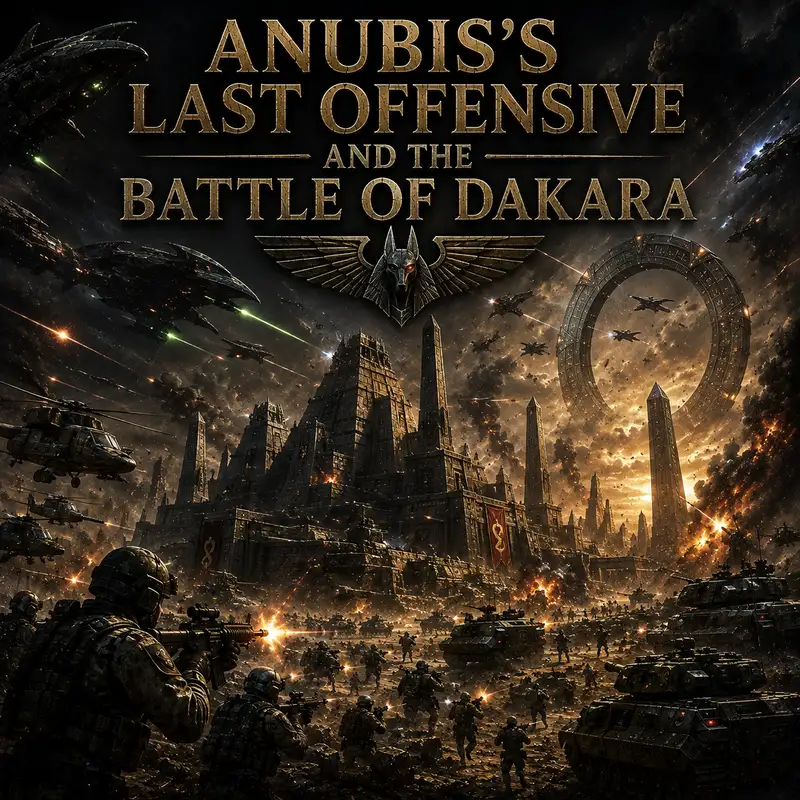
Anubis’s Last Offensive and the Battle of Dakara
The Stargate began dialing before anyone in the control room touched the controls. Samantha Carter had been trying to establish an outbound wormhole to the Alpha Site, hoping to keep both gates occupied and deny Anubis immediate access to Earth. Instead, the mountain received an incoming connection with no identification code. The iris closed, but Carter knew the barrier would not stop the energy carried by the Ancient weapon. General Jack O’Neill ordered the base self-destruct. Above Dakara, Anubis had already won the military battle.
His last offensive was not the largest campaign he ever commanded. Much of his fleet had been destroyed over Antarctica, and the Replicators had consumed many of the forces that remained. Anubis did not need to reconquer an empire world by world. He needed one temple, one Ancient machine, and the Stargate modifications developed by Ba’al. Together, those pieces could strike every gate-connected region of the Milky Way at nearly the same time.
The offensive followed a victory that had transformed Jaffa politics. Rebel forces had captured Dakara while Ba’al’s fleet was fighting the Replicators. From beneath the temple, Earth, the Tok’ra, and the Jaffa activated an Ancient device and transmitted a destructive frequency through the Stargate network. The wave disassembled Replicators across the galaxy before any surviving group could adapt. Ba’al then discovered that his own crews no longer accepted his authority. Free Jaffa boarded his command ship, defeated his Kull guards, and forced him to flee.
Dakara became the founding symbol of the Free Jaffa Nation. It was sacred ground associated with the first Prim’ta ceremony, the biological arrangement that had bound Jaffa survival to larval Goa’uld symbiotes. Seizing the temple therefore carried meaning beyond territory. The place where dependence had been presented as divine order now belonged to warriors who rejected the gods that created it. Thousands gathered there, and a new council prepared to build a capital for a people who had spent generations serving separate masters.
The new government inherited the Ancient device at the center of that symbol. Stargate Command and the Tok’ra wanted it destroyed. The machine had just saved the galaxy, but it was also capable of disassembling life on a planetary scale and transmitting its effect through active wormholes. The Jaffa council refused immediate demolition. Its members believed the weapon strengthened unity, deterred surviving Goa’uld, and proved that liberation had produced real power rather than another period of vulnerability.
That decision was understandable and dangerous. The Free Jaffa had no established strategic reserve, mature intelligence service, stable system of civilian authority, or settled procedure for controlling a galaxy-scale weapon. They did have enemies, captured fleets, and a population still deciding whether the old gods had truly fallen. Destroying the device might have looked like surrendering the strongest evidence that the rebellion could protect its people. Keeping it turned Dakara into the most valuable target in the Milky Way.
Anubis understood that contradiction. He had survived the destruction of his fleet above Antarctica because he was no longer fully corporeal. Long before, Oma Desala had helped him ascend after he deceived her about his character. The other ascended beings forced him partway back into the lower plane, restricted his direct use of ascended power, and left him with knowledge that ordinary Goa’uld did not possess. He could be defeated in ships and laboratories. Removing him permanently was another matter.
Ba’al had served Anubis during the war against the Replicators while looking for a way to survive his master. He revealed the Dakara device to Stargate Command because Anubis intended to use it against all life, including Ba’al. After the Replicators were destroyed, Anubis confronted him. Ba’al argued that the remaining Kull warriors could retake Dakara. Anubis accused him of betrayal, spared him temporarily, and announced that Ba’al would live only long enough to witness the result of his own technical work.
That work involved the Stargate network’s update system. Ba’al had previously manipulated the process by which gates exchanged positional corrections, allowing a program to propagate from one gate to others. Carter later used his expertise to distribute the anti-Replicator wave from Dakara. Anubis intended to use the same network architecture for extermination. The machine would supply the energy pattern. The gates would supply reach. A transportation system built to connect inhabited worlds would become the delivery system for their destruction.
The plan also exploited the original function of the Dakara device. The Ancients had used it to reseed life in the Milky Way after a devastating plague. Its energy could be adjusted to break matter apart and, under controlled conditions, reorganize it. Anubis intended to erase existing life, survive in his partially ascended state, and rebuild according to his own design. It was imperial planning with the inconvenience of existing populations removed.
A direct assault on Dakara would still have been difficult. The Free Jaffa controlled captured Ha’taks, Al’kesh bombers, death gliders, infantry, and the temple itself. The new nation remained politically fragmented, but the victory over Ba’al had strengthened morale. Anubis needed to reduce the defenses before committing the Kull warriors that survived the Replicator campaign. He chose intelligence deception rather than immediate force.
The Jaffa council was already searching for a common enemy around which previously hostile armies could unite. Teal’c and Bra’tac warned that liberation had arrived before the rebellion had built the institutions required to manage it. Warriors who had served rival System Lords still distrusted one another. A campaign against Anubis promised a shared purpose, a visible threat, and an opportunity to destroy the remaining Kull production base on Tartarus. The political value of the target made the intelligence supporting it especially attractive.
Reports indicated that Anubis was gathering his surviving Kull warriors on Tartarus. The exact source chain was not preserved, which is itself an important warning. The council accepted the intelligence and prepared a preemptive strike. Roughly half of the available ships left Dakara for the assault. The movement concentrated experienced crews and mobile firepower around a target believed to contain the enemy’s remaining elite ground force. It also stripped the new capital of the reserve needed to answer a second attack.
The Jaffa force reached Tartarus and fought through the defenses. What it found was an empty installation. No Kull army waited inside. The resistance had encountered automated systems designed to make the base appear defended without committing living troops. Teal’c and Bra’tac recognized the trap only after the fleet was fully engaged. Anubis had planted the intelligence, predicted that the council would act aggressively, and used its need for unity to remove much of Dakara’s protection.
This was a mature counterintelligence operation against an immature state. Anubis did not merely conceal his real force. He supplied a report that confirmed what the Jaffa leadership already wanted to believe. The council wanted a common campaign. Tartarus offered one. The rebels wanted to eliminate the Kull before those soldiers could be used against them. The report promised that opportunity. Automated defenses gave the deception credibility. By the time the target proved empty, the operational effect had already been achieved.
The Stargate could not correct the mistake quickly enough. Gate travel could move small groups and messages almost instantly, but the fleet defending a planet still had to travel through hyperspace. The ships committed to Tartarus could not simply dial home. Dakara’s remaining defenders faced the assault with reduced orbital strength, incomplete warning, and no guarantee that the returning formation would arrive before the temple fell. Strategic mobility had removed distance for infantry. It had not removed distance for capital ships.
Anubis struck the depleted world with the remaining Kull army and enough space power to defeat the rebel ships left behind. The surviving record does not provide a reliable count of attackers, defenders, or casualties. It does establish the result. The fleet guarding Dakara fell. Kull warriors overran the temple approaches and killed many of the Jaffa who remained. Bra’tac’s returning ships would not arrive in time. Anubis captured the facility before the Free Jaffa could organize a second defensive line.
The Kull were ideal for this phase of the operation. Their engineered hosts, conditioned symbiotes, integrated weapons, and energy-resistant armor allowed them to advance through fire that would stop ordinary Jaffa. More important, their obedience did not depend on belief. Anubis had built them to replace soldiers capable of rebellion. At Dakara, they were used against the very movement that had made such replacement necessary.
Their strength also contained the weakness that would later decide the battle. Kull warriors possessed little independent identity and existed within a command system centered on Anubis. They could take a temple, kill defenders, and hold a corridor under direct purpose. They were not designed to create strategy when the source of that purpose disappeared. Anubis had solved the problem of disobedience by removing the qualities that allow an army to continue when command collapses.
Stargate Command learned that the rebel fleet had fallen and that Anubis controlled the device. O’Neill proposed sending the largest nuclear weapon available through the gate. Teal’c pointed out that Anubis would have shielded the Dakara Stargate. Any warhead arriving against that barrier would fail to reintegrate properly. Earth possessed destructive power. It did not possess access to the target.
Carter offered a delaying measure. If Earth established an outbound wormhole to the Alpha Site, both gates would remain occupied and unavailable to Anubis’s network command. The connection could last only the normal maximum duration, roughly thirty-eight minutes. It would protect two planets briefly and do nothing for the rest of the galaxy. The proposal was not a solution. It was the kind of action a command takes when time itself is the only resource left to preserve.
The control room never completed the outbound dial. The Stargate began rotating under external command and established an incoming wormhole from the network. No identification code followed. The iris closed automatically, but the defense had been designed to prevent matter from reintegrating inside the gate room. The Dakara wave was not a squad of Jaffa or a missile striking the metal barrier. It was an energy effect transmitted through the wormhole. The strongest gate defense on Earth had become irrelevant to the threat using the gate.
O’Neill ordered the self-destruct. Carter warned that the explosion would not reliably destroy the Stargate and had only a remote chance of forcing an active incoming wormhole to disengage. He understood. The order accepted the destruction of Cheyenne Mountain because no better method remained. If the blast interrupted the connection, Earth might survive. If it did not, the personnel in the control room would die seconds before everyone else. This is not usually considered a robust continuity-of-government plan.
Above Dakara, Anubis prepared to activate a system that no conventional fleet could stop in time. The Free Jaffa forces were displaced or defeated. Earth could not reach the weapon. The Tok’ra had no force capable of penetrating the site. Ba’al had helped create the network modifications and lacked control of them. Anubis had done almost everything correctly. He had deceived the enemy, concentrated force against the weakened objective, captured the decisive terrain, and begun the firing sequence.
The remaining opposition existed on another plane. Daniel Jackson had been killed by the human-form Replicator created in Carter’s image after he reached into the Replicator network and temporarily froze the collective. Oma intercepted him before final death and placed him in a familiar diner drawn from his memories. There he faced another choice between ascension and ordinary death. He also learned that Anubis intended to retake Dakara and erase life across the galaxy.
Most of the ascended beings present refused to intervene. Their policy prohibited direct interference in the lower planes, and Oma had already violated that policy repeatedly by helping others ascend. Her greatest mistake had been Anubis. He had found Ancient research, approached her with enough knowledge to conceal his nature, and gained assistance he did not deserve. The Others’ response left him between planes and forced Oma to watch the damage caused by her judgment.
Anubis appeared in the diner as an ordinary man calling himself Jim. He spoke to Daniel when the other ascended observers would not and repeatedly emphasized the hopelessness of stopping the attack. His behavior carried the confidence of a commander who had already arranged the battlefield below. When he revealed that Oma had helped him ascend, Daniel understood who had been sitting beside him. The enemy directing the assault on Dakara was also present to watch the person he blamed for his punishment.
Daniel could not stop him directly. He had not yet completed ascension and lacked the power to affect Anubis. The Others would not act. Oma believed she could not kill the being they had preserved as part of her punishment. Daniel’s role was therefore not to deliver a weapon or command a rescue. It was to force the moral issue into the open. Noninterference had become active protection for the aggressor because the rules constrained everyone willing to resist him more effectively than they constrained Anubis.
Oma chose a form of containment rather than victory. She confronted Anubis and acknowledged that she could not destroy him. She could fight him. Anubis might be impossible for her to kill, but he would have to devote all his power to resisting her. Their struggle removed both from effective action in the lower plane. It was not a battlefield defeat in the conventional sense. It was an indefinite engagement imposed at the only level where Anubis could no longer escape through ships, shields, or another host.
The effect at Dakara was immediate. Anubis vanished before the destructive wave crossed the network. Inside Cheyenne Mountain, the incoming wormhole disengaged with little more than a second remaining on the self-destruct clock. Carter aborted the detonation. The base had no sensor capable of explaining why the connection closed. From the perspective of the control room, the galaxy survived because the enemy system stopped for no identifiable technical reason.
On Dakara, the Kull warriors became confused and disorganized. Their master no longer supplied purpose, and the army built to obey perfectly could not adapt to his disappearance. Free Jaffa forces attacked the remaining positions and defeated them. The counterattack was costly. Teal’c later reported that many Jaffa had died, although no reliable total was established. The survivors retook the temple after first losing it to a force that had exploited their own strategic overconfidence.
The military result should be described precisely. The Free Jaffa did not prevent the initial capture of Dakara. Stargate Command did not destroy the weapon, penetrate its shield, or break the incoming connection. Bra’tac’s fleet did not return in time to save the first defensive force. Anubis’s operation succeeded until an ascended confrontation removed its commander. The final counterattack worked because his army lost coherence, not because the Kull armor or physical capabilities had suddenly become less formidable.
The political effect was larger than the tactical recovery. The Jaffa who survived had fought for a shared capital against the ruler most closely associated with their former servitude. Previously rival armies returned to the same battlefield and found a common loss. The attack that was meant to decapitate the Free Jaffa Nation instead gave it a founding defense. Liberation had been declared after the Replicators fell. It was defended against Anubis at Dakara.
The battle also changed the argument over the Ancient device. Teal’c and Bra’tac reported that the survivors were united in favor of destroying it and replacing it with a memorial. The machine had helped end the Replicator threat, but its continued existence had nearly allowed Anubis to erase the galaxy. Possession had not produced security. It had produced a target, a political dispute with allies, and a temptation for leaders who believed strategic power could substitute for stable institutions.
Later continuity shows that the device remained operational longer than that immediate decision suggested. Whether the council delayed, reversed itself, or simply failed to implement the agreement is not fully explained. The gap matters. Revolutionary governments often reach clear conclusions during crisis and discover afterward that symbols, deterrence, factional interests, and fear make disarmament more difficult than the briefing implied. Dakara’s weapon remained both a foundation myth and an unresolved command problem.
Anubis’s removal did not eliminate every Goa’uld. Ba’al survived, retained followers, and continued looking for ways to rebuild power. Lesser rulers, hidden symbiotes, occupied worlds, and old military networks remained. What disappeared was the last coherent offensive capable of combining superior technology, Kull troops, gate-network manipulation, and a plan for galaxy-wide domination under one commander. The Goa’uld order had already been shattered. Dakara removed the ruler best positioned to replace it with something worse.
The final offensive failed for a reason no conventional intelligence estimate could have guaranteed. Anubis correctly identified the Free Jaffa’s political weakness, planted usable intelligence, drew away roughly half their fleet, captured the decisive installation, and began using the Stargate network as a strategic weapon. Earth had no military countermeasure available. The Jaffa had no reserve close enough to intervene. His defeat came because Oma Desala finally accepted responsibility for the enemy she had helped create and chose to contain him at permanent personal cost.
That does not make the battle irrelevant. Anubis reached the firing point because the new Jaffa state confused possession of a weapon with control of the strategic situation. It lacked verified intelligence, retained too little reserve, and concentrated symbolic, political, and military value on one world. The attack exposed those failures with extraordinary severity. The survivors gained unity, but they gained it through casualties that better intelligence and less confidence in the weapon might have reduced.
Dakara was therefore both Anubis’s last offensive and the Free Jaffa Nation’s first defensive war. He captured the planet, defeated its fleet, occupied its temple, and activated the system meant to erase every rival. He still lost because his empire, his army, and his plan depended on one irreplaceable will. When that will was locked in combat beyond the reach of ordinary forces, the Kull stopped, the gate closed, and the Jaffa reclaimed the ground.
The most revealing image is not Anubis standing over the Ancient controls. It is the aftermath, with confused Kull warriors falling among the ruins and surviving Jaffa deciding what should replace the machine beneath them. A ruler who planned to remake all life disappeared before the weapon fired. The people he meant to erase remained, but freedom now required something harder than rebellion. They had to build a government capable of surviving its own victories.