Apophis: The Enemy Who Started the Modern War
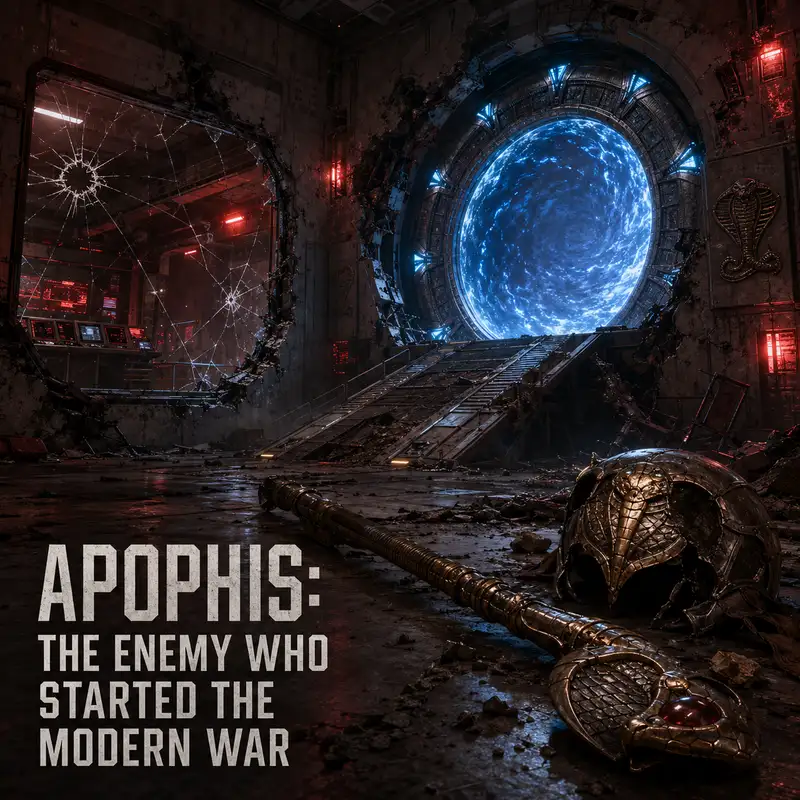
A small Air Force security detail was guarding a covered Stargate when the ring activated without warning. Serpent-helmeted Jaffa entered the underground chamber, killed the defenders, and presented a captured airman to the figure behind them. He examined her as a possible host, ordered his troops back through the gate, and disappeared before the base could respond. Apophis had not launched an invasion. He had conducted a raid. The distinction mattered to him. It would not matter to Earth.
That brief penetration started the modern Goa’uld war because it transformed an abandoned strategic problem into an active national-security emergency. Apophis forced the United States to reopen the Stargate Program, recall Jack O’Neill, recover Daniel Jackson from Abydos, and accept that Ra had been one ruler among many. He also turned several individual grievances into a sustained military campaign. Sha’re was taken. Skaara was taken. Teal’c defected. Chulak was breached. Within months, a routine imperial hunt for hosts had produced an enemy organization dedicated to dismantling the system that made such raids possible.
Apophis entered the modern era as an established System Lord, not an unknown raider. He controlled Chulak, commanded Serpent Guard formations, possessed Ha’tak motherships, and maintained enough prestige to place his queen and his son within human hosts selected from captive populations. His chosen identity also declared his political position. In the mythology Daniel Jackson used to interpret the Goa’uld, Apophis was the serpent rival of Ra. Ra’s death over Abydos removed the dominant ruler of the old order and gave ambitious competitors room to expand. Apophis moved quickly.
His political history also mattered. Apophis had once joined Ra and other Goa’uld in defeating Sokar, an older ruler whose attempt at supremacy threatened them all. That placed Apophis inside the old balance-of-power system long before Earth reopened its gate. He understood coalition warfare, dynastic rivalry, and the value of waiting for a stronger ruler to weaken. What he did not understand was a state that could lose every conventional comparison and still keep sending small, informed teams into the seams of his empire.
His first actions suggest that he initially saw Earth as a source of bodies rather than a peer military threat. The gate room raid used a small force. The Jaffa secured a captive, withdrew, and left no occupation element behind. On Abydos, the same pattern followed. Apophis’s guards seized Sha’re and Skaara, injured defenders, and departed through the Stargate. This was how a mobile imperial elite exploited worlds that could not contest the gate. Arrive suddenly, take what was useful, punish resistance, and leave before a larger response could form.
The assumption behind that method was that the victims would remain local. A village might grieve. A family might resist. No one was expected to trace the raiders across a galactic network, assemble an expedition, and arrive at the ruler’s stronghold with automatic weapons and demolition charges. Earth did exactly that. Ferretti had seen enough of the dialing sequence to identify the destination, and Daniel had discovered that the Abydos chamber contained addresses for many worlds. General Hammond authorized new teams, and the dead-end assignment beneath Cheyenne Mountain became Stargate Command.
Apophis therefore created his opponent before he understood that an opponent existed. The United States began with almost no strategic depth beyond the iris, no spacecraft, limited naquadah, and very little knowledge of Goa’uld politics. What it did possess was a defensible gate room, a professional military chain of command, scientific personnel, and the ability to send small teams into places where Goa’uld rulers expected obedience rather than reconnaissance. The early program was vulnerable and improvised. It was also learning faster than Apophis’s political system was accustomed to permitting.
The abduction of Sha’re and Skaara gave that institution a personal center of gravity. Apophis chose Sha’re as host for his queen, Amaunet, and Skaara as host for his son, Klorel. To Apophis, both were suitable vessels. To Daniel and O’Neill, they were family. That difference explains much of the war’s intensity. Goa’uld strategy treated human identity as replaceable. Stargate Command defined recovery of the captive person as a legitimate objective even when the symbiote had taken physical control.
The selection also reflected the way Apophis organized power around a divine household. Amaunet was not only his mate but his queen. Klorel was not only an offspring but a subordinate ruler whose host connected Apophis’s dynasty to the population he controlled. Family, succession, and command were intertwined. That arrangement gave the court continuity, but it made personal loss strategically important. An injury to Klorel could delay a campaign. The disappearance of Amaunet could redirect military resources. A household crisis became an imperial operation.
On Chulak, Apophis made the decision that damaged him more than the loss of any single ship. He ordered his First Prime, Teal’c, to execute prisoners who had been rejected as hosts. Teal’c had already begun to doubt the divinity of the Goa’uld, and O’Neill recognized the hesitation. When Teal’c turned his staff weapon on the Serpent Guards and led the captives toward the gate, Apophis lost a senior commander, a symbol of Jaffa loyalty, and one of the most valuable intelligence sources Earth could have acquired.
Teal’c knew the enemy from the inside. He understood Jaffa ranks, weapons, guard routines, shipboard practices, religious language, gate operations, and the personal rivalries of the System Lords. He could distinguish intimidation from capability and explain which customs were sacred, which were security procedures, and which were both. He also gave Earth credibility with other Jaffa. A Tau’ri officer could claim that the Goa’uld were false gods. The gold-marked former First Prime of Apophis could prove that one of their highest servants had reached the same conclusion.
From an intelligence perspective, the defection changed the war immediately. Before Teal’c, Earth could observe Goa’uld equipment without knowing how it fit into a political system. After Teal’c, commanders could interpret guard symbols, understand the role of a First Prime, anticipate the importance of larval symbiotes, and distinguish a System Lord’s threat from a Jaffa commander’s bluff. He could not provide perfect intelligence on every rival domain, but he gave Stargate Command a framework. In a new theater, a reliable framework is often more valuable than a long list of disconnected facts.
Apophis responded to betrayal through punishment rather than institutional reform. Teal’c’s family was disgraced. His home was destroyed. His wife and son became vulnerable to exile, deprivation, and manipulation. This was consistent with Goa’uld command culture. Loyalty was personal, status came from proximity to the ruler, and failure could be collected from an entire household. The system discouraged desertion, but it also ensured that a deserter had very little reason to seek reconciliation.
The Serpent Guard reflected the strengths of that order. They were disciplined, experienced, physically resilient, and conditioned to move rapidly under a clear chain of command. Their armor and staff weapons projected the identity of Apophis wherever they appeared. Against unarmed populations or fragmented resistance, the effect was overwhelming. Against an enemy using radios, automatic weapons, explosives, and decentralized initiative, spectacle could become less useful than accuracy. The problem was not that the Jaffa lacked courage. It was that Apophis had built them to enforce certainty, not report inconvenient change.
Earth’s missions soon demonstrated that the threat could not be contained by another raid on Chulak. Stargate Command interfered with Goa’uld operations, liberated prisoners, sheltered Teal’c, and continued searching for Amaunet and Klorel. Apophis escalated from extraction to annihilation. His objective was not occupation of Earth. It was the destruction of a technologically advancing world that had killed Ra, penetrated his territory, and humiliated his household.
The invasion force consisted of two Ha’tak motherships, one commanded by Apophis and the other by Klorel. From orbit, either vessel could strike cities beyond the reach of conventional aircraft. The ships carried shields, death gliders, Jaffa troops, and enough firepower to make a ground campaign unnecessary. Apophis intended to place them over the planet and burn organized resistance from above. Earth’s gate defenses could stop infantry entering Cheyenne Mountain. They could not stop a fleet crossing interstellar space.
The attack exposed how little Earth could do in return. Senior officials debated secrecy while the ships approached. Selected personnel were moved through the Stargate to an Alpha Site in case civilization on Earth did not survive. Two prototype missiles carried naquadah-enhanced nuclear warheads, but the Goa’uld detected them and their shields absorbed the attack. Earth had developed a weapon. It had not developed a space-defense architecture, reliable targeting against alien sensors, or a second chance.
Apophis then delayed the final assault until Klorel recovered in a sarcophagus. The decision reflected dynastic concern and political theater. His son had been wounded by human intruders, and Apophis wanted him restored before their victory. The delay also gave Stargate Command time. In a personal empire, the ruler’s household and the campaign plan are rarely separate subjects. Apophis’s desire to punish Earth with Klorel beside him became an operational vulnerability.
S G One had reached the approaching fleet through a Stargate aboard Klorel’s ship, acting on intelligence from an alternate reality and in defiance of orders shutting the program down. The team planted C four but was captured before it could guarantee destruction of both vessels. Bra’tac, Teal’c’s former master, then used his regained position inside Apophis’s forces to free them. The resistance that saved Earth was not an Earth force alone. It depended on Jaffa who had served Apophis long enough to understand the weaknesses of his ships and command culture.
Bra’tac and S G One disabled critical controls, escaped in death gliders, and forced Klorel’s damaged vessel into Apophis’s ship as the explosives detonated. The collision destroyed both Ha’taks and the army carried aboard them. Daniel Jackson survived separately by using the shipboard Stargate. Apophis and Klorel escaped, but the invasion force did not. Tactically, Earth had survived through sabotage, insider access, and an improvised attack against two platforms it could not defeat in a conventional engagement.
Strategically, the loss was catastrophic for Apophis. He had committed major ships, troops, and prestige to a punitive campaign against a planet he considered primitive. The target survived, the fleet was destroyed in view of that planet, and Jaffa rebels had participated in the defeat. Other System Lords did not need an independent investigation to understand the opportunity. A ruler who loses an army in a failed expedition soon discovers that his allies have become appraisers.
Apophis returned to Chulak weakened and used Teal’c’s son to recover the initiative. Rya’c was captured, conditioned to denounce his father, and prepared as a biological weapon. Two organisms hidden in replacement teeth were designed to combine after his return to Earth and spread through the population. The operation exploited Stargate Command’s rescue instincts, Teal’c’s family loyalty, and the assumption that a recovered child was no longer part of the enemy’s plan.
The attack failed because O’Neill remained suspicious and Drey’auc noticed that her son’s missing teeth had been replaced. Its design nevertheless showed that Apophis could adapt. He understood that Earth’s gate room was difficult to penetrate by force and that its personnel would accept risk to save a hostage. He used a human carrier, concealed payload, and emotional pressure instead of another frontal assault. The plan was ruthless, but not irrational. It was a counterintelligence operation built around the values that distinguished Earth from the Goa’uld.
Those values also limited what Stargate Command would do when Apophis finally arrived as a defeated fugitive. The destruction of his invasion fleet had left him vulnerable, and Sokar captured and tortured him. Apophis sent a false signal on Tok’ra frequencies, drew S G One to a rendezvous point, and made certain they carried him to Earth. He was seeking refuge, intelligence leverage, and one final act of revenge. If Sokar followed him, Earth might be destroyed along with the enemy responsible for his fall.
In the infirmary, Apophis offered Goa’uld knowledge in exchange for a new host. The bargain was strategically tempting. He possessed information about ships, weapons, rivals, and routes that Earth badly needed. Accepting would have required sacrificing an innocent person so the symbiote could continue living. Stargate Command refused. It was a moral decision, but also a declaration of war aims. Earth was not fighting merely to replace one ruling group with another. Involuntary hosting was part of the enemy system.
As the symbiote died, the human host briefly surfaced. He remembered being a scribe at Karnak, a wife, children, and a life buried beneath an unending dream. The moment revealed the full duration of Apophis’s rule inside one body. The conqueror who had treated Sha’re, Skaara, and countless others as vessels had himself been wearing a prisoner for millennia. Earth returned the body through the Stargate under pressure from Sokar. A sarcophagus revived Apophis, and his punishment continued.
Netu should have ended him. Instead, it demonstrated his most dangerous quality: political survival. Disguised under another name, Apophis killed the prison governor, took control of the inmates, captured S G One and Tok’ra personnel, and used memory technology to extract intelligence. He then offered that intelligence to Sokar while planning to assassinate him at close range. The deception failed, but the Tok’ra attack that destroyed Netu and Sokar’s ship created a new opportunity. Apophis escaped to Delmak and seized the domain of the ruler who had tortured him.
This return was not proof of supernatural favor. It was a succession operation. Sokar’s fleets, Jaffa, bases, and subject worlds did not disappear when he died. Someone capable of reaching the command center and asserting authority could absorb them. Apophis understood personal empire because he had built one. He converted a prison uprising, an enemy covert operation, and a rival’s death into restoration of his own power.
Apophis also resumed the search for the Harsesis child born through the hosts of Amaunet and himself. The child carried inherited Goa’uld knowledge without being a symbiote, making him both a potential intelligence source and a danger to every System Lord. Apophis’s forces competed with Heru’ur’s for control of him. The campaign showed that Apophis’s ambitions extended beyond recovering territory. He wanted the memory, legitimacy, and future advantage embodied in his own lineage, even when acquiring it meant attacking worlds that had no part in the original conflict.
His next major move was an attempted alliance with Heru’ur. Combined, their forces could have threatened the remaining System Lords. The Tok’ra and S G One intervened at the meeting site, using the ancient Tobin minefield and a covert operative aboard Apophis’s ship to make the negotiations appear treacherous. Apophis had brought a concealed fleet. When he believed Heru’ur had attacked him, those ships struck, destroyed Heru’ur’s vessel, and left Apophis positioned to absorb the surviving forces.
The result was another strategic reversal. Earth and the Tok’ra had prevented an alliance but eliminated the partner Apophis might have needed to share power with. Apophis emerged stronger because he gained access to forces that no longer had a living ruler. He was no longer the fugitive who had died in Stargate Command. He had become one of the greatest immediate threats in the Milky Way, largely by surviving plans intended to remove him.
At his peak, Apophis located the Tok’ra base on Vorash and advanced with a fleet. The defenders could not win a conventional space battle. Samantha Carter and Jacob Carter instead used the Stargate, a connection to a black hole, and the local sun to trigger a supernova after the evacuation. Decoy death gliders drew Apophis’s ships into position. The blast destroyed most of his fleet and devastated the system. Once again, Earth and its allies defeated superior mass by attacking the environment and the assumptions behind the enemy’s approach.
Apophis’s flagship survived the initial destruction and was thrown millions of light-years away with the captured Ha’tak carrying S G One and Jacob Carter. He had also recovered Teal’c, revived him in a sarcophagus, and restored his loyalty through conditioning. Even after losing another fleet, Apophis still possessed a ship, a First Prime, and the determination to return to Delmak. His political system could regenerate around the ruler as long as the ruler remained alive.
The final enemy was not Earth. Replicators infested Apophis’s mothership, killed his Jaffa, took control of the systems, and modified the hyperdrive for an extraordinarily rapid return to the Milky Way. S G One used the journey rather than trying to fight the ship. They destroyed the sublight controls as it emerged near Delmak, escaped in a cargo vessel, and left the Replicator-controlled Ha’tak unable to arrest its descent. Apophis died as his own flagship crashed into his new homeworld, surrounded by machines indifferent to rank, fear, and divine claims.
His last victory was psychological. Teal’c had been recovered alive, but his mind still belonged to the ruler who had conditioned him. He refused to believe Apophis could be dead because gods could not be killed. Bra’tac and S G One had to take him through the dangerous Rite of M’al Sharran, forcing him to confront the memories and choices that had led from service to rebellion. Apophis’s body was gone. The command relationship remained embedded in one of the people who had fought him longest.
Apophis was not the most technologically advanced enemy Earth would face, and he never became the uncontested ruler Ra had been. He was dangerous because he combined imperial habit with extraordinary resilience. He understood host selection, family coercion, propaganda, biological attack, deception, alliance politics, and succession. He could recover from military defeat by exploiting another ruler’s collapse. His weakness was that every solution preserved the same system of fear and ownership that produced Teal’c’s rebellion and Earth’s refusal to submit.
The modern war began when Apophis treated Earth as another unprotected address in the Stargate network. He expected a captive and found a military program. He took Sha’re and Skaara and gave that program a personal mission. He ordered Teal’c to kill prisoners and gave Earth its most important early ally. He sent ships to erase the threat and proved that the Goa’uld could be defeated. Apophis started the war because he acted first. He lost it because each act of domination created another person with a reason to fight him.