Atlantis on Earth: The Pegasus War Without an Ending
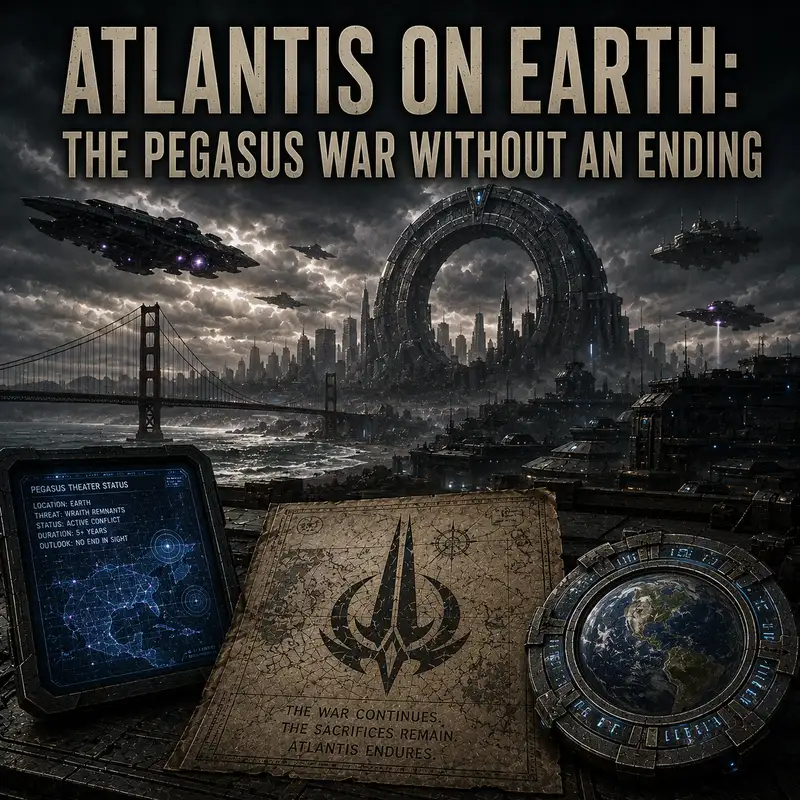
Atlantis floated invisible off San Francisco while the United States Navy quarantined an apparently empty stretch of water around it. Commercial crews had already reported a fireball crossing the North Pacific, and only the city’s cloak kept the final approach from becoming the least manageable public-relations event in the history of classified programs. On a balcony overlooking the Golden Gate Bridge, the expedition’s survivors saw Earth at close range. It looked like a homecoming. Militarily, it was something more complicated: Earth had gained an Ancient city, and the Pegasus galaxy had lost its most important human stronghold.
The destruction of the super-hive saved Earth from culling. It did not end the Wraith war, establish peace in Pegasus, or settle whether Atlantis would ever return. The city had crossed two galaxies because every conventional defense failed. It arrived damaged, short of certainty, and carrying people whose homes, allies, and obligations remained on the other side of the intergalactic void. The central contradiction was immediate. Atlantis had completed the greatest defensive movement in Earth’s history, yet the movement itself looked like a strategic withdrawal from the theater where the expedition had spent years building influence.
The city’s condition limited every political argument that followed. Wraith fire had driven Atlantis into a lower orbit, battered its shield, and forced an uncontrolled atmospheric reentry. Carson Beckett brought the city down over the Pacific, but the landing did not make it ready for another launch. Internal systems had been damaged, power had been consumed at extraordinary rates, and the expedition had just used the stardrive, the shield, Ancient drones, and an experimental wormhole drive in one emergency sequence. John Sheppard’s assessment was simple. Even with the zero-point modules aboard, Atlantis was not going anywhere for a while.
The wormhole drive deserves particular caution. Radek Zelenka used it once after the city’s hyperdrive failed near the edge of the Milky Way. The system moved Atlantis across an enormous distance almost instantly and delivered it near Earth in time to fight. That success did not make the drive a routine transportation capability. The calculations allowed almost no margin for error, the system had not been fielded through repeated tests, and the city’s post-arrival damage prevented immediate reuse. The device worked exactly when required, which is an excellent result for survival and a poor basis for scheduling the next intergalactic deployment.
Earth’s first task was therefore containment rather than celebration. The cloak concealed the city before it approached a heavily populated coastline, and the Navy established a quarantine around the landing area. Aircraft, satellites, commercial shipping, civilian radar, coastal observation, and emergency communications all had to be managed without acknowledging what had fallen from orbit. Atlantis was too large to move into a hangar and too valuable to leave without layered protection. The same city that had hidden from Wraith sensors now depended on naval patrols and classification guidance to remain invisible to fishing boats, news helicopters, and anyone wondering why an empty part of the bay had acquired a security perimeter.
The arrival also created an unresolved command question. Atlantis had been operated by a multinational expedition under international oversight, with American military forces, civilian scientists, foreign personnel, and Pegasus allies sharing one installation. On Earth, the President, Homeworld Command, the International Oversight Advisory, national governments, and the expedition leadership all had legitimate interests in what happened next. The live-action record never shows the final decision. It does show enough to reject the simplest assumption. Atlantis was not merely another American base returning from deployment. It was an Ancient city, an international project, and a strategic asset powerful enough to alter relations among Earth governments.
Every department would have found a reason to keep it. The city contained the largest surviving collection of Lantean systems available to Earth, along with laboratories, transporters, shield technology, a stardrive, a Stargate, control interfaces, and an immense database that human researchers had only partly explored. It also carried zero-point modules recovered through Todd’s assistance. Inspecting those systems beside Earth’s universities, laboratories, shipyards, and secure industrial facilities offered opportunities impossible in an isolated ocean of Pegasus. The procurement difficulty remained familiar. Earth had acquired the platform. It had not acquired the civilization that manufactured its power sources, drones, crystals, and replacement parts.
Atlantis could also replace part of the planetary defense architecture destroyed during the Wraith assault. The Ancient control chair at Area Fifty-One was gone, and Earth’s available battlecruisers had been damaged or scattered. A city protected by an Ancient shield and capable of launching drones represented an extraordinary defensive reserve. Keeping it near Earth would strengthen the homeworld while repairs continued. The disadvantage was concentration. Atlantis, its database, its power modules, its expedition, and a large share of Earth’s remaining Ancient capability now occupied one hidden position near a major city. A fortress can defend the capital. It can also ensure that the capital and fortress become the same target.
Todd made that security problem more personal. He remained in Atlantis custody after the landing, and the screen record does not establish his release, execution, or transfer. He was an invaluable source on Wraith politics, technology, and biology. He was also a commander who had seized the Daedalus, concealed zero-point modules, engineered alliances, and helped create the research program behind the super-hive. Earth had saved itself partly through his intelligence and his hidden power sources. It ended the crisis with a senior Wraith inside the most valuable installation on the planet. There are less complicated ways to conduct a debrief, although few would have produced information of equal value.
For the expedition’s Pegasus-born members, Earth was not a simple destination. Teyla’s people, her political relationships, and much of the world she had spent years defending remained in Pegasus. Ronon’s homeworld had been destroyed, but Satedan survivors and the wider war that shaped him remained there. He told Sheppard that Atlantis itself had become his home, a statement that joined loyalty to place with loyalty to people. The city’s arrival brought the team together on Earth while separating them from the societies that had made Teyla and Ronon essential to the expedition in the first place.
The strategic situation in Pegasus had not been resolved by the loss of one super-hive. That vessel belonged to one Wraith faction and had reached Earth because an exceptional power source, one successful integration program, and intelligence from another reality converged. No evidence showed another hive following it into the Milky Way. That was good news for Earth. It was not evidence that the Wraith population had surrendered or disappeared. The hives remaining in Pegasus retained ships, Darts, feeding grounds, commanders, queens, laboratories, and centuries of experience surviving losses that would have ended a more centralized state.
The Wraith civil war also continued. Too many Wraith had awakened, human populations had not recovered enough to feed them all, and no queen possessed authority over every hive. Alliances could hold for one campaign and collapse when the immediate threat changed. Todd had returned to leadership of one alliance before being betrayed by the underling who seized the super-hive. His captivity on Earth removed him from that political system without determining who inherited his followers or enemies. The destruction of the prototype eliminated one ambitious faction’s advantage. It did not remove the scarcity, rivalry, and territorial competition that had produced the conflict.
That fragmentation made a conventional war termination almost impossible. There was no Wraith capital whose capture would compel every hive to negotiate. There was no universal monarch who could surrender for the species. A treaty with one queen might protect one region while another alliance continued culling nearby worlds. Destroying a faction could reduce immediate pressure and free its competitors to seize the abandoned feeding grounds. Atlantis had learned to exploit these divisions, especially through Todd. It had never created a diplomatic mechanism capable of converting temporary bargains into a galaxy-wide settlement.
The biological cause of the war remained as well. Jennifer Keller’s gene therapy offered the possibility of removing the Wraith need to feed on humans, but the first large trial became a medical disaster. Todd and his crew fell ill, some Wraith became feral, and the organic hive itself began failing with them. Atlantis saved survivors and reversed the crisis, but the treatment was not ready for broad deployment. No safe cure had transformed Wraith society by the time the city reached Earth. The central relationship between Wraith survival and human vulnerability therefore remained intact, along with every political institution built around it.
Several of Pegasus’s other great threats had been removed, but each victory changed the balance rather than producing peace. Michael was dead and much of his hybrid network had been destroyed. The principal Asuran civilization and fleet had been eliminated at Asuras. The Attero device was gone, and the Asgard exiles had lost control of the facility that threatened the gate network. These successes removed enemies capable of exterminating human populations on a massive scale. They also left the Wraith as the largest organized military power still operating across the galaxy. Winning several wars had not eliminated the oldest one.
Human worlds remained exposed to that power. Some had alliances, local weapons, hidden settlements, or experience resisting cullings. Most lacked starships capable of challenging a hive in orbit. The destruction of the Asurans prevented systematic annihilation, but it did not protect a village when the next Dart appeared above its gate. Wraith civil war could make matters worse by encouraging hives to reach feeding grounds before rivals did. Atlantis had reduced the chance of one coordinated conquest while leaving ordinary populations inside a contest among predators. For those worlds, the city’s absence was not an abstract change in basing. It was the loss of the strongest outside force that sometimes answered distress calls.
Atlantis had served Pegasus as more than a weapons platform. It was a reconnaissance headquarters, medical center, scientific laboratory, diplomatic venue, intelligence fusion site, and refuge. Teams moved through its gate, Puddle Jumpers extended their reach, Earth ships used it as a destination and support point, and local leaders knew where to seek assistance or negotiation. The city connected human societies that otherwise shared little more than fear of the Wraith. Removing it from Pegasus did not erase those relationships, but it deprived them of the physical center around which cooperation had slowly formed.
The expedition’s intelligence picture would deteriorate first. Wraith movements, Genii politics, Traveler reports, trading rumors, and distress calls all depended on sources distributed across the galaxy. Atlantis collected those fragments, compared them, and dispatched teams before a local incident became a strategic surprise. Earth could still receive reports through ships or exceptional gate connections, but response time would increase. A Wraith alliance could change leaders, a human world could disappear, or a laboratory could relocate long before a battlecruiser completed the intergalactic journey. Distance does not merely slow reinforcement. It makes yesterday’s intelligence look current until somebody arrives and discovers otherwise.
Earth still possessed space forces, but the final battle demonstrated their limits. The Daedalus was crippled in Pegasus. The Sun Tzu was badly damaged, and the Apollo had lost propulsion while rescuing its crew. The Odyssey was committed elsewhere. Those ships could be repaired, rotated, and redeployed, but none replaced a permanent city with a Stargate and local aircraft. Battlecruisers were scarce strategic assets supporting missions in more than one galaxy. Using them to sustain a reduced Pegasus presence meant accepting fewer ships for Earth defense, Milky Way contingencies, transport, and every emergency that senior headquarters had not yet placed on the schedule.
The gate network could not simply erase that logistical problem. Routine travel from Earth to Pegasus required either a functioning intergalactic bridge, which no longer existed, or power and circumstances beyond normal gate operations. Atlantis carried a gate and zero-point modules, but the live-action record does not show the post-landing procedure for using them to restore a stable expeditionary link. Even if personnel could be sent, heavy equipment, replacement ships, large stores, and city-scale repairs still required industrial capacity and transport. The Stargate remained extraordinary strategic mobility. It was not a tow truck for an Ancient city.
Local allies therefore faced a new degree of autonomy. Ladon Radim’s Genii retained the most organized human military state known in Pegasus, but their cooperation with Atlantis had always been pragmatic and incomplete. The Travelers still possessed ships and regional intelligence, yet they had lost a colony, thousands of people, and their recovered Ancient warship. Athosian survivors had endured displacement, abduction, and experimentation. None of these societies had agreed to become Earth’s substitute garrison. They had their own governments, losses, and reasons to distrust promises made by a city that was no longer in the galaxy.
The Genii might expand into the vacuum, using their hidden industry, nuclear expertise, and intelligence networks to offer protection on terms favorable to themselves. The Travelers might preserve trade and evacuation routes without accepting permanent territorial responsibilities. Wraith factions could court, threaten, or infiltrate the same worlds. Atlantis had often acted as though its presence created a balance among these powers. Its removal gave each participant an opportunity to renegotiate that balance. A strategic withdrawal rarely leaves empty space. It leaves space that everyone else begins measuring.
This created the central policy dispute Earth never resolved on screen. Keeping Atlantis near the homeworld protected the most valuable human population, allowed repairs beside Earth’s industrial base, and placed Ancient technology under direct international oversight. Returning it to Pegasus restored a forward base, honored commitments to local allies, and kept the primary Wraith conflict far from Earth. Both positions were defensible. Both imposed risk on people who had little influence over the decision. The issue was not whether Atlantis belonged on Earth or in Pegasus in some abstract sense. It was which population would carry the danger created by placing it elsewhere.
The argument for keeping the city was strongest immediately after the assault. Earth’s chair weapon had been destroyed, its fleet was damaged, and the enemy had demonstrated that the homeworld could be reached. Atlantis provided a shielded platform, drones, sensors, laboratories, and a surviving command team with direct experience of the attack. Repairs could proceed under naval and Homeworld Command protection. Removing the city again before understanding its damage would risk losing it between galaxies, as nearly happened during both major relocations. A cautious government does not normally approve another flight by a city that has recently fallen out of orbit.
The argument for returning was strategic rather than sentimental. Pegasus contained the Wraith fleets, human allies, intelligence sources, and unresolved obligations that made Atlantis useful in the first place. A city held permanently near Earth could become an exceptionally advanced research installation while ceasing to perform its expeditionary mission. It would also leave the Wraith free to rebuild without the one opponent able to combine Ancient systems, Earth warships, local diplomacy, and gate-based operations. Defending Earth only at Earth surrendered the depth that had allowed the expedition to identify threats before they crossed the intergalactic void.
Control of the city would have shaped the decision as much as military logic. The International Oversight Advisory had already replaced expedition leaders, reviewed operations, and asserted multinational authority over the program. The United States supplied much of the military security and now controlled the waters around Atlantis. Other governments had personnel, investments, and legitimate claims to access. The exact bargaining is not shown, so any detailed settlement would be speculation. The likely issue is clear. Every government could support shared stewardship in principle, especially until the discussion reached who controlled the shield, the Stargate, the database, and the zero-point modules during an emergency.
Secrecy placed a practical limit on prolonged basing near San Francisco. The cloak could hide Atlantis visually, but maintaining a naval quarantine, controlling air and sea traffic, masking energy signatures, supporting a large expedition, and moving supplies would create patterns. Commercial crews had already seen the reentry fireball. Satellites and governments outside the Stargate Program would eventually notice unusual restrictions or missing data. Earth had hidden Cheyenne Mountain by placing the gate inside an existing military installation. Hiding a city in coastal waters required a security operation the size of the object being concealed, which was not a reassuring measurement.
The later live-action record does not settle the issue. Rodney McKay and Richard Woolsey appeared again in an Earth-led operation involving the Destiny expedition, showing that both remained active within the wider Stargate system. Their appearance did not establish where Atlantis was based, whether the city had been repaired, or whether a permanent Pegasus mission resumed. A planned continuation would have sent Atlantis back toward Pegasus, but that story was never produced. It belongs to unproduced material, not the prime historical record. The last canonical position of the city remains on Earth under cloak and naval quarantine.
That unresolved status is appropriate to the war Atlantis had entered. The expedition defeated individual hives, survived sieges, broke Asuran power, stopped Michael, destroyed the Attero device, and saved Earth. None of those victories created a political order capable of protecting Pegasus after the city left. The Wraith remained divided but alive. Human worlds remained scattered. Earth remained powerful enough to intervene and too limited to guarantee every settlement. Atlantis had become a weapon, a capital, a home, and an obligation. Moving it solved one emergency by transferring all four roles to another galaxy.
The final view of the Golden Gate Bridge was therefore not the end of the Pegasus war. It was the clearest image of its unfinished character. The expedition stood together, alive after a campaign that had nearly destroyed two civilizations and carried the enemy to Earth. Beneath them, Atlantis was safe enough to hide and damaged enough to stay. Beyond them, Earth waited with political authority, industrial resources, and new reasons to fear the sky. In Pegasus, gates still opened onto worlds that no longer had the city nearby. Atlantis had come home. The war that made it necessary had not.