First Strike: Earth Attacks the Asuran Homeworld
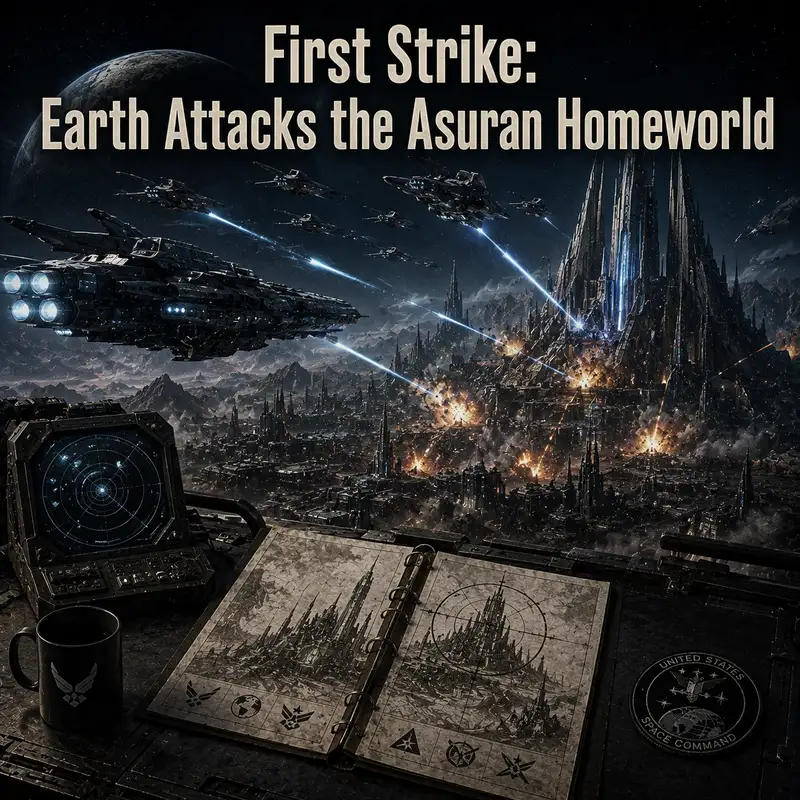
The Apollo emerged from hyperspace uncomfortably close to Asuras with its bomb bay already open. Colonel Abraham Ellis wanted no delay between arrival and launch. Below the ship lay an expanding Asuran military complex and a fleet of Aurora-class warships still under construction. Inside the Apollo, Rodney McKay completed the final sequence for Horizon, a custom weapons platform carrying six Mark Nine nuclear warheads and four decoys. He asked whether this was the right thing to do. Ellis answered by ordering the strike. Seconds later, six nuclear clouds rose above the Asuran homeworld.
The attack was tactically efficient, politically authorized, and strategically incomplete. Earth destroyed the visible ships and most of the selected secondary targets before the Asurans could respond. It did not destroy the machine civilization that had built them, eliminate its industrial base, or prevent retaliation. The question behind First Strike is therefore not whether the bombs hit. They did. The question is why Earth chose a limited preemptive attack against a self-replicating enemy, and why a mission judged successful on the Apollo’s bridge nearly resulted in the destruction of Atlantis.
Earth’s concern was not hypothetical. The Asurans had already demonstrated hostility, seized Atlantis after returning Lanteans reclaimed the city, killed those Ancients, and attempted to hold the installation. They possessed Ancient-derived technology, working zero-point modules, city-ships, drones, and bodies that ordinary firearms could not reliably destroy. They also knew the location of Atlantis and, through earlier mind probes, had learned that humans from Earth occupied it. The adversary was sentient, technologically superior, and capable of rebuilding losses that would have crippled a biological state.
After the Asuran occupation, the Daedalus began regular reconnaissance passes near their homeworld. One image taken roughly two months before the strike showed an empty construction zone. A follow-up image from about three weeks before the mission showed the same area crowded with warships. The rate of construction was the most alarming intelligence. Earth did not merely see ships. It saw an industrial system capable of producing a fleet faster than conventional surveillance and diplomacy could comfortably absorb. The Asurans already knew where Earth was, and a completed armada would give them the means to reach it.
What the intelligence did not establish was equally important. No intercepted order identified Earth as the fleet’s destination. No Asuran commander announced a launch date. The ships might have been intended for Atlantis, the Wraith, homeworld defense, or a campaign not yet selected. John Sheppard believed a fleet that large was meant for Earth because Atlantis alone did not require so many vessels. The International Oversight Advisory reached the same assessment. That was a reasonable warning judgment. It was not proof of imminent attack. Earth was acting against capability, inferred intent, and shrinking decision time.
The available alternatives all carried serious risk. Elizabeth Weir wanted to open negotiations and use the delay to complete a planet-wide anti-Replicator weapon under development at Area Fifty-One. The concept followed an Asgard system capable of disrupting Replicator bonds across an entire planet. Earth scientists had not yet made their version operational. Waiting might produce a decisive weapon, or simply allow the Asurans to finish the fleet first. Negotiation might reveal intentions, buy time, or warn Oberoth that Earth had discovered the buildup. The decision was not between a safe diplomatic option and a reckless military one. No safe option existed.
Earth chose a two-stage strategy. Horizon would destroy key military targets immediately. The planet-wide weapon would later eliminate the larger Asuran threat. Colonel Ellis described the first mission as buying time rather than finishing the war. That distinction was honest and dangerous. A first strike can succeed when it removes the enemy’s ability to answer, creates a durable advantage, or opens space for a political settlement. Horizon was expected to do none of those things by itself. It was the opening half of a campaign whose decisive second weapon was still being developed and had no guaranteed completion date.
The command arrangement made the decision harder to challenge. Ellis arrived aboard the new Apollo with orders already issued through Earth’s military and international oversight structure. He informed Weir that the strike would begin in twelve hours. He did not request her approval. Weir contacted Richard Woolsey and General Jack O’Neill in an attempt to stop it, but neither reversed the mission. Atlantis was her command, and any Asuran retaliation would probably fall on her people. The operation against Asuras, however, belonged to Ellis. The division between local responsibility and external authority had rarely been more obvious.
Their disagreement concerned more than personality. Ellis described the Asurans as a weapon rather than a people. Weir argued that sentience made negotiation necessary even if their origin had been military. Both positions contained operational consequences. Treating the Asurans as equipment made destruction easier to authorize and surrender less relevant. Treating them as a political society required considering factions, motives, deterrence, and the possibility that attacks would strengthen Oberoth’s control. Earth had already learned that individual Asurans could dissent. The first strike nevertheless targeted the collective as one hostile military system.
The Apollo could carry the mission to Asuras, but it could not defeat the expected fleet in a conventional battle. Horizon compensated for that gap. The platform packaged six tactical nuclear devices and four decoys into one rapid delivery system. Its purpose was not to destroy nanite bodies one at a time. Asuran warships and shipyards were built from conventional material, even though their crews were machine beings. Hulls, launch facilities, power systems, and construction areas could therefore be destroyed by sufficient explosive force. Earth was attacking the industrial products of the collective rather than the nanites directly.
The decoys gave Asuran defenses ten incoming objects to assess during a very short approach, while the six real warheads separated toward assigned targets. The screen record does not establish the exact yield of each weapon, the guidance method, or the detailed target list. It does establish that the aim points included major ship construction areas and associated military facilities. This was a counterforce nuclear strike rather than an attempt to crack the entire planet. That limitation reduced the scope of destruction. It also guaranteed that millions of Asurans, functioning infrastructure, and surviving code would remain after the explosions.
McKay and Radek Zelenka performed the final technical inspection. For a moment, they considered reporting a false fault or making the platform genuinely unready. They abandoned the idea because the reconnaissance images were real. Sabotaging Horizon could preserve the chance for diplomacy, but it could also leave Atlantis facing a completed Asuran armada. Their decision captured the moral pressure placed on technical personnel in strategic operations. They did not select the policy or command the ship. Their certification made the policy executable, and refusing certification without an actual defect would have been its own unauthorized strategic decision.
Sheppard joined the operation to conduct battle-damage assessment from a cloaked Puddle Jumper. The mission profile was designed to minimize exposure. Apollo would emerge close to Asuras, release Horizon immediately, deploy Sheppard after detonation, and leave the system before an organized response. The Jumper could remain hidden, observe the target area, and be recovered later. This separated strike delivery from assessment and prevented the Apollo from lingering above a planet whose surviving defenders might adapt quickly. It also meant the ship responsible for the attack would be gone while one officer remained behind to determine what six nuclear weapons had actually accomplished.
Ellis began launch preparation while the Apollo was still in hyperspace because the exit point placed the ship near the planet. Once the battlecruiser returned to normal space, Horizon dropped clear, accelerated into the atmosphere, and divided into its component vehicles. All six warheads detonated. There was no prolonged exchange of fire and no visible Asuran interception. From a tactical perspective, surprise was complete. The Apollo left, Sheppard observed the aftermath, and later analysis reported that every primary target and most secondary targets had been incinerated. Earth had achieved the mission assigned to the strike force.
Battle-damage assessment was less precise than the official satisfaction suggested. Radiation interference made exact measurements difficult. The reconnaissance confirmed the destruction of ships and large sections of the target area, but it could not count every surviving nanite, identify every duplicate of a senior Asuran, or determine how quickly the industrial system could rebuild. An ordinary state might lose trained crews, engineers, archives, and command personnel permanently in such an attack. The Asuran collective could reproduce bodies, share information through subspace, and restore individuals from patterns retained elsewhere. Physical destruction and institutional destruction were not equivalent.
The strike therefore produced a clear tactical success and an uncertain operational result. Earth removed the fleet visible in the reconnaissance photographs and reduced the immediate number of ships available for a possible attack on the Milky Way. It did not establish space superiority over Asuras, occupy the construction zones, blockade raw materials, or maintain surveillance close enough to prevent recovery. No follow-on force remained in the system. Horizon had conducted a raid, not a campaign. The difference became important almost immediately because the surviving Asurans retained the initiative after the Apollo departed.
Ellis viewed the result through Earth’s defensive requirement. Whatever happened next in Pegasus, the armada shown in the photographs could no longer attack Earth. That was true in the narrowest sense. Weir viewed the same result from Atlantis, the nearest known human target and the location most closely associated with the Asurans’ grievance against the Ancients. Earth had transferred risk rather than eliminated it. The homeworld gained time. Atlantis inherited the enemy’s first opportunity to retaliate. Strategic distance made those outcomes look different depending on which command center was receiving the briefing.
The political cost appeared before the counterattack. Weir had the highest clearance available to the expedition, yet the strike had been planned without her consultation. She believed parts of the military establishment distrusted civilian command and stepped over her whenever a crisis became serious. Ellis later apologized for crossing command boundaries, but the damage was institutional. Atlantis had been treated as both the source of essential expertise and a forward base whose leader did not control the operation most likely to endanger it. Coordination had become notification, delivered twelve hours before nuclear release.
The Asuran response arrived soon after the strike force returned. A small object emerged from hyperspace and settled into geosynchronous orbit above Atlantis. It appeared to be a satellite until the central structure became visible. The Asurans had mounted a Stargate inside an automated weapons platform equipped with navigation, shielding, and a hyperdrive. Whether the entire system had existed before Horizon or was assembled in response is not established. Its rapid appearance proved that destroying the visible shipyards had not removed Asuran engineering capacity or their ability to conduct an immediate long-range operation.
When the satellite’s Stargate activated, a sustained energy beam passed through from Asuras. The weapon first struck the Apollo’s shield, forcing Ellis to move the ship away, then rotated toward the planet and locked onto Atlantis. Missiles could not penetrate the satellite’s defense because the incoming beam also powered its shield. The weapon carried only enough internal energy to travel, maneuver, and protect itself until the wormhole opened. After that, the homeworld supplied both the attack and the protection. Earth had struck Asuran industry at close range. The Asurans answered without risking another fleet.
The system also turned the Stargate network into a blockade. Because the active satellite gate was close to Lantia, Atlantis could not establish its own connection. The expedition lost its normal evacuation and reinforcement route at the moment the shield began absorbing continuous fire. Sheppard initially hoped the wormhole would close after the normal thirty-eight-minute limit. McKay recognized the exception. With enough energy fed through the connection, a Stargate could remain active far longer. The weapon was not merely a beam in orbit. It combined bombardment, protected power transmission, evacuation denial, and control of the local gate environment.
The Apollo could not simply return fire until the problem went away. Its first contact with the beam had already drained much of its shield strength. The satellite’s shield weakened only slightly under attack and recovered from the same energy sustaining the weapon. A nuclear strike against the platform was unlikely to pass through. Returning to Asuras to attack the source risked a damaged battlecruiser against whatever defenses had survived Horizon. The operation that began with Earth exploiting surprise ended with the Asurans creating a target that firepower alone could not solve.
Weir attempted the negotiation she had wanted before the strike. Oberoth answered from Asuras and confirmed that the weapon would not be disabled. He treated the bombing as justification for neutralizing Atlantis. The communication itself became hostile when the Asurans tried to upload malicious code through the channel, forcing McKay to sever the link. The exchange did not prove that earlier diplomacy would have succeeded. Oberoth had attacked Atlantis before and had little reason to trust Earth. It did prove that the first strike had produced no political mechanism for stopping escalation once the bombs landed.
McKay calculated that the city’s shield would fail in twenty-nine hours if the beam continued. Atlantis could not dial out, could not move personnel through the local gate, and could not destroy the satellite. Every surviving member of the expedition had become dependent on one zero-point module whose energy was being consumed continuously. Horizon had been authorized to prevent a future fleet from threatening Earth. Its immediate consequence was a siege against a city with a finite power reserve. The strategic risk had changed from possible intergalactic attack to a measured countdown on the Atlantis control-room display.
The first response was to submerge Atlantis, repeating the method the Ancients had used against Wraith bombardment. Water would attenuate the beam and reduce the energy reaching the shield. The city reached the ocean floor, but the Asuran weapon cut through the water far more efficiently than expected. Three hours of preparation bought roughly nine additional hours. The solution was not useless. Nine hours can be the difference between rescue and extinction. It was not enough to sustain the city, and the continuing beam could track Atlantis anywhere on the planet.
Sheppard and McKay concluded that survival required leaving Lantia. The underwater drilling station could provide about ninety percent of the initial power needed to launch the city, while the zero-point module supplied the remainder and supported flight after the umbilical connection broke. The shield, however, was already consuming the power required by the stardrive. Major Evan Lorne led F three-oh-two fighters to tow a large fragment from the moon’s debris into the beam’s path. The improvised obstruction needed to hold for only about a minute. That was a generous estimate by emergency engineering standards and a very short one by geology.
Nonessential personnel transferred to the Apollo while Sheppard took the control chair. Atlantis rose from the ocean floor and reached the surface under continued fire. When the asteroid fragment interrupted the beam, McKay redirected shield power into the stardrive. The city initially stalled, forcing Weir to authorize lowering the shield during ascent so the engines could receive enough energy. Atlantis began flying, but the beam burned through the rock before the shield fully closed again. It grazed the central tower, shattered the control-room windows, injured personnel, and left Weir with a severe head injury.
Atlantis entered hyperspace and escaped the satellite’s range, but the victory remained incomplete. The city dropped out of hyperspace before reaching its selected destination, damaged and short of power in deep space. The Apollo could not immediately locate it. The expedition had survived the Asuran counterstrike by abandoning its planet, exhausting critical systems, damaging the drilling station, and accepting casualties in the command center. A mission intended to protect Earth from a possible future attack had displaced Earth’s most important base in Pegasus and nearly killed its civilian commander.
None of this makes the original threat imaginary or Weir’s preferred approach certain to work. The Asurans had already killed Lanteans, occupied Atlantis, and begun producing a large fleet at extraordinary speed. Earth leaders were entitled to treat that capability as dangerous. Waiting for a perfect weapon might have left them facing dozens of completed warships. The failure was not simply that force was used. It was the mismatch between the objective and the means. Earth attacked an industrial target as though destroying the current inventory would neutralize a civilization designed to replicate, learn, and answer.
A sound first strike required a plan for the surviving enemy. That might have meant a ready planet-wide weapon, persistent surveillance, immediate follow-on attacks, a protected Atlantis evacuation route, or defenses prepared for asymmetric retaliation. Earth had none of those measures in place when Horizon launched. The strike package was technically mature. The larger campaign was not. Six warheads could remove six sets of aim points. They could not supply political intelligence, block a remote Stargate weapon, preserve Weir’s authority, or guarantee that Asuras would respond in the form Earth had prepared to fight.
First Strike succeeded exactly where its planners were most confident. Horizon functioned, the Apollo reached the target, surprise held, and the visible armada burned. It failed where the intelligence was weakest. Earth did not know the Asurans’ immediate intentions, the depth of their surviving industry, or the counterattack they could mount without using a fleet. The operation bought time for Earth by spending Atlantis’s security. The image that defines the campaign is not the nuclear clouds above Asuras. It is Atlantis lifting through its own shield as the retaliatory beam reached the tower, escaping the enemy Earth had wounded but had not defeated.