Klorel, Skaara, and the Assault Force Built for Earth
Klorel stood above Earth with a direct order from Apophis. His ship was to burn the first city. Below him, the planet had no spacecraft capable of reaching his position, no shield capable of protecting a population center, and no weapon known to penetrate a Goa’uld mothership. The command appeared simple because the military problem appeared solved before the firing began. Yet Klorel was not alone inside the body issuing that order. Skaara, the young Abydonian taken as an unwilling host, was still conscious, still resisting, and still capable of interfering with the assault. Earth’s first battle in space would turn on a conflict happening inside one human body.
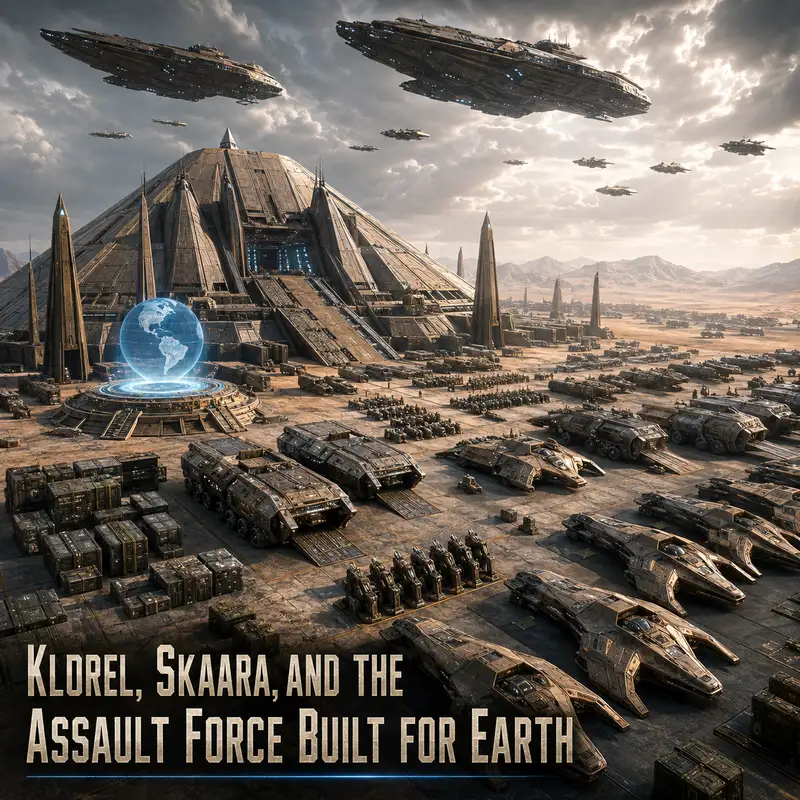
The assault force assembled for Earth was small by the standards of an interstellar empire. It consisted of two Ha’tak motherships under Apophis and his son, supported by Jaffa crews, heavy shipboard weapons, defensive shields, and large complements of death gliders. The surviving record gives no formal Goa’uld operations order, no exact troop strength, and no complete targeting list. Its behavior nevertheless reveals the mission. This was not a carefully prepared occupation with administrators, garrisons, and a plan for governing billions of people. It was a punitive extermination strike intended to destroy Earth’s major cities, eliminate the Tau’ri as a threat, and demonstrate that resistance to Apophis brought annihilation.
Klorel’s place in that force began on Chulak. Skaara had been captured during Apophis’s raid and selected as the host for a Goa’uld symbiote. The symbiote was Klorel, the son of Apophis. Goa’uld parentage was biological, political, and ceremonial at the same time. Apophis had fathered Klorel through a queen and then selected the body in which his son would rule. To Apophis, Skaara was not a prisoner with legal or moral claims. He was the living vessel through which a dynastic heir could command soldiers, receive worship, and participate in imperial war.
For Skaara, the arrangement was captivity without the privacy of being alone. Klorel controlled the body, accessed the host’s memories, used his face, and spoke through his voice. Skaara remained present but suppressed. That distinction matters because the Goa’uld repeatedly claimed that nothing meaningful survived implantation. Klorel made precisely that claim when Jack O’Neill tried to reach his friend. The claim was propaganda as much as intimidation. Skaara’s later actions showed that the host had not disappeared. He had been denied control, not erased.
Klorel also represented the way Apophis organized political power. The Goa’uld did not operate as a single professional military under an impersonal state. Authority rested in rulers who combined religious claims, personal loyalty, family relationships, and armed force. Apophis placed one mothership under Klorel and ordered its Jaffa to obey his son as they would obey him. That gave the assault a two-ship command structure built around father and heir. It also imported every weakness of dynastic politics into the formation. A son could be a trusted subordinate, a rival claimant, or both, sometimes before lunch.
The two Ha’taks gave Apophis overwhelming local superiority. Their shields could absorb weapons far beyond anything Earth had previously fielded. Their shipboard systems could attack from orbit, beyond the reach of conventional aircraft and ground forces. Their death gliders provided atmospheric strike capability, interception, and close support if the Goa’uld chose to descend or pursue surviving targets. Jaffa aboard the ships supplied internal security, flight crews, boarding forces, and troops for any limited ground action. Against a planet with no armed spacecraft, two capital ships were not a token force. They were more than enough to begin destroying civilization while remaining almost untouchable.
Klorel’s vessel carried an additional capability that was unusual even to Teal’c. A Stargate and dial-home device had been installed aboard the ship. Most Goa’uld vessels he knew did not carry gates, and he regarded the ship’s systems as unfamiliar. The purpose of the onboard gate is not fully established. It may have supported cargo movement, personnel transfer, or rapid access while the ship remained at a usable point of origin. Whatever Apophis intended, the gate created a narrow vulnerability. It allowed S G One to enter the ship before launch. Later, it allowed Daniel Jackson to escape. Advanced logistics had produced an excellent doorway and a very poor surprise for the people who owned the ship.
The operational concept relied on strategic surprise and technological asymmetry. The ships traveled through hyperspace toward the solar system, emerged near Saturn, and continued toward Earth before most governments even understood that objects were approaching. Once in orbit, Apophis could strike cities from above. Earth’s armies, aircraft, armored formations, and naval forces had no practical way to engage him. The Stargate iris protected one underground room from incoming travelers. It did nothing against a warship in space. Apophis did not need to defeat every national military in detail. He could bypass them and attack the political, economic, and population centers they existed to defend.
Earth possessed one warning, and it came from an alternate reality. Daniel had seen another Earth under Goa’uld attack and returned with the gate coordinates associated with the assault’s point of origin. His account was extraordinary, difficult to verify, and politically inconvenient. At the same moment, Senator Robert Kinsey had forced the shutdown of the Stargate Program. General George Hammond had appealed through the Secretary of Defense, the Joint Chiefs, and the President, but the political decision stood. Earth was preparing to bury the only system that had provided warning of the force already on its way.
S G One responded with an unauthorized mission. O’Neill, Samantha Carter, Daniel, and Teal’c dialed the coordinates from the alternate reality and sent a reconnaissance probe through. The destination appeared dark but clear. They crossed before base security could stop them. Officially, they had violated direct orders. Operationally, they were the only available team acting against a threat that national leadership had not accepted in time. The distinction would have mattered greatly at a court-martial, assuming there was still a court, a military, or a continent on which to hold it.
The destination was not a planet. The team had gated into a compartment aboard Klorel’s mothership while it was still in a position that allowed the address to work. Once the ship launched and entered hyperspace, Earth could not redial the same location. The changing point of origin made the route invalid. S G One was trapped aboard a moving enemy capital ship, without reinforcement, extraction, or reliable knowledge of the vessel’s layout. The gate had given them strategic reach, but not logistical depth. Everything they could use had to be carried on their bodies or taken from the enemy.
The discovery of a hangar filled with death gliders confirmed the mission. This was an attack ship, and it was moving toward Earth much faster than Carter’s first estimate. The team divided its effort. Carter and Daniel began placing C four where they believed it could trigger secondary explosions. They targeted the glider area, the gate room, and other critical spaces. O’Neill and Teal’c went after Klorel. Carter correctly recognized that O’Neill’s decision was emotional. Skaara had been his friend on Abydos. O’Neill also understood that capturing the enemy commander could disrupt the ship, produce intelligence, and perhaps give Skaara a chance to fight back. Personal loyalty and operational logic pointed in the same dangerous direction.
Klorel’s response exposed the central lie of Goa’uld hosting. He insisted that Skaara no longer existed and that the host had surrendered willingly to protection. O’Neill did not accept the claim. After one shot from a zat’nik’tel, Klorel lost control long enough for Skaara to surface. Skaara recognized O’Neill, spoke of Sha’re and Daniel, and asked forgiveness for what the ship was about to do. He could not stop the assault, but he could warn the people trying to stop it. The host was not a passive container. He was a suppressed source of intelligence inside the enemy commander.
That moment changed the meaning of every later action aboard the ship. When Klorel halted the immediate execution of O’Neill and Teal’c and took them to the bridge, Skaara’s influence was possible, although the record does not prove exactly how much control he exerted. When Klorel tried to kill Daniel with a hand device, O’Neill faced a decision with no clean answer. He could preserve Skaara’s body and allow Klorel to kill Daniel, or shoot his friend to stop the symbiote. O’Neill fired. Klorel fell, and Skaara fell with him.
The shooting did not end Klorel’s role in the campaign because Goa’uld command included a technology Earth could not yet counter. Klorel was placed in a sarcophagus. The device repaired the damage and restored him to life. That recovery took time, and time became the one resource Earth had not expected to receive. Apophis held the ships outside immediate attack position while his son recovered. The pause lasted approximately eighteen hours. A wound inflicted during a failed rescue therefore delayed the planetary strike long enough for Stargate Command to mobilize, begin evacuation, and prepare its only experimental weapons.
The delay also allowed Master Bra’tac to act. Bra’tac had infiltrated the campaign after regaining Apophis’s trust. He had not joined because he believed Earth could defeat the assault in a conventional battle. He intended to exploit the political structure of the Goa’uld force. Once fighting began, he planned to lead Klorel’s wing against Apophis and make the attack appear to have been ordered by the son. Apophis would retaliate, suspicion would replace coordination, and the two rulers might destroy one another. It was a plan based less on firepower than on the reliable insecurity of tyrants.
Bra’tac explained that Goa’uld rulers were often challenged by their sons. That made the father-and-son command arrangement both useful and unstable. Apophis wanted Klorel beside him as heir, symbol, and subordinate commander. Bra’tac saw a fault line that could be opened with a single false act of betrayal. His immediate rebel force was tiny, only three trusted Jaffa before Teal’c joined them. They could not defeat two Ha’taks in a direct engagement. They might still provoke the commanders into doing the work themselves. The plan was daring, politically informed, and dependent on Klorel remaining alive and unsuspecting.
S G One’s assault on Klorel disrupted that scheme. The attack on the son gave Apophis and Klorel a common enemy at the exact moment Bra’tac wanted to divide them. Yet the same action created the delay that made another plan possible. This was the campaign’s recurring pattern. Every solution damaged something else. Capturing Klorel endangered Skaara. Shooting Klorel united father and son but delayed the attack. The sarcophagus restored an enemy commander but bought Earth time. In a well-run operation, planners prefer fewer contradictions. This was not a well-run operation. It was simply the operation available.
On Earth, the warning arrived through deep-space radar as two large contacts passing Saturn. Hammond converted Stargate Command into a command-and-control center and requested full military alert. The Pentagon initially preferred not to reveal that Earth had detected the ships, hoping to preserve surprise for a counterstrike. That decision left national forces vulnerable on the ground and delayed public warning. It also reflected an uncomfortable truth. Conventional mobilization could not solve the orbital problem. Alerting every fighter squadron on Earth would not give any of them the altitude, weapons, or shields required to engage a Ha’tak.
Earth’s only direct response came from Area fifty-one. Two experimental Mark twelve A warheads had been enriched with naquadah recovered by an SG team. The projected yield exceeded one thousand megatons each. The missiles were launched from Vandenberg Air Force Base after the Goa’uld ships entered geosynchronous orbit over the United States. This was an extraordinary increase in destructive power, but yield was not the same as access. Apophis detected the weapons and allowed them to approach. Klorel hesitated while activating his shield, and the evidence strongly suggests Skaara was resisting again. Klorel forced control at the last moment. Both warheads struck the energy barriers and caused no damage.
The failed strike demonstrated the gap between possessing alien material and possessing an alien weapons system. Earth had integrated naquadah into a familiar warhead, but it had not solved targeting, shield penetration, or space control. The detonations produced an electromagnetic effect that degraded satellite communications, making public warning more difficult. Earth’s most powerful weapons had failed to harm the enemy and had complicated its own communications. The device had worked exactly as designed. The operational concept surrounding it had not.
Hammond therefore continued the Alpha Site evacuation. Selected military personnel, scientists, technicians, and specialists moved through the Stargate to preserve a fragment of human capability if Earth fell. This was not a plan to save the population. It was continuity of civilization on the smallest scale available. The gate could move people rapidly, but only through one underground chokepoint and only in limited groups. There was no time to evacuate nations. The assault force had reduced planetary defense to two grim questions. Could someone stop the ships, and if not, who would be sent away to remember what had been lost?
Klorel’s resurrection ended the pause. The two Ha’taks moved into attack position. Apophis ordered his son to destroy the first city. Klorel admitted that the host was strong and asked for more time in the sarcophagus, another sign that Skaara’s resistance affected command performance. Apophis refused. Dynastic expectation now pushed the wounded commander forward. Klorel was not merely a ship captain carrying out a fire mission. He was the son who had to prove himself before his father by destroying the world whose soldiers had helped Skaara overthrow Ra.
Bra’tac and S G One seized Klorel’s bridge by using his trusted position to approach without immediate challenge. During the fight, Daniel was struck by a staff weapon and left critically wounded. O’Neill wanted to carry him, but Daniel understood that the team had minutes before the C four detonated. He remained behind while the others took Klorel hostage and used the transport rings to enter Apophis’s ship. The human cost of the assault was no longer abstract. Saving Earth required O’Neill to leave one friend bleeding on an enemy deck after already shooting another.
The team could not destroy Apophis’s ship with the explosives already planted on Klorel’s vessel because the second Ha’tak’s shields would protect it. Bra’tac supplied the missing operational solution. He had directed Klorel’s ship closer to Apophis’s. On the second vessel, he damaged the controls and trapped the two Goa’uld rulers on the bridge. O’Neill then dropped his final grenades into the shield generators. The weapons were crude compared with Goa’uld technology, but they were used inside the protection they could never penetrate from outside. Once the shield failed, Klorel’s approaching ship and its C four charges became a weapon against both vessels.
This was not a victory of superior technology. It was a victory of access, sabotage, and internal intelligence. Teal’c knew Goa’uld procedures. Bra’tac knew the commanders and the ship. Carter understood how to create secondary explosions with limited explosives. Daniel recognized the gate as an extraction route once the ship was close enough to Earth to use a valid point of origin. O’Neill kept changing the plan as each assumption failed. The assault force had been designed to defeat Earth’s visible military systems. It had not been designed to survive a rebellion inside its own command structure.
Apophis and Klorel escaped the doomed bridge through transport rings. The immediate destination was not shown, but their later survival confirmed that they cleared the ships before impact. Daniel reached a sarcophagus, recovered enough to move, and dialed the Alpha Site through the onboard Stargate seconds before the charges detonated. O’Neill, Carter, Teal’c, and Bra’tac escaped in two death gliders. Klorel’s Ha’tak collided with Apophis’s unshielded vessel, and both ships exploded above Earth. The damaged gliders would have burned in the atmosphere, but the space shuttle Endeavour located them and brought the survivors home.
The destruction of the assault force saved Earth, but it did not free Skaara. Klorel remained in control after escaping. Much later, while fleeing forces loyal to Heru’ur, his death glider crashed on Tollana. Injury again allowed Skaara to emerge and request protection. A Tollan legal proceeding treated Skaara and Klorel as separate claimants rather than pretending that possession settled ownership. The judgment recognized Skaara’s right to his own body, and Tok’ra specialists removed Klorel. The commander who had nearly burned Earth was finally separated from the prisoner whose resistance had repeatedly compromised the attack.
The campaign proved that Apophis had judged Earth’s hardware correctly and its people incorrectly. Two shielded Ha’taks were enough to defeat every conventional defense available at the time. The missiles failed. The planet had no combat spacecraft. Most of humanity never knew the attack was underway. Yet the assault force depended on coerced Jaffa, a captive host, a brittle dynastic relationship, and commanders who believed technological superiority made internal resistance irrelevant. Those were not minor administrative problems. They were the vulnerabilities that destroyed both ships.
Klorel was meant to embody the future of Apophis’s empire. He commanded a capital ship, received worship from Jaffa, and approached Earth as the heir who would prove himself through planetary destruction. Skaara turned that symbol inside out. The body chosen to display Goa’uld power became a source of delay, warning, hesitation, and resistance. Earth survived because a boy from Abydos refused to disappear, because Bra’tac understood the fear beneath Goa’uld family loyalty, and because S G One reached the inside of a force no weapon on Earth could defeat from the outside. The assault had been built for Earth as Apophis understood it. That Earth was helpless. The people aboard his ships were not.