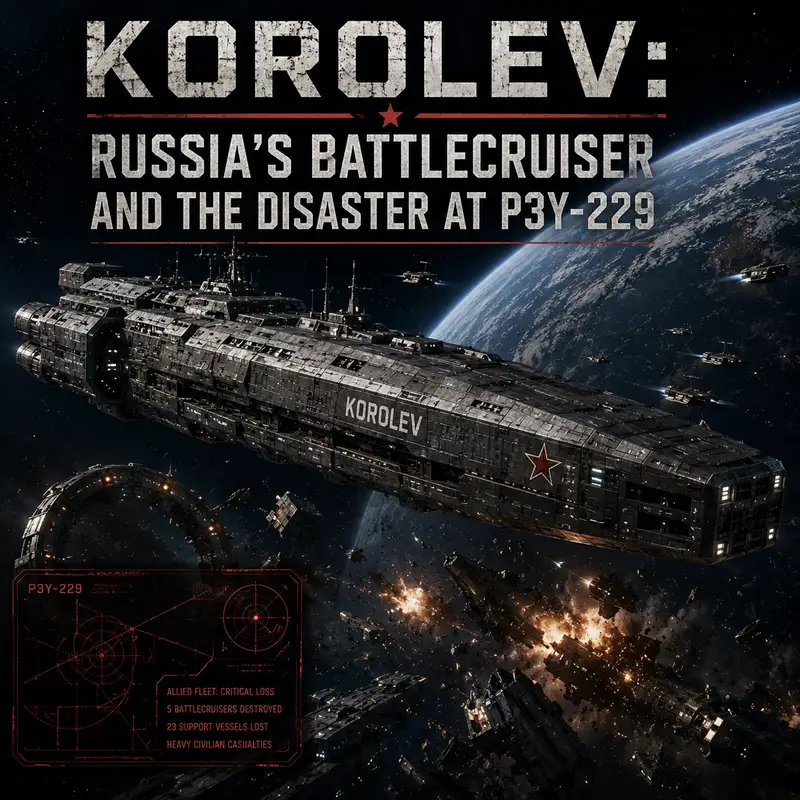
Korolev: Russia’s Battlecruiser and the Disaster at P3Y-229
The Korolev’s final attack began after the ship had already lost the battle. Its shields were failing, power had dropped across the vessel, and Ori weapons were cutting through the allied formation around P three Y two twenty-nine. A Russian sensor officer detected a brief fluctuation in the enemy shields whenever the Ori ships fired. Colonel Chekov ordered a neutron bomb beamed during the fluctuation. When that failed, Daniel Jackson proposed using the ring transporters instead. Chekov ordered the battlecruiser closer. Seconds later, another Ori beam struck the ship, and the Korolev disappeared in fire.
Russia’s first battlecruiser had gone from political bargaining chip to combat loss on its maiden voyage. The destruction is often remembered as proof that the Ori warships were overwhelmingly powerful. That is true, but incomplete. The Korolev also represented Earth’s attempt to turn a secret American program into a shared planetary defense. Its brief service reveals what happened when international politics, accelerated procurement, immature fleet doctrine, and a civilization-level technological threat all arrived at the same point in space.
Russia’s path to the Korolev began years before the ship was built. After recovering the original Giza Stargate from the Pacific, the Russian government operated a separate program and gained leverage over Earth’s access to the network. Later agreements placed the Russian gate at Stargate Command in exchange for money, participation, shared technology, and a recognized Russian role in the program. The arrangement kept one principal gate command under Cheyenne Mountain while giving Moscow a direct stake in discoveries made beyond Earth.
Colonel Chekov became the principal Russian liaison within that arrangement. He could be difficult because his government’s interests were not identical to Washington’s, which is generally why governments employ representatives rather than admirers. He pressed for access to technology, Russian participation in SG teams, and enforcement of the agreements surrounding the Stargate. He also supported continued Air Force control during the first multinational disclosure and later helped avert nuclear war when Goa’uld infiltration compromised senior Russian officials.
By the time the Ori prepared their invasion, Chekov was not an outsider trying to learn what Stargate Command did. He understood the program, its technologies, its political weaknesses, and the degree to which the United States had benefited from operational control. Russia had accepted American leadership because Washington carried much of the financial cost and most of the immediate risk. That bargain became less attractive once Earth began producing battlecruisers capable of crossing galaxies while Russian participation remained concentrated in committees and liaison offices.
The approaching renewal of the Gate Alliance Treaty gave Moscow leverage. Chekov informed General Hank Landry that Russia would reclaim its Stargate and establish a different program, with China prepared to support the new arrangement. The threat would have fractured the international system during the opening stages of the Ori war. It could have produced competing gate commands, conflicting schedules, divided intelligence, and another contest over which nation spoke for Earth beyond the planet.
Washington’s answer was the next B C three-oh-four. The vessel was transferred to Russia so the existing gate arrangement could continue. Landry described the concession as enormous and admitted that the United States had little choice. The latest ship was pushed toward service far earlier than the normal production schedule had suggested. The agreement therefore solved an immediate political crisis by accelerating a military capability that had not yet completed the ordinary path from construction to deployment.
The Russians named the ship Korolev, honoring Sergei Pavlovich Korolev, the chief designer whose work had driven the early Soviet space program. The choice carried more than ceremonial value. Russia was not entering spaceflight for the first time. It was connecting its modern interstellar force to a national tradition built around rockets, orbital missions, and human spaceflight. The name also suited a program still protected by extraordinary secrecy. Korolev himself had spent much of his career known publicly only through the title of chief designer.
Technically, the Korolev belonged to the same class as Daedalus and Odyssey. It was a human-built battlecruiser incorporating Asgard-derived shields, sensors, transport beams, and hyperdrive technology. It carried human weapons, ring transporters, and F three-oh-two aerospace fighters. The design gave Russia a vessel able to travel independently of the Stargate, operate across interstellar distance, deploy fighters, transport personnel, and represent Earth with a degree of force that no SG team could provide alone.
The ship did not yet possess the Asgard plasma beam weapons later fitted to other battlecruisers. At P three Y two twenty-nine, its principal offensive systems remained missiles, railguns, transported explosives, fighters, and whatever improvisation the crew could produce after those methods failed. That configuration was effective against many Goa’uld vessels and useful in mixed operations. It had never been tested against an Ori capital ship because no Milky Way force had previously fought one.
The surviving record does not provide a full crew roster, exact complement, training history, or detailed acceptance report for the Korolev. It shows Russian bridge personnel under Chekov’s command and confirms that the vessel had been rushed into service. It does not establish that an unfinished component or poorly trained crew caused the loss. That distinction matters. A ship can enter battle before its planned schedule and still be destroyed for reasons having nothing to do with the missing months of preparation.
The strategic emergency left little room for a cautious shakedown. A Jaffa vessel investigating unusual energy readings near P three Y two twenty-nine discovered a completed Ori supergate. The planet that had occupied the system was probably destroyed when the Ori created the micro-singularity powering the structure. The gate was already beyond the point where conventional bombardment could break it. Jaffa forces had tried. Their weapons had no effect.
Odyssey was ordered to collect S G One and proceed immediately to the supergate. Daedalus remained committed in the Pegasus galaxy, leaving only the newest Earth ships available for the Milky Way crisis. Korolev was instructed to join Odyssey and whatever Free Jaffa, Tok’ra, Asgard, and other allied assets could be assembled. Earth had built several advanced vessels, but geography had already divided them. The first intergalactic war found the fleet operating on an intergalactic schedule.
Before joining the task force, Korolev collected Daniel Jackson and Cameron Mitchell from the world known as Camelot. They had been searching for Merlin’s weapon against the ascended Ori and had found evidence pointing toward the Sangreal, but not the weapon itself. Their arrival placed two members of S G One on Chekov’s bridge just as the ship approached the largest fleet action Earth had ever attempted.
The allied plan had two branches. If the supergate could be destroyed, the invasion route would close. If destruction remained impossible, Samantha Carter and the Asgard scientist Kvasir would alter the control system and dial outward before the Ori could establish an incoming connection. A stable outbound wormhole might deny the enemy use of the gate. Carter began an extravehicular operation on one of the massive gate segments to install the replacement crystal.
Korolev dropped out of hyperspace while Carter was still beside the supergate. The structure activated before her modification initialized. Interference prevented Odyssey from transporting her back, leaving Carter drifting near the event horizon as the incoming wormhole formed. Chekov had barely reported his arrival when Colonel Paul Emerson warned him to prepare for battle. The Russian ship had no time for formation drills, detailed coordination, or a review of the enemy’s known capabilities. There were almost no known capabilities to review.
Four Ori warships crossed into the Milky Way and formed a line before the gate. Mitchell observed that only four had arrived. Daniel correctly treated them as a probable first wave. The allied commanders faced a brutal operational choice. Withdrawal would preserve some ships but leave the invasion route open. Immediate attack offered little evidence of success, but waiting would allow the Ori to bring more vessels through. The fleet had assembled to stop the crossing. Once the crossing began, its mission became stopping the ships.
The Ori transmitted a religious warning rather than a military demand. Daniel answered with a contradictory passage from the Book of Origin, an attempt to challenge the ideology accompanying the invasion. The exchange produced no negotiation. The Ori powered their weapons. Emerson ordered every battery to open fire, and the allied fleet committed its missiles, staff cannon, and other weapons against the four ships.
The first volley established the technological balance. Missiles struck Ori shields without visible effect. Ha’tak weapons failed to penetrate them. The Ori answered with energy beams that damaged Earth’s battlecruisers and destroyed smaller vessels with single strikes. Odyssey’s shields fell rapidly, and its sublight engines failed. Korolev’s bridge filled with electrical damage and casualty reports. The fleet had entered the engagement expecting a difficult battle. It discovered that its weapons and defenses belonged to a lower category of warfare.
This was not a failure of courage or coalition size. The defenders had brought two B C three-oh-fours, an Asgard vessel, Free Jaffa ships, and later Lucian Alliance Ha’taks. Those forces represented some of the strongest military technology available in the Milky Way. The Ori had built their warships with knowledge supplied by ascended beings and industrial resources mobilized for a religious crusade. Four vessels were enough because the defenders could neither break their shields nor survive repeated return fire.
Korolev lost power early in the exchange. Mitchell urged Chekov to launch the F three-oh-twos. Chekov initially refused because the fighters could not harm the Ori ships. His judgment was technically sound. Sending pilots against invulnerable targets would expose them without changing the outcome. Mitchell argued that the fleet was already being destroyed and that fighters might draw fire while the crew restored the ship. Chekov authorized the launch because a low-probability action had become preferable to waiting for the next beam.
Mitchell ran toward the hangar while damage-control teams fought fires in the corridors. The fighters did not suddenly acquire weapons capable of defeating Ori shields. Their value lay in dispersal, distraction, reconnaissance, and survival outside a capital ship that had become a fixed target. Launching them was not a winning tactic. It was a way to create additional choices after the battle plan had stopped producing any.
Three Lucian Alliance Ha’taks arrived and opened fire from another direction. Their entry added weapons and targets, but not technological parity. Ori ships destroyed Ha’taks while continuing to damage Odyssey and Korolev. The coalition had achieved political breadth at the worst possible moment. Former Goa’uld servants, criminal powers, the Asgard, Free Jaffa, and Earth ships were fighting on the same side. Shared danger had produced cooperation. It had not produced a weapon able to exploit that cooperation.
Inside Korolev, Chekov moved from command oversight to direct control as bridge stations failed. The ship’s crew continued searching for any weakness rather than merely reporting that the shields remained impenetrable. Sensors detected a slight fluctuation synchronized with Ori weapons fire. The opening was brief, but it was the first evidence that the defensive system was not completely continuous.
Chekov immediately ordered a neutron bomb transported through the fluctuation. Odyssey had already found that Asgard beaming could not place weapons aboard the enemy ships. The shield opening was either too short, too narrow, or protected in a way the transporter could not overcome. The attempt failed, but it converted observation into tested intelligence. Earth now knew that the shields changed during firing and that its most advanced transport method could not exploit the change under battle conditions.
Daniel proposed using the ring transporters. Ori ships employed ring technology, which meant Korolev’s system might seek and connect with the nearest compatible platform. Chekov did not delay for a committee review. He ordered a warhead moved to the ring room and directed the ship closer to the nearest enemy vessel. The maneuver increased the risk to a battlecruiser already losing power, but distance and alignment mattered if the rings were going to establish a connection.
The plan almost worked. Daniel and two crewmen prepared the warhead with a five-second delay while Korolev closed on the Ori ship. Another energy beam struck. The ship’s shields failed, the ring room erupted, and the warhead was thrown off the platform. Daniel inserted the control crystal and activated the system anyway. He reached the rings as the Korolev broke apart and was transported to the nearest compatible set, which was aboard an Ori warship.
Daniel’s escape did not detonate the bomb or save the Korolev. It did place a trained linguist and intelligence officer inside the enemy fleet, where he later located Vala Mal Doran and learned more about the invasion’s command structure. The outcome was accidental, not a planned infiltration. It still demonstrated that ring transport could cross the same defensive boundary that had defeated Asgard beaming. The ship died while producing intelligence that would shape the next operation.
Mitchell reached an F three-oh-two and launched through a hangar already being torn apart. Two Ori blasts then struck the Korolev, destroying the vessel and throwing his fighter across space. He lost consciousness and remained adrift until Carter’s radio calls woke him hours later. His survival resulted from the decision Chekov had initially considered militarily ineffective. The fighters did not save the fleet. Launching one saved the officer who had argued for them.
The Korolev’s black-box data supplied the final accounting. Six personnel had escaped through Asgard beaming before the explosion. Mitchell survived in his fighter. Daniel survived through the rings. The record therefore identifies eight survivors from the ship. It does not establish the Korolev’s full crew complement, and no reliable casualty total should be invented to make the loss sound larger. The ship was destroyed, Chekov was killed, and almost everyone aboard failed to return. That is sufficient.
Odyssey survived in a badly damaged state. Its communications, weapons, propulsion, transporters, and life support had all been affected. The Asgard vessel and multiple Ha’taks were destroyed or disabled. Carter remained outside the ship until Mitchell used Odyssey itself to recover her through a hangar bay. By the time Mitchell regained consciousness, the Ori warships had left roughly four and a half hours earlier and proceeded toward Chulak. The allied fleet had not destroyed one of them.
Measured against its mission, the Battle of P three Y two twenty-nine was a strategic defeat. The supergate opened. The invasion force entered the galaxy. The defenders failed to stop the ships, and the Korolev was lost on its first operation. Yet the battle also clarified the problem Earth now faced. Ori shields resisted every normal weapon in the allied inventory. Their beams could cut through B C three-oh-four defenses. Transporters were blocked, while ring systems offered a narrow possibility. Future plans would have to begin with those facts rather than with assumptions inherited from the Goa’uld wars.
The disaster should not be attributed to the Korolev being Russian or to its crew lacking the experience of Odyssey. Both Earth battlecruisers were cut apart by the same weapons. Landry later summarized the engagement by noting that the Ori had gone through two B C three-oh-fours, an Asgard ship, and a fleet of Goa’uld-designed motherships. Odyssey survived through damage tolerance and circumstance, not because its original plan worked. Korolev received the hits that finished what the opening exchange had already begun.
Rushing the ship into service may have reduced training time, testing, and familiarity with the hull. The surviving record does not connect any such deficiency to its destruction. Korolev’s shields activated. Its weapons fired. Its fighters launched. Its sensors detected an enemy fluctuation, and its transport systems attempted two different attack methods. The ship performed the functions its class was built to perform. The problem was that those functions were insufficient against the enemy it met.
Chekov’s command decisions deserve the same distinction. He questioned the fighter launch because the fighters could not damage the target. He then accepted Mitchell’s argument when distraction and survival became valid objectives. He approved an untested ring attack after the standard transporter failed. He ordered the ship closer because the mission required proximity. None of those decisions rescued the vessel. They show a commander adapting rationally while the tactical situation removed every safe option.
The Korolev also exposed the cost of Earth’s thin fleet. Daedalus was in Pegasus. Odyssey was the principal available American battlecruiser. The newest hull had been transferred to Russia and sent directly into the crisis because no reserve force existed. Earth had acquired intergalactic mobility but accumulated commitments in more than one galaxy faster than it could build ships. The result was a maiden voyage that went directly from collecting two passengers to confronting an invasion fleet.
Politically, the loss transformed the meaning of international participation. Russia had demanded a tangible share of alien-derived power and received one of the most valuable military assets Earth could produce. It then lost the ship and its crew fighting a threat to every government represented in the alliance. The Korolev was not destroyed defending a narrow Russian interest. It was destroyed in a multinational operation intended to prevent religious conquest across the Milky Way.
The vessel’s namesake had represented a secret national program that placed the first satellite and first human into orbit. The battlecruiser bearing his name represented a different era, when no nation could secure space alone and no national fleet was large enough to absorb failure comfortably. Korolev’s launch proved that Earth could place advanced warships under more than one flag. Its destruction proved that political distribution of technology did not create technological equality with the enemy.
Russia’s first battlecruiser failed to stop the Ori, but it did not fail because its crew lacked purpose or because the international fleet was meaningless. It failed because Earth committed its best available ships before it possessed weapons capable of winning the battle they were ordered to fight. The black box recorded six beams out. One fighter escaped the hangar. One ring transporter reached the enemy. Everything else ended with the ship. The Korolev’s brief service was the moment Earth learned that building an international fleet and surviving fleet warfare were two different achievements.