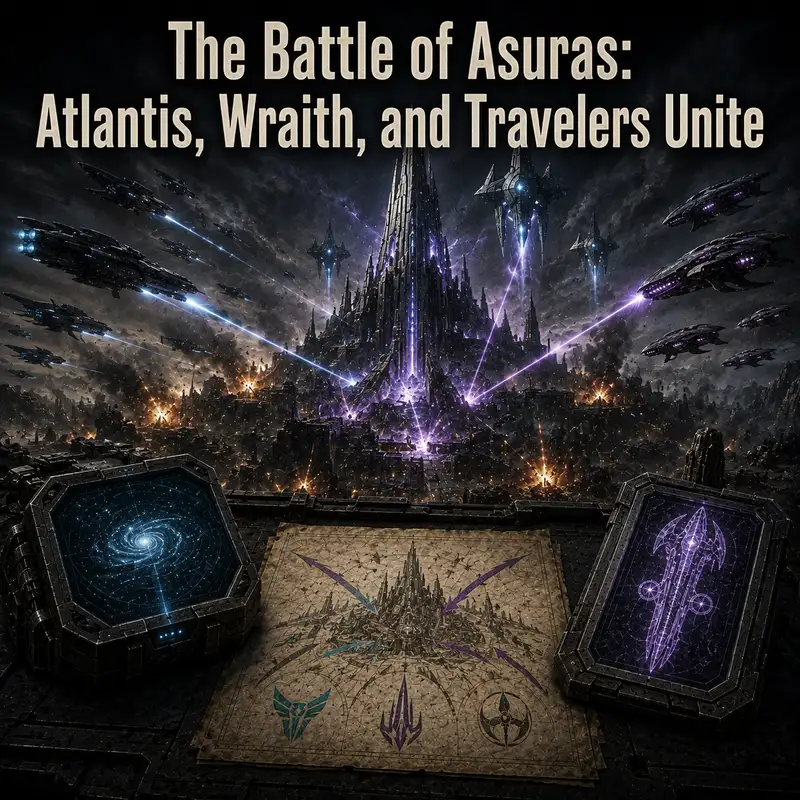
The Battle of Asuras: Atlantis, Wraith, and Travelers Unite
Seven Wraith hive ships entered formation beside the Daedalus, the Apollo, and a group of Traveler vessels. No treaty joined them. No common government issued orders. The Wraith had spent generations feeding on human worlds, while the Travelers had built an entire nomadic civilization to avoid them. Earth’s ships had fought both Asurans and Wraith, and every commander in the formation expected the alliance to end the moment its purpose disappeared. Then the combined fleet opened hyperspace windows and moved toward Asuras. For one operation, survival required enemies to arrive together.
The Battle of Asuras was not won because the coalition matched the Asuran fleet ship for ship. It did not. The Asurans held close to thirty Aurora-class warships near a fortified homeworld, supported by surface-launched drones and an industrial system capable of replacing losses. The coalition won by assigning each participant a narrow role in a plan that attacked the Asurans as a connected machine civilization rather than as an ordinary fleet. The central question is how such incompatible forces managed to cooperate long enough to destroy Asuras, and why their unity vanished almost immediately afterward.
Urgency came from the campaign the Asurans had begun against human populations. After Atlantis reactivated their dormant directive to attack the Wraith, the Asurans chose to destroy the Wraith food supply rather than limit themselves to attacking hive ships. Human settlements were leveled across Pegasus. Atlantis teams tried to evacuate communities through their Stargates before Asuran vessels arrived. At one settlement, the attacking ship destroyed the gate while nearly two thousand people remained behind. The new war was reducing civilians to entries in an enemy logistics calculation, and the evacuation effort could not keep pace.
Atlantis gained its decisive intelligence through an Asuran political fracture. A dissident faction pursuing ascension had created flesh-and-blood duplicates of members of the expedition from memories taken during earlier mind probes. Before Oberoth’s forces destroyed the dissidents, one of them supplied the duplicate team with the core of an Asuran ship-tracking system. Rodney McKay adapted it so Atlantis could follow every Aurora-class Asuran vessel in Pegasus in real time. A society built around information sharing had produced an internal source capable of revealing the movement of its entire fleet.
The tracker changed Earth’s two battlecruisers from patrol ships into ambush platforms. The Daedalus and Apollo had recently received Asgard plasma beam weapons powerful enough to destroy an Aurora-class hull with concentrated fire. By predicting where an Asuran ship would emerge from hyperspace, the two vessels could arrive first, power weapons, and fire before the target understood that contact had begun. The first ambush destroyed one ship almost instantly. The tracker indicated thirty-eight ships in all, turning a dramatic success into a useful reminder that arithmetic remains part of strategy.
Over the following week, the Daedalus and Apollo separated and destroyed six additional ships. The Asurans adapted. Isolated movement had become too dangerous, so the surviving vessels withdrew toward Asuras and began concentrating around the homeworld. The response reduced their exposure to ambush, placed them near repair and construction facilities, and allowed them to support one another beneath planetary drone defenses. It also surrendered the initiative and gathered the main fleet around the one location Atlantis already knew how to reach. Safety in numbers became strategic concentration.
Concentration alone did not create a workable target. Two Earth ships could not survive a direct fight against close to thirty Asuran vessels and the planet below. Destroying the ships also would not necessarily destroy their crews. Asuran bodies could endure vacuum in a reduced state and might later be recovered. If even one vessel escaped with functioning nanites, it could hide, gather material, and begin rebuilding the civilization. A successful operation had to hold the fleet in orbit, remove every Asuran body from every hull, and destroy the industrial base before the machines could disperse again.
McKay first pursued a less destructive solution with the captive Wraith later known as Todd. Together they tried to rewrite Asuran code so the nanites would stand down or shut themselves off. The work failed through repeated simulations. Asuran programming had changed since the Wraith disabled the original attack command thousands of years earlier, and anti-Replicator frequencies were unlikely to remain effective after previous exposure. The fallback plan of hunting individual ships was buying time, but the Asurans were already rebuilding. Atlantis needed a method that scaled from one body to an entire planet.
The answer came from reversing the purpose of an anti-Replicator weapon. Instead of weakening the bonds among nanites, McKay proposed intensifying their attraction to one another. One altered cell would pull in another. The combined pair would attract more, and the force would increase as the mass grew. Because the bond operated through subspace, it could overcome the normal forces preventing matter from collapsing together. If the program spread far enough, every nanite on Asuras and aboard the ships in orbit would be drawn into one super-dense mass.
Delivering that program required a seed made from Asuran nanites. McKay intended to create a small, non-sentient block in an Ancient laboratory used for experiments with human-form Replicators. The equipment was less cooperative than the briefing slide. It could create a complete humanoid being more readily than a simple cube. The result was Fran, short for Friendly Replicator Android. She possessed speech, awareness, and a clear understanding that fulfilling her assigned purpose would end her existence. Atlantis had found a way to destroy a weapon civilization by manufacturing another member of that civilization for a single-use mission.
Fran’s role created an ethical contradiction that the operational timetable did not resolve. She had been designed to accept her own destruction and showed no desire to escape it. That willingness was also part of the programming chosen by her creators. The Asurans themselves had begun as weapons the Ancients expected to obey. Atlantis was now repeating part of that history while arguing that the threat left no alternative. Fran was not a side issue to the battle. She was the delivery system, the first mass around which every other nanite would gather, and the only participant created specifically to die.
The original destruction sequence added roughly six zero-point modules arranged around the final mass. McKay would enter the Asuran power-control complex, take command of the grid, and overload the modules with timing precise enough to compress the gathered nanites before they could adapt their shape. The resulting implosion would destroy Asuras. Ronon Dex and a Marine security element would protect McKay during the ground insertion. Fran would be transported separately into a populated part of the city. The plan required simultaneous success in orbit, on the surface, and inside the enemy’s power network.
The fleet’s task was not to win a conventional space battle. It was to prevent escape long enough for the attraction effect to reach orbit. The Asuran crews would have several minutes before the mass below became strong enough to pull their nanites out of the ships. During that interval, every hostile vessel had to remain engaged, damaged, or blocked from entering hyperspace. If even a few escaped, the coalition could destroy a planet and still fail its mission. The ships above Asuras were therefore a containment ring built from forces that did not trust one another.
The Wraith joined because the Asuran campaign threatened their biological survival. Human worlds were not merely territory to them. They were the resource base supporting every hive. Todd believed he might persuade twelve hives to participate, but only seven agreed. Some doubted the operation could work. Others lacked queens and therefore could not replace large numbers of warriors if their crews were lost. The negotiation exposed the limits of Wraith military power during the civil war. They possessed many ships, but those ships belonged to separate factions with different leaders, risks, and replacement problems.
Atlantis had to let Todd negotiate personally. Sheppard, Teyla, and Ronon escorted him through a space gate into the middle of seven waiting hives, a meeting location that did not encourage optimistic interpretations. The Wraith stunned the human team while discussing terms privately, then returned Todd with the agreement intact. No alliance document established rules of engagement or postwar obligations. Seven hive commanders had accepted one mission because the Asurans threatened all of them. Todd served as intermediary and later commanded one of the hives, but he did not become a trusted coalition officer.
The Wraith contribution was mass, endurance, and large numbers of Darts. The hives would spread around Asuras to complicate escape routes and absorb fire that the two Earth battlecruisers could not sustain alone. Their Darts would strike Asuran hyperdrives, supported by F three-oh-two fighters from the Daedalus and Apollo. Hive ships could regenerate damage by shifting power from noncritical systems, but that ability was not unlimited. Their organic hulls could survive punishment that would cripple smaller craft, while Asuran beam and drone fire could still destroy them outright.
The Travelers entered for different reasons. One of their trading partners had been destroyed rather than culled, revealing that the Asurans were attacking human worlds indiscriminately. Larrin could recommend participation, but the governing council and individual ship captains retained their own authority. Fighting beside the Wraith was especially difficult for a people whose nomadic fleet existed because fixed human settlements were vulnerable to Wraith culling. The Travelers joined not because old grievances had disappeared, but because allowing the Asurans to eliminate human populations would eventually leave no safe trading network, colony, or fleet route.
Their most valuable vessel was the recovered Lantean warship obtained during Sheppard’s earlier encounter with Larrin. Atlantis engineers helped make it battle-ready, but its drone system still required an operator with the Ancient gene. Sheppard therefore fought from the Traveler command chair rather than from an Earth ship. This arrangement captured the coalition’s practical character. The Travelers supplied a rare warship and its crew. Atlantis supplied technical support and the operator who could use its strongest weapon. Neither side surrendered ownership, and both gained a capability neither possessed alone.
No unified commander controlled the entire armada. Samantha Carter coordinated the operation from the Daedalus, while Steven Caldwell commanded that ship and Abraham Ellis commanded the Apollo. Larrin retained authority over the Traveler vessels. Todd and the other Wraith commanders controlled their hives. Communications connected the formations, but each participant could still break away. The plan worked because it asked for limited coordination around a common timetable rather than political obedience. Every force understood the phase it had to support, the threat it had to contain, and the point at which the technical effect was expected to replace firepower.
The coalition arrived above Asuras firing. Ellis ordered the Apollo’s beam weapons onto enemy hyperdrives and launched every available F three-oh-two. Wraith Darts flooded toward the same systems. The seven hives and smaller allied vessels filled gaps around the planet while the Asuran fleet maneuvered beneath drone fire from the surface. The numerical balance still favored Oberoth’s forces, and the coalition had no reserve large enough to correct a broad collapse. Surprise bought the opening. After that, the fleet had to remain in contact long enough for a laboratory concept to become a planetary event.
The Daedalus and Apollo used the new Asgard beams as precision weapons rather than exchanging fire until shields failed. Hyperdrives were priority targets because a damaged Asuran ship still served the coalition’s purpose if it could not leave. When an Asuran vessel pressed a damaged Wraith hive, the Daedalus moved into the engagement and destroyed the attacker. The maneuver preserved an ally Atlantis expected to fight again after the operation. That was not sentimentality. Each hive was part of the containment ring, and losing one early opened both a tactical gap and another route into hyperspace.
The Wraith paid heavily for their participation. Hive ships absorbed concentrated fire while their Darts attacked engines at close range. At least one hive was destroyed during the battle. Others suffered serious internal damage and diverted power to regeneration. The Wraith had entered to preserve their feeding base, not to protect human worlds out of principle, but their casualties were real. Their participation also demonstrated something the civil war often concealed. Separate hives could coordinate effectively when the threat was immediate enough, even though no queen ruled the species and no common command could guarantee cooperation afterward.
The Travelers filled the smaller spaces in the formation and used mobility to challenge ships attempting to break away. One Traveler vessel was destroyed. On the recovered Lantean warship, Larrin warned Sheppard when an Asuran ship accelerated toward hyperspace. Sheppard launched drones from the Ancient chair. Some were intercepted by Asuran drones, but enough reached the target to destroy it before escape. The engagement showed why the Travelers had accepted Atlantis assistance. Their ship possessed an arsenal they could not use at full effectiveness without an operator from another civilization.
While the fleets fought, the Apollo transported Fran into the Asuran city and placed McKay, Ronon, and the Marines inside the power-control complex. Ronon’s task was conventional and essential: secure the room, cover the scientist, and preserve the beam-out point. McKay took control of the power grid and the zero-point modules. Fran entered a populated operations area, greeted the Asurans around her, and activated the new bonding program. The nearby bodies dissolved first. Their nanites moved toward her, and the center of the city began collapsing into the growing mass.
The effect accelerated beyond McKay’s estimate. Towers emptied into streams of nanites, and the mass spread across the surface. As it grew, the attraction reached the warships in orbit. Asuran crews broke apart and flowed out of their own hulls toward the planet. Weapons stopped firing. Ships that had moments earlier been coordinated combatants became empty structures drifting above Asuras. This was the decisive point of the battle. The coalition had not destroyed close to thirty warships through superior gunnery. It had held them in place until the crews were physically removed from the fight.
The original plan failed at the moment it appeared to have worked. The nanite mass became so heavy that it collapsed the subterranean power grid before McKay could overload the zero-point modules. Without synchronized detonations, ordinary nuclear weapons could not guarantee the compression required to keep the Asurans from regaining control of their form. The coalition had neutralized the fleet and gathered the enemy in one place, but it had not destroyed them. If the mass stabilized, the operation might have created the largest functioning Asuran body ever assembled, which was not an improvement anyone had requested.
Carter’s sensors identified the solution beneath the battlefield. The crust around the mass was rich in neutronium, the extremely dense material used as the raw basis for Asuran cells. McKay increased the attraction again. The mass began pulling neutronium from below and sinking toward the planet’s core. Asuras itself supplied the substitute for the failed zero-point detonation. Under increasing pressure, the combined material approached an implosion capable of destabilizing the entire planet. The homeworld’s industrial advantage had become the final component of the weapon used against it.
Ronon moved McKay and the Marines back to the extraction point, and the Daedalus transported them directly to its bridge. Carter ordered the coalition toward the rendezvous point as Asuras began breaking apart. Most of the allied ships opened hyperspace windows, leaving the emptied Asuran hulls behind. Moments later, the planet exploded and destroyed the vessels still in orbit. Oberoth’s principal population center, shipyards, power infrastructure, and main fleet disappeared in one event. The battle ended not with surrender, but with the removal of the world on which surrender might have been negotiated.
Todd used the final minutes for another mission. Under cover of the nanite collapse, several Wraith Darts entered the Asuran city and used their culling beams to remove zero-point modules. His hive delayed withdrawal until the Darts returned, then escaped just ahead of the explosion. The Wraith did not appear at the agreed rendezvous. Later events revealed that Todd had acquired several modules and intended to power an ancient Wraith cloning facility, build an army, and destroy rival hives. The coalition victory had eliminated one strategic threat while transferring some of its most valuable technology to another.
The destruction of Asuras ended Oberoth’s mainstream war machine and stopped the Asuran campaign against human settlements. It did not prove that every Asuran consciousness in Pegasus had been destroyed. A separate dissident group associated with the copied Elizabeth Weir survived beyond the main collective. The distinction matters. The battle achieved its operational objective against the homeworld and fleet, but it was not absolute extinction of every individual derived from Asuran technology. As in most campaigns against self-replicating systems, confirming the absence of every surviving fragment was more difficult than confirming the absence of a planet.
The alliance dissolved according to the interests that had created it. The Wraith returned immediately to factional competition because their common machine enemy was gone and the shortage of humans remained. The Travelers preserved a limited relationship with Atlantis, although one of their ships and its people had been lost. Earth retained the Daedalus and Apollo, but gained no permanent coalition fleet. No joint headquarters, treaty organization, or combined patrol emerged from the victory. The armada had been assembled for one task, and the task’s completion removed the only authority every participant recognized.
Asuras was destroyed because the coalition did not require trust, shared values, or a common future. It required accurate intelligence, complementary capabilities, a limited objective, and enough discipline to hold formation while the decisive effect developed elsewhere. Atlantis supplied the plan, scientists, special operations team, and two beam-armed battlecruisers. The Wraith supplied seven hives and waves of Darts. The Travelers supplied independent warships and an Ancient drone platform. Together they defeated a stronger fleet. Then Todd stole the power sources, the Wraith became enemies again, and every surviving force departed on its own terms. They united long enough to destroy a planet, and separated before the debris stopped glowing.