The Battle of Asuras: Coalition Warfare Against the Replicators
The plan failed after it had already begun consuming the enemy. Every Asuran tied to Oberoth’s collective on the planet was breaking apart into nanites and flowing toward the artificial Replicator called Fran. The same attraction was pulling crews and nanite-based systems out of nearly thirty warships in orbit. Then the growing mass crushed Asuras’s subterranean power grid. Rodney McKay lost control of the zero-point modules he intended to overload around it. Above him, Earth ships, Wraith hives, and Traveler warships were taking damage to hold the Asuran fleet in place. The coalition had created the target it needed and lost the weapon intended to destroy it.
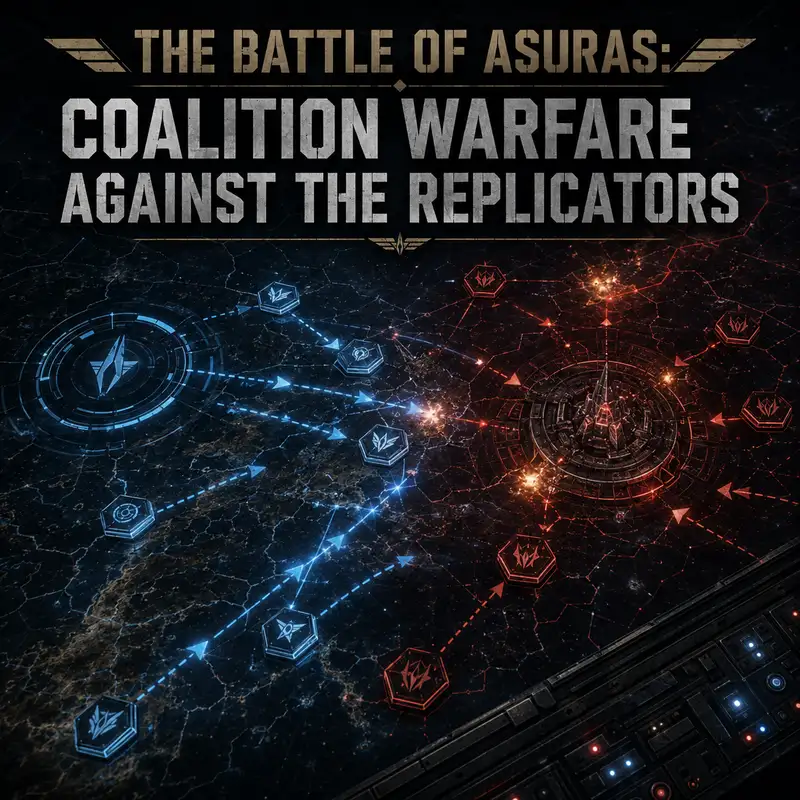
The Battle of Asuras was won because the allies were not trying to defeat the Asuran fleet through ordinary firepower. They were trying to prevent it from escaping long enough for a ground operation to destroy the Asurans as one connected technological organism. That distinction explains why enemies who distrusted one another could cooperate, why several different ship types were essential, and why the operation remained viable even after its original destruction mechanism failed. The fleet battle was a containment action. McKay’s nanite program was the decisive weapon. The planet beneath both forces became the final explosive.
The crisis was partly the result of decisions made by Atlantis. The Asurans had been created by the Ancients as Replicator weapons against the Wraith. Their base programming included a directive to attack that enemy, but the command had been disabled long before the modern expedition arrived. After Earth launched a preemptive nuclear strike against Asuran shipyards and the Asurans retaliated against Atlantis, Sheppard’s team returned to Asuras to steal a zero-point module. During that mission, McKay found the dormant attack directive and reactivated it. The hope was that two dangerous enemies would weaken one another while Atlantis recovered.
The Asurans did begin attacking the Wraith. They also adopted a strategy that made military sense inside their programming and produced mass killing among people who had never been consulted. Wraith survival depended on human populations. The Asurans therefore began leveling human settlements to deny the Wraith their food supply. Atlantis teams tried to evacuate threatened communities, but warnings did not always arrive in time and not every population believed them. One failed evacuation ended with a gate destroyed and almost two thousand people still on the planet. The expedition had redirected the Asurans toward the Wraith and helped turn human worlds into the campaign’s logistics targets.
The first requirement was intelligence. An Asuran-created duplicate of the Atlantis team delivered the core of a tracking system able to locate Oberoth’s Aurora-class vessels across the Pegasus galaxy. That device converted a scattered machine threat into an observable order of battle. Daedalus and Apollo, both newly armed with Asgard plasma beam weapons, began hunting individual Asuran ships. Their first ambush destroyed a target before it could respond. Splitting the two Earth battlecruisers allowed them to destroy seven vessels within roughly a week. For the first time, Atlantis possessed both a sensor capable of finding the enemy and a weapon capable of killing one of its capital ships quickly.
That success created a misleading tactical picture. The first ships were engaged separately and without warning. The Asurans learned from losses, recalled their forces, and concentrated close to thirty warships over their homeworld while rebuilding. Colonel Steven Caldwell understood what would happen if those ships began traveling in groups. The Earth ships’ kill rate would collapse, their shields would be exposed to concentrated return fire, and every damaged Asuran vessel would be supported by others. Daedalus and Apollo could win ambushes. They could not attack a massed Asuran fleet, remain in combat indefinitely, and guarantee that no ship escaped to reproduce the collective elsewhere.
Samantha Carter therefore faced a time-limited command problem. She could continue evacuating human worlds while the Asurans rebuilt, or she could attack their concentration before it dispersed. McKay and the captive Wraith later known as Todd tried to write a shutdown program, but the Asuran code resisted every attempt. Reconfiguring the old stand-down command failed. Programming the nanites to deactivate themselves failed. The established anti-Replicator field was unlikely to work because the Asurans could adapt, and even a successful local effect would leave surviving ships free to rebuild. A weapon that destroyed most of a self-replicating enemy was another way of scheduling the next campaign.
McKay changed the problem by reversing the principle behind the anti-Replicator weapon. Instead of breaking the bonds among nanites, he proposed increasing their attraction. One affected cell would pull another toward it. The growing group would exert greater force, attracting more cells until every Asuran on the surface and every nanite in orbit joined one immense mass. At sufficient density, the mass could be compressed and destroyed before it regained control of its shape. The idea treated the Asurans’ distributed nature as a vulnerability. Their ability to become almost anything would be turned into an inability to remain separate.
The program needed a seed that could enter the Asuran city and initiate the attraction. McKay first tried to create a simple block of nanites with most normal Replicator functions disabled. The Ancient fabrication system had been designed to produce complete human-form Replicators, and simplifying the result proved harder than reproducing the original architecture. The blocks repeatedly lost cohesion. McKay eventually created a humanoid form because that was what the machinery could sustain. She could walk, speak, analyze the plan, and understand that activating the program would end her existence. She asked for a name and became Fran, the Friendly Replicator Android.
Fran solved a technical problem and created an ethical one. Carter questioned sending a self-aware being to certain destruction. McKay argued that Fran was a program rather than a living person, yet his own discomfort increased as she spoke about fulfilling the purpose for which he had created her. Her willingness cannot be separated from the fact that the mission was built into her reason for existing. Atlantis had responded to a civilization of artificial beings by manufacturing another artificial being as a disposable weapon. The battle’s most important munition could understand the farewell being offered to her.
The next requirement was containment in orbit. The Asuran ships would feel the attraction later than the population on the surface. Any vessel that entered hyperspace before the effect reached it could preserve enough nanites to rebuild the entire threat. Carter had only two Earth battlecruisers against nearly thirty Asuran ships. The operation did not need another fleet capable of winning a conventional engagement. It needed enough ships, fighters, and drones to attack hyperdrives, block escape routes, and keep the Asurans occupied for the minutes Fran required.
Todd offered Wraith participation because the Asurans were destroying both hives and the human population on which the Wraith depended. He initially claimed he could bring twelve hives. After negotiating with other Wraith leaders, he secured seven. Several commanders doubted the plan, and some hives lacked queens. Losing those ships could mean losing the ability to produce new soldiers. Even under existential pressure, the Wraith did not act as one state. Each hive weighed the common danger against its own survival, position, and biological future. The alliance began with seven separate calculations rather than one unified policy.
The Travelers joined for another reason. Their mobile civilization depended on a limited number of ships and trade relationships with settled worlds. Larrin had found one of those trading partners completely destroyed. The population had not been culled. The settlement had been leveled, which pointed toward the Asuran campaign. She agreed to seek approval from the Traveler governing council, but individual captains still had to choose whether to participate. Fighting beside Wraith hives was politically repellent and operationally dangerous. The Travelers joined because the Asurans had made neutrality increasingly indistinguishable from waiting for a trading world or ship to be selected next.
The resulting force was a coalition without a single commander who could order every participant into position. Carter shaped the plan as commander of Atlantis. Caldwell retained command of Daedalus, and Colonel Abe Ellis commanded Apollo. Todd coordinated the participating hives. Larrin represented the Travelers, whose captains had preserved their own authority. Sheppard transferred to Larrin’s Ancient warship because his genetic compatibility and experience allowed him to use its control chair and drones more effectively than the crew could. McKay led the technical assault on the surface. Cooperation rested on a shared objective and a schedule, not on a permanent chain of command.
That arrangement worked because every contingent received a mission suited to its strengths. The seven hives would distribute themselves around Asuras, while the smaller allied ships filled gaps in the containment ring. Wraith darts and Earth’s F three-oh-twos would target Asuran hyperdrives. Daedalus and Apollo would use their beam weapons against capital ships and transport the ground teams through the defensive perimeter. Sheppard would use Traveler drones to stop vessels attempting to break orbit. Fran would enter the city separately. McKay, Ronon, and a Marine security element would seize the core room, control the power grid, and prepare several zero-point modules for a precisely timed overload.
The fleet arrived over Asuras firing. Ellis ordered the beam weapons onto enemy hyperdrives and launched the F three-oh-twos. The Wraith released large dart formations. Traveler ships entered a battle against vessels derived from the same Ancient technology that sustained their own civilization. The Asurans responded with concentrated weapons fire and drones of their own. One Traveler ship was destroyed, and at least one Wraith hive was lost. Shields fell across the coalition. The battle plan had accepted those risks because destroying every Asuran ship was never the immediate requirement. Preventing even one intact ship from leaving was.
Coalition warfare became visible in the way the ships protected one another. When an Asuran vessel damaged a Wraith hive, Daedalus moved between them and destroyed the attacker with its Asgard beam. Earth was not defending the Wraith as a future ally. It was preserving one section of the containment ring. Wraith hull regeneration kept damaged hives in the fight. Their darts added numbers Earth could not provide. Traveler drones gave Sheppard a method of killing a ship that tried to accelerate toward hyperspace. Each force supplied a capability the others lacked, and none could afford to ask what those capabilities might be used for after the battle.
On the surface, Fran entered a populated Asuran control area and activated the attraction program. Nearby human-form Replicators broke apart first. Their nanites flowed into her, increasing the force drawing on the rest of the city. Towers began collapsing inward as their machine inhabitants and nanite-based systems joined the mass. McKay gained control of the planetary power grid and the zero-point modules from the core room while Ronon and the Marines secured the position. For several minutes, the operation proceeded almost exactly as planned, which in an Atlantis mission was usually the point at which everyone should become concerned.
The Asuran commanders eventually recognized the threat and tried to leave orbit. One vessel accelerated toward escape while powering its hyperdrive. Sheppard activated Larrin’s control chair and launched drones. Asuran drones intercepted part of the salvo, but enough reached the ship to destroy it. Then the attraction extended into orbit. Nanites tore out of Asuran hulls and streamed toward the planet. Crews, control systems, and other Replicator components abandoned the warships together. The coalition had not defeated nearly thirty ships through an exchange of fire. It had removed the beings and machine elements that made those ships an organized fleet.
The growing mass became superheavy and began sinking through the surface. Carter’s sensors indicated that every Replicator nanite associated with Oberoth’s main collective had joined it. McKay prepared to overload the zero-point modules in a symmetrical pattern. The explosions had to compress the mass with extraordinary precision before the nanites could adapt and regain control. Then the weight of the target collapsed the underground power grid. The zero-point modules remained present, but McKay could no longer command their detonation. Nuclear weapons dropped from orbit would not reproduce the timing and force needed for the planned implosion.
The failure did not end the operation because Carter and McKay still shared sensor data and could reinterpret the battlefield together. Carter detected large concentrations of neutronium in the ground surrounding the mass. The material was the dense raw basis of Replicator cells and helped explain why the Ancients had established the Asuran project on that world. McKay increased the attraction again, causing the mass to draw surrounding neutronium toward itself and sink deeper. The planet’s increasing pressure would provide the compression that the zero-point modules could no longer create. The ground operation had lost its bomb and turned Asuras into the replacement.
Ronon moved McKay and the Marines to the extraction point, and Daedalus beamed them directly to its bridge. Carter ordered the coalition to break contact and jump to the rendezvous point. The emptied Asuran ships drifted above a world beginning to tear itself apart. Allied vessels entered hyperspace as the mass descended toward the core. Asuras broke apart and exploded, destroying the remaining ships and the physical center of Oberoth’s collective. The plan that began as a controlled zero-point-module implosion ended as planetary destruction driven by the enemy’s own material.
Tactically, the coalition held the Asuran fleet in orbit and extracted the ground force. Operationally, it destroyed the main Asuran collective, its homeworld, and most of its fleet in one action. Strategically, it ended the campaign that was erasing human settlements across Pegasus. The victory was not cost-free. The Travelers lost a ship their civilization could not easily replace. Wraith crews and soldiers were lost aboard at least one hive. Human communities had already been destroyed, and refugees remained displaced. The screen record does not provide a complete casualty total, which is often the point at which a clean strategic map begins hiding a very untidy war.
Nor did the operation eliminate every Asuran. The Asuran-bodied Elizabeth Weir and a dissident group had separated from Oberoth’s collective while pursuing ascension. Their Aurora-class vessel survived away from the planet and later confirmed that the main population had been destroyed. This exception matters. Atlantis annihilated the organized enemy conducting the campaign, not every nanite or every independent Asuran consciousness in existence. The surviving group was smaller and followed a different objective, but it also proved why the coalition had been so focused on preventing escape from Asuras.
The alliance ended almost as soon as the planet did. The surviving Wraith did not appear at the planned rendezvous. With the common enemy gone, Todd’s hives returned to their own interests, which still included feeding on human beings and competing with rival Wraith factions. The Travelers accepted repairs and departed under their own authority. No combined headquarters remained, no mutual-defense treaty followed, and no shared patrol structure protected the evacuated worlds. Coalition warfare had produced an operation, not a political community.
That limited duration was one reason the coalition succeeded. The objective was narrow, urgent, and measurable. Hold the Asurans near Asuras until the attraction program took effect. Every participant understood what failure meant. The Wraith would lose ships and food populations. The Travelers would lose trading partners and perhaps their mobile civilization. Atlantis would face responsibility for a campaign its own intervention had helped trigger. Nobody had to agree on the future of Pegasus, the morality of culling, ownership of Ancient technology, or control of Atlantis. They needed only to agree that Oberoth’s collective could not be allowed to disperse.
The operation also succeeded because intelligence created concentration. The tracking system revealed where the Asuran ships were and showed that they had gathered to rebuild. After losing several ships to separate attacks, the Asurans concentrated their remaining force to rebuild. McKay’s weapon then exploited that concentration. The coalition did not chase a self-replicating enemy across hundreds of worlds. It struck when the enemy’s ships, population, power grid, and command network were connected to one planet. The Asurans’ effort to recover from tactical losses created the operational target that destroyed them.
Most importantly, the coalition fought the correct battle. A conventional fleet commander might have measured success by Asuran ships destroyed. Carter measured success by ships prevented from escaping. Wraith darts, F three-oh-twos, drones, and beam weapons were used to damage hyperdrives and enforce containment. McKay attacked the common material and code underlying every Asuran form. When the zero-point-module plan failed, Carter and McKay used the planet’s composition as another weapon. The allies did not become stronger than the Asurans in a general sense. They made Asuran strength irrelevant for a few decisive minutes.
The moral result remains harder to simplify. Oberoth’s collective was conducting a campaign that destroyed whole human communities. There was little time and no credible evidence that a negotiated ceasefire would stop it. The coalition’s response was still a civilization-ending attack against self-aware artificial beings. Atlantis created Fran to die, used a Wraith alliance built on the continued exploitation of humans, and destroyed an entire planet to solve a crisis partly produced by its own attempt to redirect the Asurans. Military necessity explains those decisions. It does not remove their weight.
The Battle of Asuras became one of the clearest examples of coalition warfare in the Pegasus galaxy because cooperation did not require affection, trust, or a shared political future. It required accurate intelligence, complementary capabilities, limited objectives, and commanders willing to adapt when the original plan collapsed beneath its own target. Earth ships supplied precision fire and transport. Wraith hives supplied mass. Travelers supplied scarce ships and Ancient weapons. Fran supplied the point around which the enemy gathered. The coalition won because it held together just long enough for the Asurans to lose the ability to remain apart.