The Battle of Dakara: Revolution Under Replicator Attack
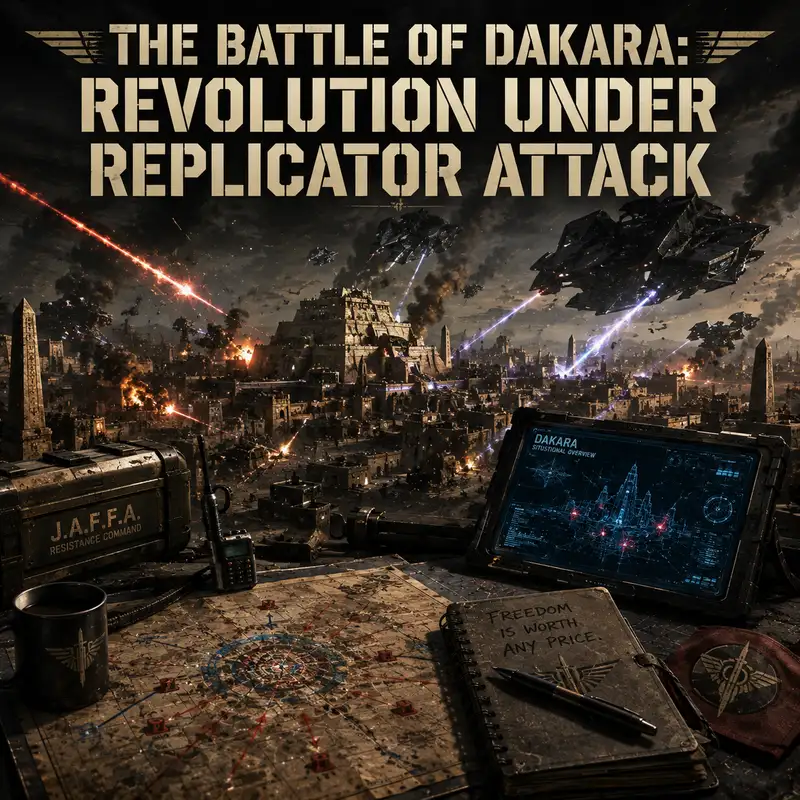
The Replicators stopped in the middle of the assault. On Dakara, block-built machines froze only meters from Samantha Carter’s defensive line. In orbit, Replicator-controlled Ha’taks ceased firing with weapons already trained on the rebel fleet. Beneath Cheyenne Mountain, General Jack O’Neill and the remaining defenders stared at swarms that had been climbing toward the surface. The Ancient weapon was not yet active. Daniel Jackson, trapped aboard Replicator Carter’s ship, had reached into the machine network and forced it still. Jacob Carter needed only a few more seconds to finish the calibration. The Battle of Dakara would be decided inside that pause.
Dakara was not one battle. It was a Jaffa revolutionary operation, a Goa’uld fleet engagement, and the final Milky Way campaign against the Replicators, all converging on one sacred world. The rebel Jaffa began the operation to prove that the Goa’uld were false gods. They soon found themselves protecting an Ancient device that could erase life across the galaxy. Earth and the Tok’ra arrived intending to destroy that device, then tried to adapt it into a weapon against machines. Ba’al arrived under orders from Anubis, yet quietly helped the defenders. Almost every participant changed objectives before the fighting ended.
The strategic crisis had begun when Replicator Carter launched a full-scale offensive against the Goa’uld. Replicators seized Ha’taks, absorbed technology, and expanded faster with every victory. Ba’al had already brought the surviving System Lords close to submission, but his fleet now faced an enemy that did not care about rank, territory, or negotiation. A captured Goa’uld ship became another Replicator ship. A lost industrial world became raw material. Jacob Carter warned Stargate Command that the machines could overrun the galaxy within weeks. The old political order was collapsing, but it was not collapsing in a way that promised freedom.
The Replicator advance also threatened the Jaffa rebellion. Thousands of frightened Jaffa began returning to their former masters. Some interpreted the machine invasion as punishment for abandoning the gods. Others made the more practical calculation that a Goa’uld fleet, however oppressive, still offered ships, weapons, and organized protection. The rebellion had survived for years through hidden cells, defections, and symbolic victories. It had not yet demonstrated that it could protect an entire people against a galactic emergency. Teal’c and Bra’tac needed an operation that would restore belief in freedom before fear dissolved the movement from within.
They chose Dakara because it was the political center of Jaffa servitude. The temple was associated with the first prim’ta ritual, the implantation that gave Jaffa strength and longevity while making them biologically dependent on Goa’uld symbiotes. Generations had been taught that Dakara was the cradle of their existence and evidence of divine favor. Capturing an ordinary fortress would remove one garrison. Capturing Dakara would attack the story that made every garrison possible. Teal’c and Bra’tac were not merely taking terrain. They were seizing the religious language through which the Goa’uld had defined Jaffa identity.
Timing made the assault possible. Ba’al’s main forces were occupied against the Replicators, leaving Dakara lightly defended. Rebel Jaffa struck the planet, seized the temple, and raised their claim before the Goa’uld could concentrate a response. The initial attack was therefore a tactical success and a strategic gamble. The rebels controlled the sacred site, but they had placed their remaining fleet deep inside Ba’al’s territory. If he disengaged from the machine war and returned in strength, Dakara could become the place where the rebellion ended rather than the place where it became a nation.
The rebel order of battle revealed the imbalance. Teal’c and Bra’tac had five Ha’taks, eight Al’kesh, and ten squadrons of death gliders. That was enough to create several formations, not enough to defeat Ba’al’s fleet in a direct exchange. Teal’c divided the force. Gliders moved to the far side of the planet. Two Ha’taks and the Al’kesh hid beyond the moon. The remaining ships stayed visible near Dakara. The arrangement created the possibility of an attack from several directions while preserving part of the force from immediate destruction. It also meant every separated element depended on timing and communications.
Ba’al’s behavior gave the rebels additional time. He was serving Anubis while looking for a way to escape that service, a relationship built on obedience, resentment, and the normal Goa’uld quantity of ambition. Anubis ordered him to retake Dakara because an Ancient device beneath the temple could destroy life across the Milky Way. Anubis’s partially ascended state would allow him to survive and rebuild the galaxy according to his own design. Ba’al had no intention of becoming one of the casualties in someone else’s new creation. He slowed his approach enough to let Earth find and destroy the device, while preserving an explanation for Anubis if he arrived too late.
The Replicators were approaching for the opposite reason. Replicator Carter had abducted Daniel and searched the remains of his ascended memories for Ancient knowledge. She learned that Dakara contained the one device capable of threatening her entire species. The intelligence compromise was severe. Daniel did not consciously know the location when he was captured, but information inaccessible to him remained inside his mind. Replicator Carter could exploit that hidden archive and share what she found across the collective. A prisoner did not need to understand the secret in order to reveal it.
General O’Neill initially wanted the device destroyed before either Anubis or the Replicators reached it. Carter and Jacob gated to Dakara with Earth personnel, technical equipment, Daniel’s notebooks, and a bomb. The temple’s Ancient script concealed a combination lock inside apparently nonsensical phrases. Carter recognized that rotating selected circular panels changed the meaning of the text and opened a hidden chamber. This was archaeology under fire, but the military purpose was straightforward. Locate the system, determine whether demolition would work, and deny it to every force converging on the planet.
Inside the chamber, Jacob and the Tok’ra symbiote Selmak determined that the device emitted an energy wave capable of reducing matter to basic molecular components. It could not disintegrate a planet, but it could remove life and other matter from the surface and surrounding space. The device had originally been used by the Ancients to recreate life in the Milky Way after a devastating plague. Its mechanism could create or destroy according to its calibration. The same machine that had helped restore a galaxy could become a sterilization weapon because advanced engineering does not arrive with advanced judgment permanently attached.
Carter and Jacob delayed the demolition when they recognized that the device worked on a principle similar to the Ancient-derived Replicator disruptor. O’Neill had built the original disruptor while carrying Ancient knowledge, and Thor had helped modify its frequency after the Replicators developed immunity. The machines adapted again after one successful shot. A local victory would therefore be temporary. If Dakara destroyed one formation, every surviving Replicator could adjust and return immune. The only workable solution was to expose the entire collective to the new waveform before any part of it had time to adapt.
That requirement turned a planetary weapon into a network operation. The Dakara wave could translate through an active Stargate, but one wormhole reached one destination. Carter needed the local dial-home device to establish connections throughout the Milky Way at effectively the same time. Earth did not know how to rewrite the network for that purpose. Ba’al did. He had previously manipulated the automatic update system to spread corrupted dialing instructions across the gates. The enemy who had demonstrated how to compromise the network was now the only available specialist capable of using the same architecture to save it.
Cooperation did not create trust. Carter refused to let Ba’al land troops near the weapon. Ba’al refused to pretend that he respected Earth, the Tok’ra, or the rebellion. He supplied instructions by hologram because Anubis would kill him if his assistance became undeniable, and the Replicators would kill him if the plan failed. Carter and Jacob adjusted the Ancient controls while Ba’al helped reprogram the dial-home device. It was coalition warfare reduced to its least sentimental form. Every participant remained a mortal enemy. For several minutes, their survival required the same result.
The fleet battle began before the calibration was complete. Ba’al’s ships attacked the visible rebel Ha’taks and drove their shields down rapidly. Bra’tac ordered a withdrawal at sublight speed, inviting pursuit toward the forces hidden behind the moon. Ba’al recognized the trap. He followed anyway because he believed the rebels lacked the strength to make the ambush decisive. The choice was not simple arrogance. His orders required him to recover the weapon, and allowing the rebel fleet to escape would leave an armed movement controlling Dakara. He accepted the ambush because delay had already served his private objective and because overwhelming strength appeared sufficient to absorb the risk.
The rebel plan bought time rather than victory. Hidden ships and fighters could attack from another direction, divide defensive fire, and complicate Ba’al’s formation. They could not change the basic force ratio. Teal’c understood that the fleet’s purpose was to keep the temple out of enemy hands long enough for Carter and Jacob to finish. This was a covering action at planetary scale. Ha’tak crews were spending shields, weapons, and lives to protect two scientists working beneath a monument. If the device failed, the fleet’s sacrifice would not become more useful through sincerity.
A massive Replicator-controlled force then emerged from hyperspace and attacked Ba’al’s ships. The battle became a three-sided engagement. One rebel commander suggested allowing the enemies to destroy one another. Teal’c rejected the option and ordered all available Jaffa vessels to target the Replicators. If the machines won and reached the device, the rebellion, the Goa’uld, Earth, and every biological civilization in the region would lose together. Teal’c chose the threat that could not be deterred, bargained with, or divided by political rivalry. The decision preserved Ba’al’s fleet long enough for Ba’al to keep helping calibrate the weapon.
The Replicators expanded the battle beyond Dakara. They remotely seized control of Earth’s Stargate system, opened the iris, and poured into Stargate Command. O’Neill ordered evacuation and prepared to destroy the base if the machines reached the surface. Security personnel fought through corridors while ammunition ran low and control systems failed. The battle now stretched from Dakara’s orbit to the temple, Replicator Carter’s command ship, and the levels beneath Cheyenne Mountain. The network intended to distribute the defensive wave had already distributed the enemy.
On Dakara, Replicator blocks reached the surface and advanced into the temple. Jaffa defenders and Carter fired into the swarm from the entrance to the inner chamber while Jacob continued adjusting the device. Projectile fire could break mechanical forms apart, but the attackers kept coming. The chamber was well shielded from ship sensors, not isolated from a ground assault. The last defensive line was measured in meters. Carter could hold the doorway or help with the calibration. She could not do both indefinitely.
Daniel created the opening from inside Replicator Carter’s own mental connection. As she searched his memories, he gained access to the collective and discovered that he could influence it. He seized control and froze Replicators across every theater. The machines stopped in Stargate Command. They stopped inside the temple. Replicator ships ceased maneuvering and firing in orbit. Daniel had not defeated them. He had imposed a temporary command interruption on a network far larger than one human mind could sustain.
The pause transformed the battle. O’Neill’s defenders used it to reposition and continue firing. Teal’c’s fleet gained a moment in which enemy ships no longer pressed the attack. Carter turned back toward Jacob. The calibration remained just outside the required tolerance. Replicator Carter broke Daniel’s control and stabbed him through the body. The collective resumed moving. Machines advanced again through the temple and Cheyenne Mountain. An enemy vessel prepared the shot that would finish Teal’c’s damaged Ha’tak. Daniel’s intervention had purchased seconds, not security. In this battle, seconds were the scarce strategic resource.
Jacob and Selmak brought the two waveforms within point seven six percent and activated the device. The top of the Dakara monument opened, the weapon rose, and an energy pulse swept over the planet and into surrounding space. At the same moment, the altered gate protocol carried the pattern through the Milky Way network. The wave emerged at Stargates across the galaxy before the Replicators could adapt. Mechanical swarms separated into harmless blocks. Human-form Replicators disintegrated. Infected ships went dormant. The collective that had defeated Asgard fleets and consumed Goa’uld territory ceased functioning almost at once.
The effect was galactic, but it was not magic. It depended on a unique Ancient device, the waveform derived from O’Neill’s disruptor, Thor’s scientific work, Carter and Jacob’s calibration, Ba’al’s knowledge of gate updates, Daniel’s interruption of the collective, and Jaffa forces holding the battlespace. Remove any element and the plan likely fails. The device was not an Earth-built superweapon ready for redeployment. It was a civilization-level machine used through a coalition whose members would have tried to kill one another under almost any other circumstances.
The destruction of the Replicators changed the fleet balance instantly. Ba’al ordered his troops to board the dormant machine-controlled ships and reclaim them in his name. He still believed the end of the machine threat restored the old hierarchy. Teal’c contacted him and demanded surrender. Ba’al dismissed the demand because his ships still surrounded the smaller rebel force. He was counting hulls and weapons. Teal’c was counting loyalties.
Jaffa aboard Ba’al’s own command ship turned against him. Bra’tac and other rebels entered the bridge, disabled the Kull warriors guarding the throne, and disarmed the crew. Ba’al escaped through a personal transporter before he could be captured. The escape did not preserve the image of divinity. Jaffa across the galaxy saw or heard that Ba’al had abandoned the field while his own warriors joined the rebellion. Dakara had been held. The sacred site remained in Jaffa hands. The supposed god had survived by running from the people he claimed were born to serve him.
That was the political center of the battle. The rebels did not need to destroy every Goa’uld ship at Dakara. They needed to demonstrate that Goa’uld rule depended on Jaffa consent more than the Goa’uld admitted. The Replicator war had weakened fleets and discredited the promise of protection. The seizure of Dakara attacked the religious claim. Ba’al’s flight attacked the personal claim. Mass defections then converted symbolism into material power. Ships, crews, weapons, and territory changed allegiance because the soldiers operating them no longer accepted the old command relationship.
At the tactical level, the rebel fleet survived an engagement it could not have won by ordinary exchange of fire. At the operational level, Carter, Jacob, Selmak, Daniel, and Ba’al used the Dakara device to eliminate the Replicators throughout the Milky Way. At the strategic level, the Jaffa seized the moment to break the Goa’uld military system from within. Those were three different victories. The first depended on delay. The second depended on technology and network access. The third depended on political legitimacy collapsing at the precise moment the old rulers lost control of their forces.
The cost remained substantial. Rebel crews fought shield-to-shield against a superior fleet. Jaffa on the ground held a temple against machines whose losses could be rebuilt from surrounding material. Stargate Command nearly destroyed itself to prevent the Replicators from reaching the surface. Daniel appeared to die aboard the Replicator ship after forcing the collective to stop. Jacob and Selmak completed the calibration under physical strain that reflected Selmak’s declining health. Victory arrived before the casualty record could be assembled, which is usually when official histories become most confident and survivors become least interested in adjectives.
Nor did the wave end the Anubis campaign. With the Replicators gone, Anubis still intended to seize the device and use it against biological life. His Kull warriors later retook Dakara, and the rebels temporarily lost the site they had just made the symbol of freedom. The galaxy escaped destruction only when Oma Desala confronted Anubis on the ascended plane and locked him in an endless struggle. The Jaffa then recovered Dakara. The battle had broken Goa’uld authority, but it had not removed every enemy capable of exploiting the weapon left beneath the temple.
The decision to preserve that device created a lasting political problem. The Free Jaffa Nation treated Dakara as its homeworld and the weapon as both inheritance and deterrent. Leaders promised restraint, but later kept the machine intact. During the Ori war, the Jaffa High Council used it against occupied worlds, killing soldiers and civilians together. Adria retaliated by destroying Dakara and the device. A weapon calibrated with extraordinary precision against the Replicators became an indiscriminate instrument once the political objective changed. Technical control had never guaranteed moral control.
The revolution also inherited the fleet culture that had sustained the empire. Jaffa commanders now possessed Ha’taks, regional loyalties, sacred authority, and armed followers. They had proven that the Goa’uld were false gods, but they had not yet built representative institutions capable of governing scattered worlds. Dakara gave the movement a capital and a founding victory. It did not settle how power would be distributed, how tretonin would be supplied, how former rival armies would be integrated, or how leaders accustomed to military command would accept civilian political limits.
The Battle of Dakara succeeded because several losing positions intersected. The Jaffa rebellion was losing members. Ba’al was losing his war against the Replicators and his freedom under Anubis. Earth was losing the effectiveness of its anti-Replicator weapon. The Tok’ra were losing the long strategic contest that had defined their existence. Daniel was losing control of his own mind and body. None could win alone. For one brief operation, their separate emergencies created a common plan.
Dakara became the turning point not because the rebels possessed the strongest fleet, but because they chose the battlefield where military, religious, and technological power could be attacked together. Teal’c and Bra’tac held the symbol. Carter, Jacob, and Selmak transformed the hidden machine. Daniel stopped the enemy long enough for it to fire. Ba’al supplied the knowledge that defeated the greater threat and then discovered that his own soldiers no longer needed him. The Replicators were destroyed by an Ancient wave. The Goa’uld empire was broken by the Jaffa who watched that wave pass and decided the future belonged to them.