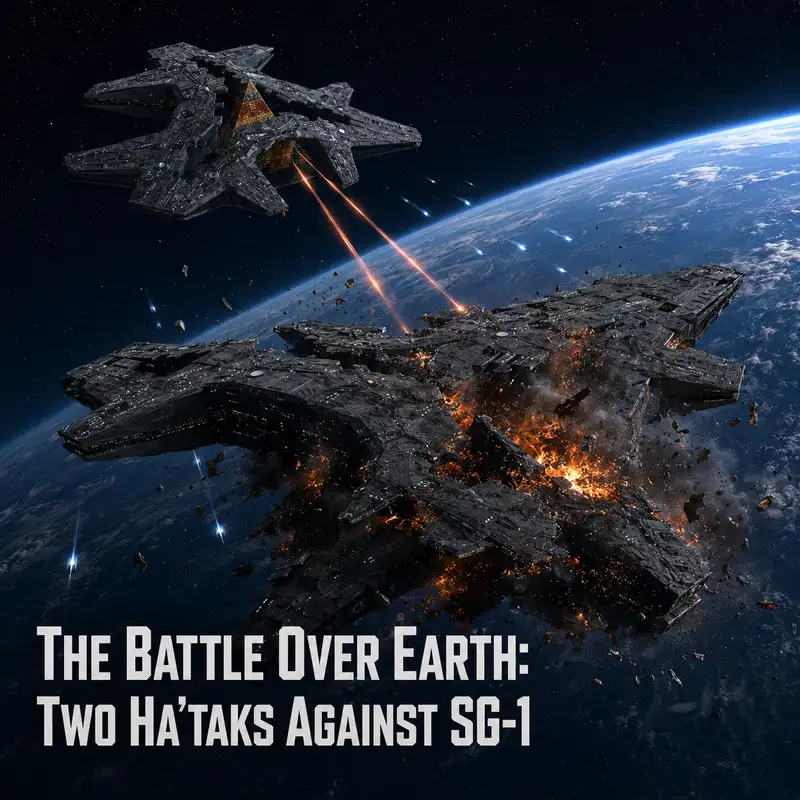
The Battle Over Earth: Two Ha’taks Against SG-1
The two missiles reached the Goa’uld ships without being intercepted. For a few seconds, that looked like success. Each carried a Mark twelve A warhead enhanced with naquadah and projected to yield more than one thousand megatons. Earth had never placed greater destructive power on a target. Then energy shields formed around both Ha’taks. The warheads detonated against barriers they could not penetrate, and Space Command reported no damage. Inside Cheyenne Mountain, the result ended any remaining argument about the balance of power. Earth had fired its strongest available weapons. Apophis and Klorel were still in orbit, still capable of striking the planet, and still apparently beyond reach.
The Battle Over Earth was therefore not a contest between comparable fleets. One side possessed two shielded capital ships, death gliders, ring transporters, orbital weapons, and crews trained for interstellar war. The other possessed no combat spacecraft at all. Stargate Command could track the enemy, launch experimental missiles, and evacuate a limited number of people through the gate. It could not maneuver against the Ha’taks or force them away from Earth. The battle was decided only because S G One had already crossed the defensive perimeter. The team was inside Klorel’s ship, carrying conventional explosives, working with Jaffa rebels, and trying to turn the enemy’s own vessels against one another.
That internal position had been gained almost by accident. Daniel Jackson’s experience in an alternate reality had provided the gate coordinates associated with an attack on another Earth. With the Stargate Program being shut down, S G One disobeyed orders and used those coordinates before the gate could be buried. The destination was not a planet. It was a Stargate installed aboard Klorel’s Ha’tak. Once the ship left the area from which that address worked and entered hyperspace, Stargate Command could not dial the team back. S G One had achieved extraordinary strategic access, then discovered that access came without reinforcement, resupply, medical evacuation, or a planned route home.
The team learned that the ship was carrying Klorel, the Goa’uld son of Apophis, inside the body of Skaara. They also confirmed that the vessel was part of an assault on Earth. Samantha Carter and Daniel placed C four throughout critical areas, intending to destroy the ship even if they died with it. Jack O’Neill and Teal’c attempted to reach Skaara through the symbiote’s control. The effort ended with Klorel shot, restored to life in a sarcophagus, and S G One captured. By the time the ships reached Earth, the team’s original sabotage plan was still active, but the people who had armed it were locked in a cell and the second Ha’tak had arrived beside the first.
Apophis then made the decision that gave Earth its only usable margin. He delayed the attack until Klorel recovered. This was not military necessity. The two ships were already capable of beginning the bombardment. It was a dynastic decision by a ruler who wanted his son restored, present, and able to participate in the destruction of Earth. The delay allowed Stargate Command to prepare the missile strike and continue moving selected personnel to the Alpha Site. It also gave S G One time to meet the one person aboard the assault force who understood both the ships and the political weakness of their commanders.
Master Bra’tac had returned to Apophis’s service as an infiltrator. He had spent years teaching selected Jaffa that the Goa’uld were false gods, while carefully rebuilding enough trust to join the Earth campaign. His original plan was to use a small wing of loyal death glider pilots to attack Apophis from Klorel’s formation. The strike would appear to be a betrayal ordered by the son. Bra’tac expected Apophis to retaliate against Klorel, turning dynastic suspicion into a fight between the two ships. It was an intelligence operation disguised as a tactical mutiny, built on the assumption that Goa’uld family loyalty was less reliable than their weapons.
S G One’s attack on Klorel had disrupted that plan. The shooting united father and son against a common enemy and left Bra’tac scrambling to keep the captured humans alive. Yet their interference also created new opportunities. The C four had already been planted. Klorel’s recovery had delayed the campaign. Skaara remained strong enough to resist the symbiote at critical moments. Most important, Bra’tac now had four additional personnel who were willing to die rather than allow the bombardment to begin. The original plan could no longer work as designed, but its essential insight remained valid. The Ha’taks were too strong to defeat from outside. They had to be broken from within.
Bra’tac released the team and explained the tactical reality. A direct attack by a handful of death gliders had almost no chance against a Ha’tak protected by shields and capable of launching a much larger fighter force. O’Neill rejected a suicide attack that would damage little and save nothing. The explosives on Klorel’s ship were due to detonate within the hour. If the team could move that vessel close enough to Apophis’s Ha’tak, and if the second ship’s shield could be disabled, one demolition might destroy both. The plan depended on capturing Klorel’s bridge, using the transport rings to cross between ships, sabotaging Apophis’s controls, reaching the shield generators, and escaping before the timer expired. It was an ambitious list for people who had recently been prisoners.
The corridor movement demonstrated the value of an insider. S G One did not possess a deck plan, a shipboard communications network, or a reliable count of the Jaffa between the cell and the bridge. Bra’tac knew the route, understood guard behavior, and still carried the authority of a trusted servant. At several points, his presence allowed the group to move farther before the alarm was raised. This was not stealth in the conventional sense. It was exploitation of identity and hierarchy. The ship’s security system depended on Jaffa recognizing rank and ritual. Bra’tac used that expectation as a credential until the moment he chose to reveal his rebellion.
Klorel’s bridge was the first decisive objective. Bra’tac entered as a loyal subordinate and then rejected Klorel’s claim to divinity. When the Goa’uld attacked him, S G One assaulted the compartment. The engagement was fought at close range with Earth firearms, Goa’uld weapons, and very little room for error. The team did not need to clear the entire ship. It needed to seize the control center long enough to alter the vessel’s course and take Klorel alive. That limited objective made the operation possible. Even so, Jaffa reinforcements were already moving through the corridors, and Daniel had to hold the approach while the others secured the bridge.
Daniel was struck in the chest by a staff weapon while covering the team. Under normal conditions, the casualty would have forced an immediate medical evacuation or at least a pause for treatment. Neither option existed. The only route to safety required continuing the assault, and the C four timer would not stop for a wounded team member. Daniel understood the calculation before O’Neill accepted it. He remained behind, still armed, while the others moved Klorel to the ring platform. The decision was tactically necessary and personally brutal. O’Neill had to leave a friend who appeared mortally wounded on a ship the team itself had rigged to explode.
With Klorel as a hostage, Bra’tac, O’Neill, Carter, and Teal’c used the transport rings to enter Apophis’s bridge. The maneuver bypassed bulkheads, guard posts, and the outer shield. It was effectively a ship-to-ship boarding action without crossing open space. Apophis could not order his Jaffa to fire without risking his son. Teal’c used that hesitation to control the room while Bra’tac damaged the command systems. Klorel was then left with Apophis, and the bridge was sealed behind the raiding party. The father and son were alive, but their vessel could no longer maneuver normally as Klorel’s ship moved closer.
The second objective was the shield generator. Bra’tac began explaining the long route required to reach machinery located deep within the Ha’tak. O’Neill instead used the last two fragmentation grenades, dropping them from the access walkway into the exposed system below. The weapons were crude beside Goa’uld technology, but technological sophistication was not the relevant measure. The grenades did not have to defeat a shield from outside. They only had to damage the equipment producing it from inside the protected hull. A defensive system capable of surviving naquadah-enhanced nuclear detonations was disabled by explosives that an infantryman could carry in his pockets.
This was the technical center of the battle. Earth did not suddenly acquire a weapon powerful enough to destroy a shielded Ha’tak. S G One changed the geometry of the problem. The team bypassed the shield through gate access, moved between ships through the ring system, and attacked the generator on the protected side of the barrier. Once the energy field failed, Apophis’s vessel became vulnerable to the destruction of a second capital ship at point-blank range. The success depended on access, timing, and local knowledge rather than raw yield. The missiles had failed because they struck the strongest layer of the defense. The grenades succeeded because they never had to meet that layer.
Bra’tac had already directed Klorel’s ship toward Apophis’s. The C four aboard the first vessel now served as the primary demolition charge, while the mass and proximity of the two Ha’taks ensured that the explosion would not remain confined to one hull. Apophis recognized the danger and attempted to maneuver away, but the damaged controls did not respond. He and Klorel escaped from the bridge through the transport rings before the final impact. Their survival prevented the battle from becoming a complete decapitation strike, but their absence did not save the ships or the Jaffa crews still aboard them.
The raiding party still needed an extraction route. Bra’tac led the survivors toward a glider bay while the timer continued to run. A Goa’uld shock grenade incapacitated the guards, and the group divided between two death gliders. The fighters offered the only immediate way off Apophis’s ship, but they were not designed as long-duration lifeboats. They had to clear the hangar, outrun the destruction of two capital ships, survive the blast, and remain operational long enough for someone on Earth to find them. No friendly combat air patrol waited outside. Earth had won no control of the orbital battlespace. It had only created a narrow path through it.
Daniel’s survival followed a different route. After O’Neill left him, he reached a sarcophagus aboard Klorel’s ship. The device repaired the staff-weapon injury and restored him before the explosives detonated. This was not part of the mission plan and did not represent an Earth medical capability. It was a one-time use of enemy technology found in the right place at the last possible moment. Daniel then reached the onboard Stargate. Once the ship was close enough to Earth for the available point of origin to function, he dialed the Alpha Site and crossed the wormhole seconds before the ship was destroyed.
The two escape methods reveal how improvised the operation had become. O’Neill, Carter, Teal’c, and Bra’tac left through a fighter bay on the second Ha’tak. Daniel left through a Stargate on the first. Neither group knew the other had survived. Neither route had been available when the mission began. The gate that had trapped S G One aboard the ship later became Daniel’s extraction system. The gliders intended to attack Earth became the vehicles that carried the saboteurs away. The battle was won by converting enemy infrastructure into friendly mobility faster than the enemy could understand what was happening.
Klorel’s Ha’tak collided with Apophis’s unshielded vessel as the C four detonated. Both ships were destroyed above Earth in a fireball visible across a wide area. At Stargate Command, the sudden reports of light in the sky confirmed that the immediate threat had ended, but the control room did not yet know how. The missile strike had failed. No Earth aircraft had reached the targets. General Hammond could only infer that something had happened aboard the ships. The planet was saved by an operation its own command structure could neither observe nor control once S G One crossed the gate.
The destruction did not end the danger to the team. The blast damaged both death gliders, leaving them low on power in a decaying orbit. They lacked the energy to remain aloft and had no established procedure for landing Goa’uld fighters on Earth. Tactical success had produced a new survival problem. Carter calculated that the gliders would eventually enter the atmosphere and burn. The surviving raiders could see the planet they had saved while knowing that they might not reach its surface. It was a fitting final condition for an unauthorized mission whose extraction plan had disappeared before the enemy ships even reached the solar system.
The rescue came from the space shuttle Endeavour. Stargate Command had kept the shuttle ready and sent it to investigate the changing situation in orbit. Endeavour was not a combat platform and could not have challenged a Ha’tak. It could, however, locate the damaged gliders once the capital ships were gone. Earth’s existing space program therefore completed an operation that its military systems could not. The shuttle’s role was modest compared with the destruction above it, but operationally essential. A mission is not finished when the target explodes. It is finished when the surviving personnel are recovered, accounted for, and returned to command.
Measured tactically, S G One and Bra’tac destroyed two enemy capital ships and prevented the bombardment of Earth. Measured as a mission, the team achieved far more than the original reconnaissance and sabotage effort had promised. Measured strategically, the result was less complete. Apophis and Klorel escaped. The Goa’uld remained capable of returning with other ships. Earth still had no repeatable method for penetrating Ha’tak shields and no fleet able to intercept another assault. The victory removed the immediate force, not the larger threat. It bought time, preserved the planet, and proved that Goa’uld military superiority contained exploitable weaknesses.
Those weaknesses were institutional as much as technical. Apophis delayed for his son, concentrated command in a dynastic pair, trusted Bra’tac because ritual loyalty appeared intact, and relied on Jaffa obedience inside the ships. The Ha’taks were designed to withstand attack from outside. Their crews were less prepared for a senior Jaffa defector, a rebellious human host, and an enemy team already within the hull. Goa’uld command culture treated fear and worship as substitutes for internal security. That system worked until people who understood it stopped believing. Once Bra’tac and Teal’c acted openly, the ships’ hierarchy became a map of vulnerabilities.
Skaara’s resistance also shaped the battle, although he never controlled the wider operation. When the naquadah-enhanced missiles approached, Klorel hesitated before raising his shield. The delay was not long enough to let the warhead through, but it showed that the host remained active inside the commander. Klorel later admitted that the host was strong. Apophis answered with pressure rather than caution, ordering his son to begin the attack. The assault force therefore carried resistance inside its own command body. Earth did not win because Skaara alone stopped the bombardment, but his struggle repeatedly complicated Klorel’s decisions and denied the Goa’uld the complete control they claimed to possess.
S G One’s strengths were equally specific. Daniel supplied the warning and later recognized the gate as an escape route. Carter understood the explosives, the ship’s movement, and the orbital problem. Teal’c provided knowledge of Goa’uld weapons, Jaffa behavior, and Bra’tac’s intentions. O’Neill kept redefining the objective as conditions changed, refusing both a futile glider attack and passive acceptance of death. Bra’tac supplied the access, deception, shipboard knowledge, and political understanding that turned those skills into a workable plan. No member could have replaced the others. The team succeeded because military command, science, archaeology, and insider intelligence operated as one small unit.
The battle also vindicated General Hammond’s decision to continue the Alpha Site evacuation after the missiles launched. He did not confuse a weapon in flight with a confirmed victory. Selected personnel kept moving through the gate while the strike was assessed. That caution mattered because the warheads failed completely, and their electromagnetic effects complicated satellite communications. Hammond was preparing for national and perhaps civilizational defeat while S G One tried to prevent it. The two efforts were not competing plans. One sought to save Earth. The other sought to preserve something human if Earth could not be saved.
Politically, the attack destroyed the argument that the Stargate could be buried and forgotten. The program’s enemies had treated the gate as the source of the danger, as though ending exploration would restore isolation. Apophis’s ships demonstrated that the threat no longer depended on Earth dialing anyone. The Goa’uld knew the planet’s location and could arrive by hyperspace. Closing Stargate Command would have removed Earth’s best intelligence and response organization without removing the enemy. The same unauthorized team that embarrassed the chain of command also supplied the only successful defense. That is not an ideal model of civil-military governance, but it is a persuasive budget justification.
The Battle Over Earth became a foundational victory because it established a pattern that would define Earth’s early war. The Tau’ri could not meet the Goa’uld ship for ship. They could exploit gates, defectors, captured technology, internal political divisions, and small-team initiative. They could make a stronger force fight under conditions for which its advantages were poorly suited. That approach was powerful, but dangerous. It depended on exceptional access, limited numbers of trusted personnel, and plans assembled under pressure. It was a method for surviving long enough to build real capability, not a substitute for planetary defense.
Two Ha’taks came to Earth expecting no meaningful opposition. Their shields defeated the strongest weapons launched from the surface, and their crews held every conventional advantage. They were destroyed because S G One was already inside the formation, Bra’tac had already penetrated the command structure, Skaara had not surrendered his body, and the Goa’uld could not imagine that their own systems would become the means of their defeat. Earth won its first battle in orbit without a warship. The victory proved that technological inferiority was not the same as helplessness. It also proved that the next attack could not be allowed to depend on four people finding another unlocked door.