The Doci and the Ori Chain of Command
Daniel Jackson believed he had finally reached the top of the Ori religious hierarchy. He had argued with a Prior, challenged the Book of Origin, and asked to speak with the official who carried the title Doci. The request was granted. Inside Celestis, the Doci listened without visible anger as Daniel questioned whether the Ori were gods at all. Then he led Daniel to the Flames of Enlightenment, raised his arms, and became the mouth through which the Ori answered. Daniel had not reached an adviser who could petition the leadership. He had reached the human terminal of the leadership itself.
That moment revealed the central function of the Doci. He was the highest visible human authority within Origin, the senior figure among the Priors, and the principal intermediary between the ascended Ori and their followers in physical form. He taught doctrine, transmitted orders, supervised key conversions, and gave sacred legitimacy to political and military action. Yet he was not an emperor in the ordinary sense. The Ori remained the source of authority. The Doci’s power came from his proximity to them and from the belief that his words carried their will.
The surviving record does not explain how the Doci was selected, how long he served, whether the title belonged to one individual, or how succession worked. Only one Doci is seen clearly. What can be reconstructed is a functional chain of command. At the top were the ascended Ori. Beneath them stood the Doci in Celestis. Priors carried policy to worlds and armies. Local administrators enforced Origin inside communities. Human commanders directed soldiers and ships. Converted rulers linked existing political systems to the new order.
This hierarchy was religious, but it was also operational. The Ori did not govern millions of followers by appearing personally in every village. Direct intervention risked conflict with the ascended Ancients, and the Ori’s own political system depended on preserving their image as remote sources of truth. The Doci solved both problems. He allowed beings on a higher plane to issue commands through a corporeal office. The Priors then carried those commands through Stargates and aboard warships. Every level below the Ori remained physically human, even when altered by advanced knowledge and biology.
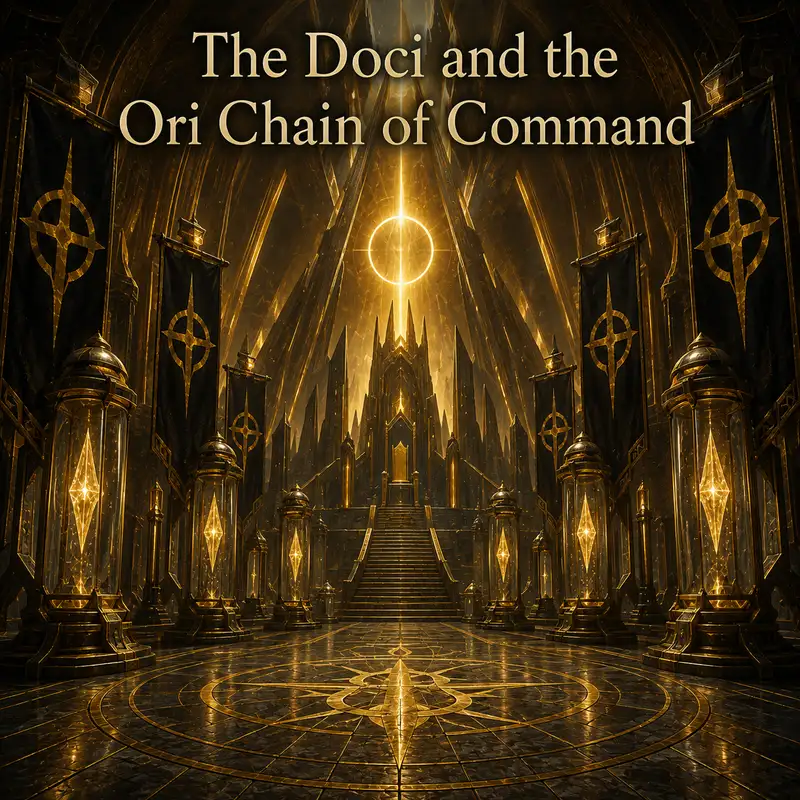
Celestis was the ideal headquarters for that system. The city was presented to believers as the City of the Gods, a sacred center rather than a conventional capital. The Doci’s chamber stood beside the Flames of Enlightenment, the visible manifestation through which the Ori could communicate. Access to that space was controlled. A villager could appeal to an administrator. An administrator could receive a Prior. A Prior could bring an exceptional person before the Doci. The Doci alone was shown standing at the threshold where human authority met the ascended power behind it.
Control of access was itself a form of command. The Doci’s office stood at the final human checkpoint before anyone was presented to the Ori, and each audience could become a demonstration of divine authority. Daniel entered the chamber believing that a senior religious leader might have misunderstood evidence from the past. The Doci allowed him to state the case, then showed that the doctrine was not an accidental interpretation created by human priests. The Ori spoke through him directly. The hierarchy was not protecting absent gods from difficult questions. It was delivering those questions to rulers who had already decided that disagreement was evil.
The possession of the Doci also clarified his ambiguous status. He was powerful enough to command Priors, yet his own body could be taken over as a communications instrument. When the Ori entered him, his eyes changed and his voice ceased to be entirely his own. The spectacle confirmed his authority to believers, but it also demonstrated the limit of his independence. He could interpret doctrine until the Ori chose to speak. At that point, the interpreter became the channel. A chief of staff normally briefs the commander. The Doci occasionally had the commander use his nervous system.
Daniel’s accidental contact gave the hierarchy a new strategic objective. The Ori learned that the Milky Way contained vast human populations hidden from them by the Ancients. The Doci immediately translated that discovery into action. A Prior had already been dispatched through the network. Daniel and Vala were returned to Ver Eger so that local heretics could be exposed and punished. The Doci framed the distant galaxy as a population led away from truth and therefore requiring correction. Intelligence became doctrine, doctrine became an order, and the order moved through the gate before Earth understood that a war had begun.
The sequence shows the Doci doing more than repeating scripture. He received information, defined its political meaning, and tasked subordinates. The Milky Way was not described as a neutral region awaiting exploration. It was designated a theater of unbelief. Its inhabitants were placed into two administrative categories, those who would accept Origin and those who would require punishment. Once that classification had been made, Priors could operate with broad discretion while remaining aligned with the same strategic purpose.
The first phase of the campaign required no fleet headquarters in the Milky Way. Priors moved independently through ordinary Stargates, selected target populations, and reported the Ori’s terms. Their orders were simple enough to survive long distances and uncertain communications. Spread Origin. Reward acceptance. Correct resistance. Prepare the way for larger forces. The Doci did not need to approve every village execution or every demonstration of power. He established the doctrine that made such actions legitimate, then relied on altered human agents whose loyalty had been tested before deployment.
Purpose was centralized, while execution was decentralized. The Ori decided the end state. The Doci converted that end state into sacred policy. Priors chose methods suited to local conditions. Administrators and collaborators supplied knowledge of the population. Soldiers enforced the result. The arrangement allowed rapid expansion without requiring constant contact with Celestis. It also made abuses predictable. When subordinates are told that unbelief is evil and destruction is purification, local initiative rarely produces a restrained occupation.
The Doci’s authority extended into personnel selection. The administrator of Ver Eger had enforced worship, conducted the trial by fire, and helped identify suspected heretics. He was later brought to Celestis and transformed into a Prior. The promotion sent a clear institutional message. Effective local repression could lead to a place in the mobile elite. The new Prior carried his village experience into the wider crusade, where he used disease, coercion, and political recruitment against populations in the Milky Way. The hierarchy rewarded commitment by increasing the servant’s power and expanding his jurisdiction.
Gerak’s conversion was an even more important command decision. He was not an obscure villager. He led the strongest political coalition within the newly formed Free Jaffa Nation and possessed authority over substantial military forces. A Prior cultivated his interest in Origin, then used Ori power to bring Gerak’s consciousness before the Doci in Celestis while his body remained on Dakara. The Doci presented him to the Flames of Enlightenment and officiated as Gerak became a Prior. The event joined religious initiation to strategic recruitment.
By transforming Gerak, the Ori attempted to capture an emerging state through its senior leadership. The Doci’s participation supplied legitimacy that an ordinary Prior could not provide alone. Gerak returned able to demonstrate extraordinary powers before the Jaffa High Council. His new body was evidence, his office was political leverage, and his conversion threatened to turn Origin into the governing faith of a civilization that had only recently overthrown false gods. The chain of command had reached around the Jaffa military and placed its influence inside the council chamber.
Gerak also showed that the hierarchy managed loyalty as well as belief. The Ori gave him enhanced abilities and expected him to use political power against dissenting Jaffa. When he refused to murder Teal’c, Bra’tac, and their followers, his reliability became suspect. He later used his abilities to cure the plague on Earth, directly opposing the Ori’s campaign. His death followed almost immediately. Whether the Ori activated a deliberate safeguard or the transformation itself punished betrayal is not completely established, but the operational result was clear. Defection from the Prior class could carry an internal death sentence.
The Doci stood at the center of a promotion system with no separation between ordination, security clearance, and weapons authorization. A loyal administrator could become a Prior. A politically valuable ruler could be elevated into the same class. Transformation granted access to knowledge and biological abilities unavailable to ordinary humans. It also bound the recipient more tightly to the Ori. The process created commanders whose authority rested on personal enhancement and whose survival may have depended on continued obedience.
The human military chain operated alongside this religious hierarchy rather than replacing it. Ori soldiers had officers, formations, weapons, and ships. Commanders such as Tomin handled discipline, movement, and combat decisions. Priors accompanied those forces as ideological authorities and representatives of sacred policy. A military commander could arrange a surrender or accept prisoners, only to have a Prior redefine the situation and order executions. In such cases, professional authority ended where religious authority began. The soldier controlled the formation. The Prior controlled the meaning of the mission.
The Doci stood above that relationship because he defined the doctrine from which the Prior’s authority flowed. He did not need to command individual squads. His proclamations established why armies were being raised and what victory required. Through Vala’s contact with Daniel, Stargate Command learned that the Doci had announced the gathering of holy armies, the construction of ships, and the destruction of those classified as wicked. It was a mobilization order expressed as prophecy. Shipyards, training grounds, religious instruction, and strategic planning were joined by one statement of sacred purpose.
That wording mattered to logistics. The Ori crusade required crews, soldiers, food, weapons, construction labor, and an industrial system capable of producing enormous warships. Origin converted those burdens into acts of devotion. A worker building a ship was not merely supporting a government contract. He was serving a divine campaign. A soldier crossing the supergate was not told that he was securing territory for an ascended ruling class. He was carrying enlightenment to people described as victims of Ancient deception. The Doci provided the narrative that turned mobilization into worship.
The resulting chain was resilient because each level reinforced the others. The Ori’s power validated the Doci. The Doci validated the Priors. Priors validated local rulers and military commanders. Those rulers organized public worship, which strengthened the Ori and confirmed the apparent truth of the entire system. Information traveled downward as revelation and upward as devotion, obedience, and reports from the field. A population could be governed without ever seeing the beings at the top. It only needed to believe that the next official in the chain spoke for them.
Compartmentalization also protected the system. Ordinary followers did not know that worship transferred power to the Ori or that the promise of ascension was false. Soldiers knew the mission but not the strategic economy behind it. Priors possessed greater knowledge, yet the record does not establish that every Prior understood the full deception. The Doci stood closer to the source than any other human official, but his later reaction suggests devotion had not become cynical collaboration. Each level knew enough to perform its role and not enough to challenge the purpose.
The Doci is difficult to classify morally. He ordered punishment, enabled conversion campaigns, and represented an expansionist system. He was not an innocent ceremonial hostage. Yet there is no clear evidence that he understood the Ori’s central fraud. He appears to have believed they were gods and that service led toward enlightenment. His body could be occupied, his perceptions were shaped by controlled information, and doubt could be punished by death. He was both an architect of the system and one of its most controlled products.
The arrival of Adria changed the visible command arrangement in the Milky Way. The Ori engineered her as the Orici, a corporeal leader carrying as much of their knowledge as a human mind could contain. She commanded the crusade, directed Priors and military forces, and provided a senior presence close to the operational theater. This did not eliminate the Doci’s office in Celestis. It created a more direct field command above the expeditionary forces. The Doci remained the central religious intermediary in the home galaxy, while Adria became the Ori’s embodied commander in the war zone.
This division resembled a strategic headquarters and a theater command, though the analogy has limits. The Doci sustained doctrine, ritual authority, and the Prior network centered on Celestis. Adria pursued military objectives, searched for threats such as the Sangraal, and adapted the campaign to resistance in the Milky Way. Both derived authority from the Ori. Neither represented an independent branch of government. The system allowed the Ori to preserve a sacred center while placing a commander with exceptional knowledge beside the fleets.
When the Sangraal destroyed the ascended Ori, the command structure did not immediately collapse. Priors continued to preach. Warships continued to fight. The Doci remained in Celestis. Followers had no reliable way to confirm what had happened on the higher plane, and reports that the fires of Celestis had gone out could be suppressed, discounted, or explained away. Adria eventually ascended and inherited the power generated by the remaining worshippers. The institution outlived its original leadership because orders, rituals, and beliefs had already been distributed through human organizations.
This persistence demonstrated why killing the leader of a coercive system does not automatically end the system. The Doci, Priors, commanders, and administrators could continue acting in the Ori’s name. Their authority depended on belief, but belief did not require daily proof. Silence from above could be interpreted as mystery, judgment, or a test. The Doci’s office helped preserve continuity because it gave the human hierarchy a familiar center even after the ascended collective was gone. The machinery of conquest could operate for some time on stored legitimacy.
The Ark of Truth was aimed at that legitimacy rather than the Ori fleet’s engines. When Daniel, Vala, Teal’c, and Tomin reached Celestis with the Ark, the Doci became the decisive target. Exposing an ordinary soldier would have changed one mind. Exposing the Doci changed the conviction of the central human node. The Ark forced him to recognize that the Ori were not gods and that the system he had served rested on deception. His certainty collapsed, and with it the religious authority attached to his office.
The effect moved through a connection linking the Doci and the Priors in the Ori home galaxy. Ori warships attacking the Odyssey ceased fire as the Prior hierarchy received the new understanding. The change did not destroy their bodies or disable their ships. It removed the command legitimacy that made the attack sacred and obligatory. The Doci had spent years functioning as a relay for Ori authority. The Ark reversed the direction of that relay and used the same network to distribute disillusionment.
The limitation of the effect is equally revealing. Priors already operating in the Milky Way did not all receive the change from Celestis. Stargate Command later exposed a captured Prior on Earth to the Ark so that the truth would spread through the local network. The command system was connected, but not perfectly across intergalactic distance. Celestis remained the center of the home-galaxy hierarchy, while the expeditionary branch had become operationally distinct. Even a religious empire with ascended leadership encountered communications boundaries.
After seeing the truth, the Doci asked forgiveness. The reaction suggests he had not privately understood the deception. It was a believer confronting the human cost of commands treated as holy. Forgiveness could not undo executions, plagues, forced conversions, or the fleets sent through the supergate. It did mark the political end of the Doci as an unquestioned mouthpiece. Once he could no longer claim that the Ori were gods, the chain beneath him had to find another source of legitimacy.
Tomin returned to the Ori home galaxy to help lead people through that transition. Origin itself did not have to vanish entirely. Some of its moral teachings could be separated from the false claims and coercive institutions built around them. That distinction would have been impossible under the old chain of command because the Doci’s interpretation was protected by the Ori’s power. After the Ark, doctrine could become a subject of human judgment rather than an order transmitted from an ascended ruler.
The Doci’s importance did not come from commanding the largest fleet or possessing the strongest individual abilities. It came from location within the system. He stood where revelation became policy, where policy became assignments for Priors, where loyal servants became enhanced officials, and where military conquest acquired sacred meaning. The Ori could remain distant because the Doci made their will administratively usable. Priors could act independently because his office gave their actions a common authority.
That same concentration created the system’s fatal vulnerability. The Ori built a hierarchy in which one human figure validated the agents below him and could be used as a direct channel by the rulers above him. As long as the Doci believed, the chain could turn doctrine into fleets, plagues, conversions, and executions across two galaxies. Once his belief changed, the network carried a different message. The man who had served as the voice of the Ori became the point through which their empire learned that the voice had been lying.