The First Wraith Awakening
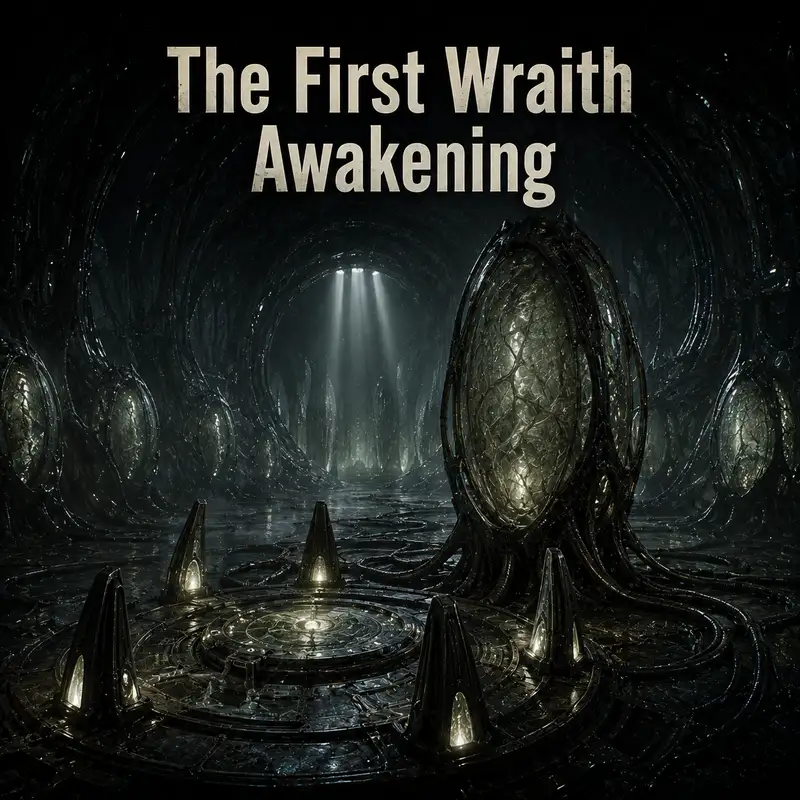
The life-signs detector in John Sheppard’s hand began filling with targets. One point became several, then dozens, then hundreds. All around the chamber, dormant Wraith were opening their eyes. Sheppard and Lieutenant Aiden Ford had entered the facility to recover prisoners taken from Athos. They had found Colonel Marshall Sumner, ended his suffering, killed the Wraith woman guarding the sleepers, and completed the rescue. The immediate mission had succeeded. The larger campaign had just begun.
The woman’s final warning was simple. She and those around her were caretakers for the Wraith who slept, and her death would awaken the others. Sheppard had no time to ask whether she meant one facility, one hive faction, or the entire species. The answer did not matter inside the room. The life-signs display showed enough enemies to overwhelm the rescue party, and Wraith Darts were already moving to block the route home.
This was the first Wraith awakening directly encountered by the Atlantis expedition, but it was not the first awakening in Pegasus history. Human societies across the galaxy had lived through repeated culling cycles for thousands of years. The Wraith slept while populations recovered, then emerged to harvest them. What made this awakening different was its timing and scale. It occurred early, before the human food supply had replenished, and it was tied to the discovery of Atlantis and the existence of Earth.
Wraith hibernation was not a period of harmless inactivity. It was a logistical system. Adult Wraith needed human life to survive, heal, and preserve their extraordinary longevity. The population of Pegasus could not support every hive at full activity indefinitely. Long dormancy reduced demand while human communities rebuilt after earlier cullings. A smaller number of Wraith remained awake to watch feeding grounds, conduct limited raids, and maintain the sleeping forces.
Awakening was therefore a mobilization process, not merely a biological event. Dormant warriors had to regain strength. Organic ships had to restore active systems. Darts needed pilots, weapons, and launch control. Prisoners had to be collected so newly active crews could feed. A hive leaving hibernation might become dangerous almost immediately, as Sheppard’s team discovered, but sustained operations still required the same resources that had made dormancy necessary in the first place.
The arrangement converted time into supply. Villages replanted fields. Children were born. Trade resumed. Survivors rebuilt homes whose previous occupants had been taken. When the available population reached a useful level, the Wraith returned. Human societies experienced the interval as uncertain peace. The Wraith experienced it as resource recovery. Neither side needed a written schedule for the system to shape every political and military decision in Pegasus.
The Athosians understood that pattern better than the expedition did. Teyla Emmagan warned Sheppard that the Wraith slept for long periods and returned when human numbers had grown. Some Athosians could sense their approach, giving communities a little time to scatter or hide. That warning did not prevent first contact because Atlantis was already in crisis. Its underwater shield was failing, and the expedition needed shelter, food, power, and local intelligence immediately.
The contact mission also carried an unseen compromise. Sheppard found a pendant Teyla had lost years earlier and returned it to her. His Ancient genetic trait activated the object, which later proved to be a Wraith tracking device. The expedition had approached Athos seeking assistance and unknowingly transmitted a signal to the enemy. It was an intelligence failure caused by unfamiliar technology, incomplete local knowledge, and the understandable habit of treating an old personal object as something less than a strategic sensor.
Darts emerged through the Athos Stargate and attacked before the settlement could organize a defense. Their culling beams removed civilians and members of the expedition without requiring a landing force to load prisoners. Sumner, Teyla, Halling, and others vanished into the Wraith collection system. The remaining Athosians fled with Sheppard to Atlantis, where the city had just risen from the ocean. The expedition’s first diplomatic contact had become a refugee movement and a prisoner-recovery problem in a matter of minutes.
Elizabeth Weir authorized a rescue with almost no reliable intelligence. Ford had memorized the symbols used by the retreating Darts, giving Atlantis a destination. The team still lacked a detailed target layout, confirmed enemy strength, knowledge of Wraith command relationships, or assurance that the space-based Stargate would remain open for extraction. Sheppard had a Puddle Jumper, a cloak, Earth weapons, and a life-signs detector. It was enough to attempt the mission. It was not enough to predict what the mission might activate.
Inside the facility, the Wraith were not merely storing prisoners. The woman later called the Keeper was interrogating Sumner while feeding on him. Wraith feeding could weaken a victim, inflict extreme pain, and open the mind to telepathic pressure. Sumner resisted, but later evidence showed that the enemy learned about Earth. They did not obtain a normal gate address from him. They learned that a human world with billions of potential victims existed and that Atlantis represented the most promising route to reach it.
That intelligence changed the value of the expedition. Before the interrogation, Atlantis was an Ancient city unexpectedly occupied by unfamiliar humans. Afterward, it was a bridge to the richest feeding ground the Wraith had encountered in ten thousand years. The expedition had arrived with fewer than a few hundred people, limited weapons, and no dependable resupply. The strategic resource was not the population inside the city. It was the information and technology that might lead beyond it.
Sheppard found Sumner after the Keeper had already drained decades from him. Sumner could not be extracted in any meaningful condition, and his expression made his request clear. Sheppard shot him to stop the feeding. Ford arrived during the fight that followed, and Sheppard killed the Keeper with a Wraith weapon. Her death triggered the awakening around them. Whether she initiated a species-wide signal or activated a succession system whose effects then spread is not established. The immediate result was visible and unambiguous. The sleeping complex became an active enemy base.
The rescue party escaped under pressure. Wraith warriors pursued them through the facility, Darts attacked the team guarding the Jumper, and additional craft surrounded the space gate. Sheppard used the cloak to approach, then deliberately revealed the Jumper to draw the Darts away from the ring. He destroyed several with Ancient drones, dialed Atlantis, and forced the craft through the gate under fire. The pursuing Darts followed and were destroyed when Atlantis raised its gate shield.
Tactically, the operation recovered Teyla, Halling, and other prisoners. It denied the Wraith control of captured expedition personnel and prevented the immediate loss of regional allies. Operationally, it exposed Atlantis to an enemy whose mobilization system the expedition did not understand. Strategically, it helped transform Earth from an unknown distant world into a desired objective. The same mission could therefore be a rescue success, an intelligence failure, and the opening action of a larger war.
It is tempting to describe the awakening as the result of one reckless killing. That interpretation is too simple. Sheppard did not enter the chamber knowing that the Keeper’s death controlled hibernation. He was fighting an enemy who had tortured and killed his commander, was about to feed on him, and was surrounded by forces preparing to stop the rescue. Capturing her was not a practical option. Leaving her alive would not have erased what she had learned from Sumner or restored the people taken from Athos.
The expedition’s deeper error occurred before the final fight. It had entered an unknown strategic environment with no current intelligence service, no regional order of battle, and no doctrine for Wraith containment. That was not entirely avoidable. Atlantis itself was failing, and the first off-world mission had been launched to prevent the expedition from drowning. The team did not choose between careful preparation and reckless action. It chose between immediate action and the collapse of its only base.
The Wraith, by contrast, possessed several intelligence advantages even while most of their population slept. Tracking devices marked people and worlds. Darts conducted rapid reconnaissance. Captured humans could be interrogated during feeding. Telepathic communication allowed information to move through Wraith networks without normal radios. Caretakers and active factions preserved knowledge of feeding grounds. The sleeping civilization was not blind. It maintained enough awareness to recognize that Atlantis had become active again.
The exact path from one facility’s awakening to the wider mobilization remains incomplete in the surviving record. The Keeper stated that the others would awaken after her death, and hundreds did so immediately. Later, Teyla entered the Wraith telepathic network and learned that hives across Pegasus had awakened early. The evidence supports a broad chain reaction, but it does not establish one central alarm controlling every queen and every hive. Wraith society was too decentralized for that explanation to fit comfortably.
A more credible interpretation is that several mechanisms overlapped. The Keeper’s death awakened the local force. Those Wraith carried news of Atlantis, the new humans, and Earth into the wider network. Other hives awakened because a major Ancient city had returned to operation, because rivals were becoming active, and because the route to a vast new feeding ground might be claimed by whichever faction moved first. No queen could safely remain asleep while competitors pursued that prize.
The process also created a dangerous gap between biological readiness and strategic control. A newly awakened faction could launch local fighters and defend its chambers before its queen possessed a complete picture of events elsewhere. Reports would arrive through telepathy, captured minds, scouts, and other hives, some of them rivals. Mobilization could spread faster than coordinated policy. That helps explain why the Wraith became active across Pegasus without immediately behaving as one fleet under one commander.
This is where Wraith political structure became as important as Wraith biology. The species had no permanent central government capable of ordering most hives back into hibernation. Each queen had to consider her own territory, food supply, intelligence, and rivals. If one hive remained awake while another slept, the active faction could seize feeding grounds, ships, facilities, and influence. Returning to dormancy might have served the species collectively. It could have destroyed the faction that volunteered to go first.
The awakening therefore created a classic security dilemma. Every hive had reason to mobilize because others were mobilizing. Every additional awakening made the food shortage worse. Cooperation against Atlantis could occur because the city threatened all of them and offered access to Earth. Cooperation on rationing, territorial restraint, or renewed hibernation was far more difficult. The enemy was numerous enough to endanger Atlantis and divided enough to turn on itself.
At first, the expedition saw only fragments of that picture. Wraith appeared during an alarming number of early missions, causing security personnel to suspect that the Athosians were revealing team movements. The real explanation included tracking technology and a newly active enemy searching for information. The suspicion damaged the first alliance and demonstrated how an awakening can create secondary effects before commanders even understand that mobilization has occurred.
The Wraith also began tagging locations and watching the expedition’s routes. An Alpha Site selected as an evacuation destination was attacked even though it had been expected to remain hidden. From Atlantis’s perspective, the enemy seemed to appear wherever the expedition established a foothold. From the Wraith perspective, every team, gate address, and recovered device was a lead pointing back toward the city. The awakening was not simply thousands of bodies leaving hibernation chambers. It was the restart of a distributed reconnaissance and collection system.
Teyla provided the first reliable strategic warning. Her inherited traces of Wraith genetic material allowed her to hear portions of their telepathic communications. The connection was dangerous, difficult to control, and psychologically invasive. It also revealed what the sensors could not. Too many Wraith were awake. There was not enough food to sustain them. The approaching hives were not acting from calm confidence alone. They were operating under biological pressure.
Her second discovery was worse. The Wraith knew about Earth. Sumner’s interrogation had given them the concept of a new population beyond Pegasus, and Atlantis was the access point. The hives moving toward Lantea were not merely seeking revenge for the Keeper or removing an irritating outpost. They wanted the city, its database, its intergalactic gate capability, and any knowledge that could open the route to Earth.
That intelligence reframed the coming battle. Atlantis was no longer defending itself only to preserve an expedition. It was defending a classified pathway to another galaxy and a human population the Wraith regarded as an almost unimaginable reserve. The expedition had no routine way to warn Earth, no fully powered city shield, and no fleet capable of matching the approaching force. One rescue mission had converted an isolated research base into the forward edge of Earth’s planetary defense.
The first major Wraith advance consisted of hive ships and supporting vessels moving toward Atlantis. Long-range sensors finally gave Weir enough warning to prepare. The expedition searched for zero-point modules, restored an Ancient weapons satellite, established evacuation plans, recorded messages for Earth, and prepared to destroy the city if it could not be held. Every measure reflected the same conclusion. The Wraith could not be allowed to capture the route, even if preserving that secret required sacrificing Atlantis.
One Ancient satellite destroyed a hive before failing. The remaining ships continued. Earth eventually forced open a brief intergalactic connection and sent reinforcements, weapons, and later the Daedalus. Atlantis survived by combining Ancient defenses, Earth nuclear weapons, railguns, Puddle Jumpers, deception, and a newly delivered zero-point module. The city was not saved by one superior system. It was saved by a layered defense assembled faster than the awakened Wraith could understand it.
The immediate siege ended without giving the Wraith Earth’s location, but the awakening did not end with the retreating fleet. Hives remained active across Pegasus, and their food requirements exceeded what the galaxy could sustain. Human worlds faced cullings earlier and more frequently than the old cycle had conditioned them to expect. Communities that had planned around generations of relative quiet now encountered hungry fleets operating on compressed timelines.
The human cost was distributed and difficult for Atlantis to measure. A hive diverted toward one world might never appear on the city’s sensors. A village could vanish without leaving a report. Trade networks collapsed when gates became dangerous. Refugees carried warnings that arrived after other settlements had already been marked. Atlantis became the principal focus of Wraith strategy, but ordinary people across Pegasus paid much of the price for the mobilization.
Scarcity also pushed the hives toward factional warfare. Queens competed over feeding grounds, ships, prisoners, and technology. Alliances formed around immediate threats and dissolved when the advantage shifted. Some Wraith approached Atlantis with proposals to attack rival hives. Others sought biological solutions to the food problem or weapons that would make competitors easier to consume. The first awakening did not produce one unified invasion force. It produced a crowded battlespace filled with predatory states under pressure.
That fragmentation later gave Atlantis opportunities. Rival hives could be deceived, negotiated with, or turned against one another. Individual commanders such as Todd could cooperate when their faction’s survival required it. Those openings should not be mistaken for control. Every alliance depended on temporary interests, and every successful strike against one hive could strengthen another. The expedition had awakened an enemy coalition problem, not a single army waiting for a final battle.
The event also showed why the Wraith had survived the Lanteans. Their strategic system expected long periods of dormancy, sudden mobilization, heavy losses, and decentralized continuation. Destroying one facility did not end the species. Killing one queen did not collapse every hive. Even the premature awakening, which damaged the balance between population and food, left enough ships and warriors to threaten Atlantis repeatedly. The system was inefficient, violent, and resilient.
The Keeper’s importance must therefore be kept in proportion. She was a critical node in the local hibernation arrangement and the person whose death triggered the visible awakening. The screen record does not prove that she personally administered every dormant Wraith in Pegasus. Her warning became true because the Wraith were linked by more than one chain of command. Biology, telepathy, rivalry, intelligence, and the discovery of Earth all pushed the species toward activity.
The same caution applies to Sheppard’s responsibility. He pulled the immediate trigger, but he did not create the Wraith, their feeding economy, or the ten-thousand-year system imposed on human worlds. The war already existed in suspended form. Atlantis ended the suspension by reactivating Ancient technology, signaling from Athos, exposing expedition personnel, and refusing to abandon captives. Sheppard’s action was the decisive moment inside a much larger collision that had begun when the expedition entered Pegasus.
The first awakening was therefore not simply a monster waking in a dark chamber. It was the mobilization of a civilization whose logistics depended on sleeping until its victims had reproduced. The rescue at the Wraith facility broke one control mechanism. Sumner’s interrogation revealed a prize large enough to draw rival hives toward the same objective. Atlantis survived the first response, but the old culling cycle did not recover.
Before the expedition arrived, the Wraith ruled Pegasus through absence as much as presence. Human societies feared the day the sleepers would return, yet they could rebuild during the years between cullings. After the awakening, that grim predictability was gone. Too many hives were active, too many queens were competing, and Earth had become the resource that might solve their shortage. The expedition saved its people from one chamber. In doing so, it opened every chamber around them.