The Free Jaffa Uprising and the Capture of Dakara
Ba’al believed the battle was over when his bridge crew reported that the Replicator ships had gone silent. He ordered boarding parties to reclaim the disabled vessels in the name of their god. Then Teal’c appeared on the communications screen and offered him mercy. Ba’al dismissed the demand because his fleet still surrounded the rebels. Teal’c corrected him. Free Jaffa already surrounded Ba’al. Bra’tac entered the bridge, disabled the Kull guards, and watched the crew surrender. Ba’al escaped by transport beam, but the image could not be repaired. A System Lord had abandoned his command ship because the warriors beneath him no longer believed.
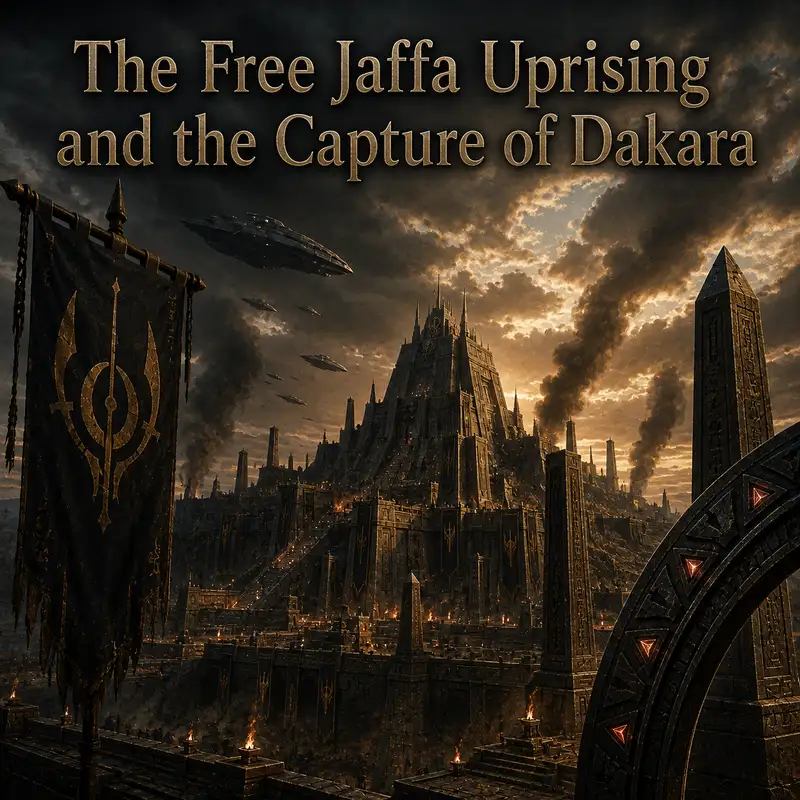
The capture of Dakara turned a failing insurgency into the Free Jaffa Nation because it attacked the foundation of Goa’uld rule rather than another outpost or patrol. Dakara was sacred ground, a fleet base, a political symbol, and the location of an Ancient device capable of affecting life across the Milky Way. Seizing it forced every Jaffa to answer the same question. If the Goa’uld were gods, how had rebels entered the holiest temple, defeated its defenders, and held it against the greatest military power still operating in the galaxy?
The Jaffa uprising had spent years growing as a hidden fifth column. Teal’c, Bra’tac, Rak’nor, Ishta, and other organizers recruited inside the armies of individual System Lords. Isolated revolts usually failed because another Goa’uld could absorb the surviving ships and warriors. Teal’c and Bra’tac therefore wanted coordinated uprisings across several domains, supported by defectors already positioned aboard enemy vessels. The rebellion required numbers, intelligence, transport, and a political idea capable of surviving the death of any one commander.
By the time Dakara became the objective, that plan was close to collapse. Human-form Replicators had launched a systematic campaign against the Goa’uld. Entire territories were falling, and the machines appeared immune to the best weapon Earth and the Asgard had developed against them. Thousands of frightened Jaffa began returning to their former masters, interpreting the Replicators as punishment for abandoning the gods. If the Goa’uld defeated the machines, they would claim divine credit. If the Replicators won, there might be no Jaffa civilization left to liberate.
Teal’c concluded that the rebellion could not wait for a better military situation. It needed an immediate victory in the war for belief. Destroying another Ha’tak would not be enough. Jaffa had seen Goa’uld ships destroyed before, and the surviving rulers always explained defeat as treachery, temporary weakness, or the work of a rival god. Dakara was different. It was woven into the religious history that justified Jaffa service. A rebel army occupying its temple would be a contradiction visible across every Goa’uld domain.
According to Jaffa tradition, Dakara was the site of the first Prim’ta ritual, the implantation ceremony that gave Jaffa strength and longevity while making them dependent on larval symbiotes. It was remembered as the cradle of Jaffa existence and was also linked in legend with Anubis. For thousands of years, the temple helped transform biological dependence into religious authority. Capturing it would turn the central monument of servitude into evidence that the gods guarding it were neither all-powerful nor especially attentive.
Dakara lay deep inside Ba’al’s territory and was normally heavily defended. The rebels could reach it only because Ba’al had committed much of his fleet against the Replicators. Surprise offered an opening, not a sustainable occupation. The uprising would have to concentrate nearly every ship it possessed, seize the temple before reinforcements arrived, defend the gate and surface approaches, and hold long enough for news to spread. Failure could expose the entire rebel fleet and end the movement in one battle.
The rebel council understood the risk. Aron and Tolok initially argued that the Replicators were the greater threat and that Dakara could not be held. Teal’c agreed that conventional battle against the machines would be suicidal. That was why the Jaffa had to fight the enemy they understood. Waiting would destroy the rebellion without a battle. Teal’c accepted that the entire cause might be lost, and the council committed its forces.
The available order of battle was small for an operation intended to overturn an empire. The rebels assembled five Ha’taks, eight Al’kesh bombers, and ten squadrons of death gliders. They also possessed Jaffa infantry, captured Earth weapons, transport rings, and allies still serving aboard Goa’uld ships. Against Dakara’s reduced garrison, that force was overwhelming. Against Ba’al’s main fleet, it was not. The campaign therefore depended on timing, deception, and the political effect of the first seizure. The fleet could open the door. It could not guarantee that the door stayed open.
The initial assault succeeded quickly. Ba’al’s remaining garrison was outnumbered, and the last defenders surrendered after only limited resistance. Bra’tac ordered them detained rather than executed. He told the prisoners that those who rejected the Goa’uld would eventually be free and assured them that they would not be harmed. This was more than humane treatment of fellow Jaffa. It was operational messaging. The rebels wanted the garrison to change sides, not become martyrs whose deaths Ba’al could use to restore loyalty.
Holding Dakara was the harder task. The temple’s columns and courtyards could be defended against infantry, but they offered no protection from orbital bombardment. Control of the Stargate provided reinforcement and communications, yet it did not prevent Ha’taks from arriving above the planet. The rebels had no planetary shield, no comparable reserve fleet, and no industrial base capable of replacing capital ships lost in the defense. Their position was politically powerful and militarily exposed. Bra’tac understood that a victory measured in hours might damage the cause more than no victory at all.
Anubis recognized the opportunity from the opposite side. He ordered Ba’al to abandon the wider battle with the Replicators, retake Dakara at any cost, and leave no rebel survivors. Anubis believed the uprising had concentrated its full strength where it could be annihilated. He also knew something the Jaffa did not. An Ancient device lay beneath the temple. In the wrong configuration, it could destroy life on a planetary or galactic scale, while Anubis’s partially ascended form might survive the result. Dakara was not merely sacred ground. It was the control point for his preferred version of a new galaxy.
Ba’al obeyed publicly and resisted privately. He served Anubis because the older ruler possessed power Ba’al could not yet defeat, but he had no desire to inhabit an empty galaxy designed by his master. Ba’al contacted Stargate Command and warned that the device had to be destroyed before his fleet reached Dakara. He then advanced more slowly than his ships were capable of traveling. His delay gave the rebels time while preserving the appearance of obedience. It was a narrow form of cooperation, conducted by a ruler who intended to betray everyone involved when the balance shifted.
Samantha Carter and Jacob Carter, blended with Selmak, traveled to Dakara with equipment intended to locate and destroy the device. The Jaffa had worshiped in the temple for generations without knowing that the structure was Ancient. Daniel Jackson’s notes helped decipher the inscriptions, and a rotating sequence hidden within the wall opened a concealed chamber. The rebellion had captured a symbol. Earth and the Tok’ra discovered that it was also a weapons installation.
The device did not function like a conventional bomb. Its controls altered the frequency of an energy wave capable of disassembling matter, with broader applications involving life itself. It could affect a planet and transmit energy through an active Stargate. Earth could calibrate the system with help, but could not reproduce it, repair it, or guarantee that an error would remain confined to Dakara. It was an Ancient device, which meant extraordinary capability accompanied by a noticeable shortage of instructions.
The original demolition plan changed when Carter realized that the output might be adjusted to match the Ancient-derived disruptor frequency effective against Replicators. The machines adapted rapidly whenever a small group was struck, sharing defensive changes through their subspace network. Destroying them permanently required hitting every Replicator before any surviving group could develop immunity. The Dakara device had the necessary power. The Stargate network provided the necessary reach. The remaining problem was making one gate connect to every other gate in the galaxy at nearly the same time.
Ba’al possessed the missing expertise. He had once exploited the Stargate network’s automatic update system to spread a dialing program from one gate to many. Carter needed him to turn that knowledge into a galaxy-wide delivery mechanism. Ba’al assisted by hologram while Carter and Jacob adjusted the Ancient controls. The chamber now held an Air Force scientist, a Tok’ra general, and a System Lord whose fleet was preparing to attack them. It was not trust. It was a temporary agreement that being consumed by Replicators would complicate their later disputes.
Above Dakara, Teal’c arranged the defense around deception rather than decisive engagement. Two Ha’taks and the Al’kesh moved behind the moon, while the death gliders deployed to the far side of the planet. Three visible Ha’taks remained to meet Ba’al. When his fleet attacked, those ships withdrew at sublight speed, presenting the appearance of a retreat and offering the concealed forces a chance to strike from another direction. Ba’al recognized the likely trap. He pursued anyway because every additional maneuver delayed his return to the temple and bought time for the device to be destroyed or redirected.
The battle became a three-sided engagement when the Replicator fleet arrived. Their ships attacked Ba’al’s formation, boarded Stargate Command through a hacked gate connection, and landed forces near the temple. The rebel Ha’taks were caught between fleets vastly larger than their own. Jaffa infantry withdrew toward the concealed chamber while insect-form Replicators swarmed through the ruins. On Earth, Jack O’Neill and the remaining base defenders were running short of ammunition. The same network intended to distribute the counterweapon was already carrying the enemy into the command responsible for using it.
Carter and Jacob still had to match the output frequency within a narrow margin. Ba’al’s guidance accelerated the process, although one adjustment moved the calibration in the wrong direction. The Dakara dial-home system then had to connect through the wider network. This was not normal Stargate behavior and did not become routine afterward. It depended on Ba’al’s earlier manipulation of the update protocol, the unique Ancient installation, and a crisis in which using the network mattered more than preserving its normal rules.
Daniel provided the final seconds. Replicator Carter had captured him and searched the memories buried from his time among the ascended. In doing so, she exposed more of the Replicator control network than she intended. Daniel used that access to freeze the machines throughout the battlefield. Replicators stopped in the corridors of Stargate Command, on Dakara, and aboard the surrounding ships. The pause did not last. Replicator Carter broke his control and mortally wounded him, but the interruption gave Carter, Jacob, and Selmak enough time to complete the calibration.
The Ancient device opened through the structure above Dakara and released its wave. Stargates across the Milky Way activated, carrying the energy into systems far beyond the planet. Replicator blocks disintegrated on the surface, inside capital ships, and within Stargate Command. The machines attacking the rebel fleet ceased functioning before they could fire the final shots. The operation destroyed the immediate Replicator presence across the galaxy without destroying Jaffa, humans, Goa’uld hosts, or the inhabited worlds connected to the network. It was scientific success at a scale no participant could have tested in advance.
The Replicators’ destruction changed the local balance instantly. Ba’al still possessed a large fleet and prepared to capture the disabled ships around him. He ignored what the battle had done to his crews. Jaffa had watched rebels take Dakara, survive his attack, help eliminate an enemy the Goa’uld could not defeat, and remain on the sacred world. Ba’al’s claim to divinity now had to compete with an after-action report witnessed by the people operating his weapons.
Teal’c offered Ba’al surrender while rebel forces boarded the command ship. Bra’tac and free Jaffa entered the bridge, disabled the Kull guards, and disarmed the crew. Ba’al escaped, but escape was the decisive political image. The rebels did not need his body to prove that he could be defeated. They needed his Jaffa to see him leave. His departure abandoned the fleet, the temple, and the warriors ordered to die for him. A Goa’uld ruler survived tactically and lost the battlefield that mattered most.
News traveled through Jaffa military networks faster than any formal declaration. Warriors across the galaxy abandoned the old allegiances and joined the victors. The movement gained ships, trained crews, weapons, gate addresses, and officers familiar with Goa’uld logistics. The capture of Dakara therefore produced more than a symbolic capital. It triggered a cascade in which the military structure of the System Lords began transferring to the rebellion from within. The Goa’uld were not defeated because every ruler had been killed. They were defeated because the Jaffa stopped supplying the obedience that made their empires function.
Dakara became the center of a newly declared Free Jaffa Nation. Teal’c and Bra’tac were honored as blood kin to all Jaffa, but both rejected the old habit of kneeling before authority. The ceremony used familiar forms while changing their meaning. A staff weapon touched the shoulders of the leaders, yet the assembled warriors were told to rise. The new state needed continuity with Jaffa culture without reproducing the submission at the center of Goa’uld rule. That was a political task, not a battlefield maneuver.
The first governing institution was a High Council drawn from leaders of the newly free armies, with Teal’c and Bra’tac among its interim members. It met the immediate need for representation and command coordination, but also carried old rivalries into the new government. Jaffa who had served different System Lords did not share one chain of command, legal tradition, or interpretation of freedom. Many still measured leadership through the ships and warriors a commander controlled.
Bra’tac recognized the problem quickly. The Jaffa had planned extensively for liberation and much less for the day after. Former enemies had to share bases, allocate captured fleets, protect worlds, distribute tretonin, and decide how to treat Jaffa still loyal to surviving Goa’uld. The Free Jaffa Nation also inherited relationships with Earth and the Tok’ra, allies whose help had been essential but whose priorities differed. Independence meant Dakara’s council could refuse their advice. It also meant the council owned the consequences.
The Ancient device created the first major dispute. Earth and the Tok’ra regarded it as an existential danger. The Jaffa council initially refused to destroy it, fearing that surrendering the system would weaken unity and leave the nation exposed to Anubis. From their perspective, outsiders were asking a newly liberated people to give up the weapon that had just saved the galaxy and secured their capital. From Earth’s perspective, an untested government controlled a machine capable of transmitting destructive energy through the Stargate network. Both concerns were reasonable. The machine remained dangerous.
Anubis exploited the new state’s inexperience. False intelligence suggested that his surviving Kull warriors were assembling on Tartarus. The Free Jaffa sent nearly half their available forces in a preemptive strike, hoping a common enemy would unite the still-fractured armies. Tartarus was empty. While the expedition was away, Anubis’s real force attacked Dakara, overwhelmed the reduced defenders, and seized the device. The episode exposed a basic weakness of revolutionary armies. Courage and battlefield experience do not automatically produce secure intelligence, strategic reserves, or disciplined national command.
The remaining defenders paid heavily. Kull warriors slaughtered Jaffa around the temple, and Anubis prepared to use Ba’al’s Stargate modifications to destroy life across the galaxy. The crisis ended only when Oma Desala confronted Anubis on the ascended plane and locked him in a struggle that prevented further action. Without their master, the Kull became disorganized. Returning Jaffa forces defeated them and retook Dakara. Many warriors died in a battle caused not by lack of courage, but by deception, divided forces, and the decision to retain a weapon that attracted every major enemy.
After the final recapture, Teal’c and Bra’tac reported agreement that the device should be destroyed and replaced by a memorial. Later events showed that it remained intact, evidence that consensus during crisis did not always become policy afterward. Dakara’s leaders had to reconcile military necessity, political symbolism, allied pressure, and the desire of a formerly enslaved people to control their own defenses. The problem was no longer whether Jaffa could decide their future. It was whether their new institutions could govern dangerous power responsibly.
The uprising succeeded because Teal’c chose a target with political meaning greater than its garrison. Ba’al’s redeployment created the operational opening. The entire rebel fleet created local superiority. Restraint toward captured Jaffa turned prisoners into potential citizens. Carter, Jacob, Selmak, Daniel, and even Ba’al helped eliminate the Replicator threat before it could erase the victory. Bra’tac’s boarding action converted a fleet engagement into visible proof that a System Lord could be abandoned by his own army. No single factor would have been sufficient.
Dakara also revealed the limit of military liberation. Seizing the temple broke the religious narrative and gave the rebellion a capital, a fleet, and a founding victory. It did not reconcile rival Jaffa traditions, create representative government, repair occupied worlds, or define relations with populations once guarded by Jaffa. Freedom removed the command that had organized their lives through coercion. It did not provide a replacement logistics system, legal code, or political culture. Those had to be built by warriors trained to believe that authority descended from someone wearing the symbol of a god.
The capture of Dakara ended Goa’uld dominion because it proved that the empire’s greatest military asset had become politically unreliable. The Ha’taks, Al’kesh, gliders, and staff weapons still existed. What disappeared was the assumption that Jaffa would use them for whichever ruler claimed divinity. The Free Jaffa Nation was born when the warriors controlling those systems changed the answer to whom they served. The final victory was not Ba’al’s empty throne or the Ancient wave crossing the galaxy. It was thousands of Jaffa standing on sacred ground without kneeling.