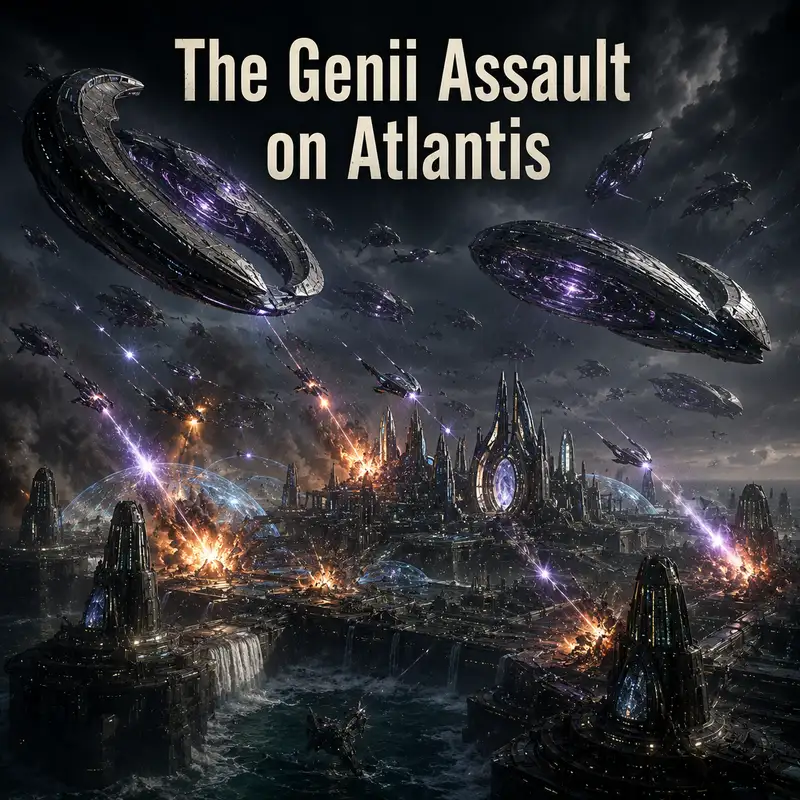
The Genii Assault on Atlantis
The incoming wormhole carried an Athosian identification code and a report of wounded people under attack. The two guards in Atlantis knew no one was expected until the following day, but the emergency appeared genuine. They lowered the gate shield and moved down the stairs to help. Figures in Athosian clothing entered around a covered stretcher. Commander Acastus Kolya rose from beneath the cloth, shot both guards, and ordered the room secured. Atlantis had not been breached by superior firepower. It had opened the door.
The Genii assault succeeded at first because it attacked trust, timing, and procedure rather than the city’s strongest defenses. A small strike force seized the gate room, captured Elizabeth Weir and Rodney McKay, and isolated John Sheppard inside a nearly empty city. The operation then failed because Cowen and Kolya confused possession of the command center with control of Atlantis itself. Their force was undertrained, their intelligence was incomplete, and their original supply raid expanded into an attempted occupation while a planetary storm imposed a deadline no commander could negotiate away.
The opportunity existed because Atlantis faced destruction from the weather. Two vast storms were merging over Lantea’s ocean and moving toward the mainland and the city. Without a charged zero-point module, Atlantis could not simply raise its shield. McKay and Radek Zelenka planned to disconnect four grounding stations, route lightning through superconductive conduits, and use the surge to power the shield long enough to survive the storm. It was dangerous and the only plan available.
Most of the expedition evacuated through the Stargate to Manara. Teyla, Lieutenant Aiden Ford, Carson Beckett, and several Athosian hunters remained on the mainland when the weather trapped their Puddle Jumper. Atlantis was reduced to fewer than ten people, most occupied with the storm-defense procedure. The gate room had only two guards, while Sheppard, Weir, and McKay worked separately across the city. The base had been stripped to the minimum crew required to keep it from sinking.
That vulnerability reached Cowen through a regional intelligence network Atlantis had underestimated. Smeadon, the Manarian leader sheltering the expedition, contacted the Genii and offered information for trade. He helped isolate an Athosian farmer named Doran, whose personal authentication device could transmit a valid code to Atlantis. Genii personnel forced Doran to operate it. The assault did not require breaking Ancient encryption. It required compromising a trusted user, still one of the most reliable ways to defeat security.
Cowen ordered Kolya to prepare the strike force training for specialized operations. Kolya objected. The personnel had guarded Genii facilities or conducted reconnaissance. They were not yet a mature assault unit. Cowen replied that Atlantis would soon contain fewer than ten people and that the objectives could be completed before the storm arrived. Kolya understood that a combat plan should not require everything to go well. Cowen understood that the opportunity might never return.
The initial objectives appeared achievable. The Genii wanted Atlantis’s C four explosives, medical supplies, the Wraith data device recovered during the failed joint mission, and one Puddle Jumper. Each item addressed a capability gap. Explosives supported mining and the nuclear program. Medicine served a population with limited health infrastructure. The Wraith device contained strategic intelligence. A cloaked Jumper could deliver teams and weapons where Genii industry could not send them on its own.
Kolya’s entry plan was disciplined. The Genii used the Athosian code, reported an attack on Manara, disguised themselves as refugees, and concealed their commander on a stretcher. The ruse created urgency and placed the defenders in a rescue mindset. One guard wanted Weir’s confirmation before lowering the shield. The other judged that wounded allies could not wait. By the time the warning reached Weir, the barrier was already down. Authentication had established identity, and the emergency story supplied intent. Neither had actually been verified.
The first shots gave the Genii local control and created their first political problem. Sora argued that the guards could have been overpowered because Atlantis personnel needed to cooperate. Kolya killed them anyway. The act removed two threats and signaled resolve, but it ensured that the expedition would regard the incursion as a lethal attack rather than coercive bargaining. Kolya claimed peaceful withdrawal remained possible. The bodies beside the gate made that difficult to believe.
Weir and McKay reached the control room expecting casualties from Manara and were captured immediately. Sheppard heard the takeover through his radio while moving toward the fourth grounding station. That accident of location saved the expedition. The Genii had captured the civilian commander, the chief scientist, the Stargate, and the main control consoles. They had not captured the senior military officer, and they did not initially know where he was. Atlantis was too large for a handful of soldiers to search without dividing into smaller groups.
Sheppard first protected what the attackers had come to take. He changed into combat equipment, moved the C four from the armory, and left a radio in its place. He offered to reveal the explosives only after Weir and McKay were released. This was not merely bargaining. It denied the Genii their easiest portable objective and forced Kolya to keep communicating. Every exchange gave Sheppard information about the hostages, the enemy’s intentions, and the locations from which Genii personnel were transmitting.
Kolya answered by exploiting McKay. A knife wound and the threat of further injury produced the information that a plan existed to save Atlantis. Once Kolya understood that the city might survive, the mission changed. The Genii no longer intended merely to collect supplies and leave. They would complete the grounding-station work, activate the shield, and retain Atlantis. What began as a raid became an occupation attempt without a new force estimate, a revised command structure, or a realistic plan for controlling the city after the storm.
This was the operation’s decisive strategic error. A strike force can enter quickly, seize material, and withdraw before defenders recover. Occupation requires guards, reserves, technicians, communications, medical support, and control of infrastructure. Atlantis was filled with transporters, laboratories, power rooms, hangars, and unexplored corridors. Kolya had enough people to dominate prisoners and hold the gate room. He did not have enough to secure every system Sheppard could use against him.
Weir argued that Atlantis could be operated only in limited ways by people without the Ancient gene and that the expedition was still discovering its capabilities. With the Wraith awakening, human defense required cooperation. Kolya heard a foreign group claiming a privileged relationship with the Ancestors and control of the greatest surviving installation in Pegasus. He believed the Genii had as much right to Atlantis as Earth did and that his people could use it to defeat the Wraith.
The Genii had spent generations preparing for the Wraith and had watched the expedition accelerate the awakening. Their suspicion was understandable. Their answer was still an armed seizure based on deception, torture, and hostage taking. A legitimate security concern can explain an operation without making the operation legitimate.
At the fourth grounding station, Sheppard discovered two Genii soldiers waiting for him. His Ancient life-signs detector revealed their positions before they could close the trap. He killed both, but gunfire damaged the controls needed to disconnect the station. That failure threatened everyone. Unless all four stations were isolated, too much electrical energy would pass harmlessly into the ocean and too little would reach the shield. The firefight denied Kolya a prisoner and nearly denied Atlantis its only defense against the storm.
Kolya responded by threatening Weir. McKay stepped between them and argued that both hostages were essential. He could repair the grounding station, and Weir possessed command codes required for the shield. Kolya spared her, then told Sheppard over the radio that she was dead. The deception was intended to break his resistance or drive him into a predictable attack. It accomplished neither. It made the conflict personal and convinced Sheppard that Kolya’s promises had no remaining value.
Sheppard fought the rest of the assault as a one-man internal defense until Ford’s group could return. He did not attack the gate room immediately. He used Atlantis as terrain. Smoke obscured search teams. Elevated walkways provided firing positions. Transporters enabled rapid movement. The life-signs detector showed approaching soldiers. Most important, distributed naquadah generators allowed him to remove power from selected zones and deny the occupiers the systems they were learning to use.
Ladon Radim became the Genii force’s most useful technical officer. From the control room, he accessed Atlantis displays and tracked Sheppard. Sheppard drew a search team into smoke, attacked from above, and disabled the generator supporting Stargate operations and the tracking network. The Genii could read parts of the city’s systems, but they did not understand the architecture well enough to preserve access when one defender began removing pieces.
Kolya recognized that Sheppard was trying to divide the force into manageable groups. He ordered personnel to consolidate around the control room while requesting reinforcements from Cowen. That decision protected the center but conceded much of Atlantis. The occupiers now controlled a fortified island inside the city rather than the city itself. They still held the gate and hostages, but Sheppard controlled movement through the outer spaces and could choose where to apply pressure.
Cowen sent a full company of sixty personnel through the Stargate. The plan assumed the receiving room remained secure. Sheppard reached the control-room level, incapacitated Ladon, regained access to the controls, and raised the gate shield after the first few soldiers arrived. Sora tried to stop the transmission, but the warning came too late. Only five of the sixty entered Atlantis. The others struck the barrier before the wormhole closed.
The event reversed the force ratio in seconds. It also showed the danger of reinforcing through a single predictable chokepoint. The Genii had no alternate landing zone, no orbital transport, and no way to observe the receiving room before committing the company. Once the first soldiers began entering, those behind them continued through a wormhole that allowed no view of the destination. The Stargate had made the assault possible. The gate shield turned the same route into a casualty mechanism.
Kolya’s reaction showed that he did not regard the loss as an abstract number. He asked whether a particular soldier had survived and learned that he had not. With earlier casualties included, more than sixty Genii were dead. The force had lost much of the specialized manpower Cowen had ordered Kolya to train. Kolya continued because withdrawal meant defeat and abandonment of the supplies already collected. The margin for error had vanished with the reinforcements.
The storm now controlled the timetable. Sheppard had disabled the generator powering the damaged grounding station, preventing McKay from completing repairs. Kolya imposed a ten-minute deadline. If power was not restored, Weir would die. McKay would follow ten minutes later, and the Genii would take what they could before abandoning the city. Sheppard had successfully denied the enemy its objective, but denial would also kill the hostages and leave Atlantis exposed to the incoming wave. Tactical resistance had reached the point where it had to become cooperation.
Help arrived through the eye of the storm. Ford, Teyla, and Beckett had waited because flying through the winds would have killed the Athosian hunters aboard their Jumper. When the calm center passed overhead, Ford realized they could climb above the weather and descend toward Atlantis. Beckett possessed the Ancient gene and could operate the craft, although medical training had not prepared him to fly an alien shuttle through a planetary storm. The route worked.
They entered Atlantis without transmitting, correctly assuming the Genii might monitor expedition frequencies. Ford gathered weapons and life-signs equipment and moved toward the generators. The group first chose the wrong power room, consuming valuable time and revealing the expedition’s own limited understanding of Atlantis. They found Sheppard under guard at the correct location, stunned the Genii soldiers, and restored power before Kolya’s deadline. The rescue preserved the hostages while allowing the occupiers to continue trying to save the city they intended to steal.
By then, the Genii assault had fragmented into several simultaneous fights. Kolya held the control room and supervised McKay’s work. Sheppard and Ford prepared to retake it. Teyla and Beckett moved toward the Jumper bay and the stranded Athosians. Sora abandoned Kolya’s order to withdraw and pursued Teyla over the death of her father, Tyrus. Personal vengeance removed another trained soldier from the defense of the command center just as the storm reached the city.
Sora’s decision exposed a deeper command problem. Genii discipline had been built for a national war against the Wraith, but the Atlantis operation carried unresolved grievances from the earlier alliance. Tyrus had died after killing a captive and alerting a sleeping hive. Sora blamed Teyla for leaving him behind. Kolya promised that her father would be avenged, but she refused to wait. The assault had mixed strategic acquisition, national resentment, and private revenge. Those motives did not remain aligned once the plan began failing.
McKay and Weir used a different weapon: technical deception. After completing the repairs, they made the shield activation appear to fail. Kolya lacked the knowledge needed to test their explanation independently. Flooding was already spreading across the piers, the storm was worsening, and a massive wave was approaching. Weir pressed the decision in operational terms. The Genii could evacuate while the gate remained available or remain inside a city that appeared certain to be destroyed.
Kolya ordered the withdrawal, but he intended to take Weir and McKay as prisoners. The remaining Genii moved stolen supplies through the Stargate while Sheppard and Ford positioned themselves below the control-room stairs. When McKay was brought toward the gate, they opened fire. Ladon escaped through the wormhole. Kolya seized Weir as a human shield and backed toward the event horizon. Sheppard took a precision shot, struck Kolya in the chest, and sent him through the gate without his hostage. The commander survived, but his assault was over.
The victory left less than three minutes before the wave reached Atlantis. McKay could activate the shield, but Teyla and Beckett were still missing. Sheppard gave them most of the remaining time. Teyla defeated Sora in close combat and refused to kill her. Sora then followed and helped bring the injured Beckett toward the control room. The choice preserved a prisoner who might still carry political value and prevented the assault’s private feud from ending in another death.
When they arrived, McKay routed the storm’s electrical energy through the city. Lightning surged along the conduits, the shield accumulated enough power to activate, and the field rose as the wall of water struck. Atlantis survived. The Genii had provided no assistance in the final defense beyond forcing the expedition to execute the plan under fire. The storm that created the opening for their assault also erased the time available to consolidate it.
Measured tactically, the Genii operation began brilliantly. Intelligence identified the evacuation. A local source exposed the sanctuary world. A trusted Athosian credential defeated the gate shield. Disguise and a false casualty report placed the strike force within arm’s reach of the guards. The attackers seized the control room, captured the senior civilian and scientific leaders, and began removing high-value supplies. Against a larger garrison, none of those achievements would have been likely.
Measured operationally, the Genii never controlled the systems that made Atlantis defensible. They held the gate but not the transporters. They held McKay but could not replace his knowledge. They used the life-signs network but could not protect its power source. They held Weir but could not force Sheppard to surrender. Once the reinforcement route was denied, they had no reserve, alternate entry point, or recovery option.
Mission expansion multiplied every weakness. Collecting supplies required minutes and a withdrawal route. Holding Atlantis required a garrison, technical administration, protection of five generators, control of hangars and transporters, and enough personnel to search an enormous installation. Cowen had ordered a force that Kolya believed was not ready even for the raid. Kolya then attempted a much larger mission because the prize was visible in front of him. The city’s value overwhelmed the discipline that should have limited the objective.
Atlantis also received an uncomfortable security assessment. The gate shield was formidable only when the procedures around it were sound. A valid code did not prove the sender was free, the emergency was real, or the incoming travelers were authorized. The expedition had concentrated most personnel off-world, left two guards at its most important doorway, and allowed urgency to bypass command confirmation. The failure was human, not Ancient.
The Manarian betrayal showed that logistics and diplomacy were inseparable. Atlantis needed a sanctuary because it lacked the power to shield itself. That dependence gave Smeadon leverage and information. He traded the evacuation plan to the Genii, then helped compromise an Athosian guest. The expedition had treated Manara as a temporary refuge rather than a counterintelligence environment. An ally did not need to attack Atlantis directly. He only had to tell someone else when the gate room would be empty.
The assault hardened the conflict between Atlantis and the Genii. More than sixty Genii personnel were lost, Kolya survived with a personal grievance against Sheppard, and Ladon returned with first-hand knowledge of the city’s systems. Atlantis retained Sora as a prisoner while Weir still considered whether releasing her might reduce tensions. That optimism reflected the expedition’s need for human allies in Pegasus. It did not erase the fact that the Genii had entered under a false rescue call and tried to take the city by force.
The most important result was doctrinal. Atlantis could not be defended by controlling the gate room alone, and it could not assume that local partners viewed the city’s ownership as settled. Distributed power, transporters, authentication, emergency evacuation, and local intelligence all required protection as parts of one system. The expedition had survived because separate individuals retained access to different pieces of that system and used them faster than the invaders could learn it.
The Genii assault failed not because Cowen’s people were primitive or Kolya was incompetent. They penetrated Atlantis without firing on its shield. They failed because they mistook entry for control, leverage for loyalty, and opportunity for readiness. The storm emptied Atlantis and gave them their opening. It also imposed the deadline that exposed every weakness in their plan. When the shield rose against the wave, the Genii were gone, the city remained in Earth hands, and both sides understood that their next meeting would begin with less trust.