The Ori Occupation of Chulak
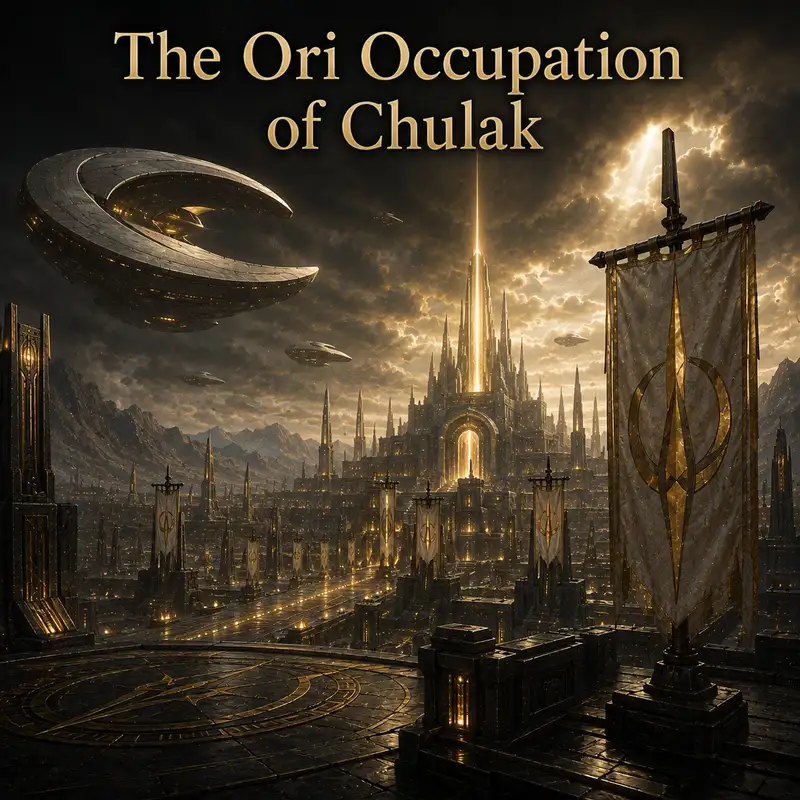
The first Ori warship descended through Chulak’s atmosphere while its fighters swept over the forest and the city beyond it. Death gliders rose to meet them and were driven back. In orbit, a defending Ha’tak had already been destroyed. The ship carrying Adria settled near the population center, its soldiers preparing to disembark beneath the protection of weapons the Jaffa could not match. Chulak had survived Apophis, rebellion, and the collapse of the Goa’uld empire. It was about to learn that liberation from one set of gods did not guarantee protection from the next.
The surviving record gives only a brief view of the Ori occupation of Chulak, but the event was strategically important. It was the first major planetary seizure after the Ori fleet entered the Milky Way through the Supergate. The attack demonstrated how the crusade would operate when missionary pressure was reinforced by capital ships and ground forces. It also exposed the central weakness of the Free Jaffa Nation. The Jaffa had won political freedom and inherited warships. They had not yet created a unified defense system capable of protecting every world that freedom now claimed to include.
Chulak mattered long before the Ori arrived. Under Apophis, it had been a major Jaffa world, military center, and site of religious authority. Its warriors served a ruler who presented advanced technology as divinity and organized society around obedience to the Goa’uld. The planet’s Stargate connected Apophis’s domain to raids, troop movements, and the wider imperial network. Chulak was not simply another settlement under occupation. It was one of the places where the Goa’uld system reproduced itself through temples, warrior training, family obligation, and fear.
It was also the place where that system first cracked open for Earth. Teal’c, serving as Apophis’s First Prime, turned his weapon against fellow guards and released prisoners who were about to be sent away as hosts or slaves. His decision allowed the first modern S G team to escape and gave Earth the ally who understood Goa’uld military culture better than anyone at Stargate Command. Bra’tac had cultivated those doubts for years. The modern Jaffa rebellion did not begin as a mass uprising in one afternoon, but Chulak became inseparable from the moment resistance stopped being private.
That history gave the planet symbolic weight after the defeat of the System Lords. Dakara became the political center of the Free Jaffa Nation and the location of its High Council. Chulak remained a cultural and military landmark, associated with Teal’c, Bra’tac, Apophis’s former power, and the early rebellion. It was a place where Jaffa had served false gods, suffered for challenging them, and learned that obedience was not inevitable. Capturing Chulak offered the Ori something more valuable than territory. It allowed them to challenge the story the Jaffa told about their own freedom.
The Ori fleet reached Chulak immediately after defeating the allied force at P three Y two twenty-nine. Four warships had passed through the Supergate, absorbed the combined fire of Earth, Jaffa, Tok’ra, Asgard, and Lucian Alliance vessels, and broken the formation waiting to stop them. They did not remain among the wreckage to destroy every survivor. They entered hyperspace and selected their next objective. This was operational exploitation. The fleet used victory at the entry point to move against a politically important world before the defenders could repair, reorganize, or determine where the ships had gone.
The precise reasoning behind the target choice was never formally stated by an Ori commander. Bra’tac believed Chulak was selected because the Jaffa rebellion had begun there. That interpretation fits the campaign, but it should remain an interpretation rather than a recorded enemy order. The Ori wanted conversion, not merely destruction. A victory over the birthplace of resistance would tell other Jaffa that their liberation had failed and that the new ascended power could reach the worlds most closely associated with defiance.
The opening orbital action was one-sided. A Ha’tak already defending the planet was destroyed as the Ori ships arrived. That loss removed the strongest local platform before an organized relief force could form. The Ori controlled the space above Chulak, which meant they controlled the altitude from which reinforcement, bombardment, fighter deployment, and landing operations could be protected. The Jaffa could still fight in the air and on the ground. They could not prevent the enemy from placing forces wherever the fleet’s commanders chose.
Ori fighters descended in large numbers and engaged Jaffa death gliders over the trees and settlements. The fight mattered because fighters could attack local defenses, escort troop movements, and keep Jaffa aircraft from concentrating against the landed warship. The Ori did not rely on the Stargate as their only point of entry. They had arrived by capital ship and could land outside the gate complex, bypass fixed defenses, and open the campaign across a much wider area. Controlling the gate would not have stopped an army already coming down from orbit.
One Ori warship landed near the city, and troops began the ground incursion. The ship carried Adria, Priors, human soldiers, Vala Mal Doran, and Daniel Jackson, who had escaped the destruction of the Korolev by using its ring transporter. The landing turned the warship into a protected headquarters and troop base on the surface. Its weapons remained available, its ring systems linked internal spaces, and its presence told the population that the invaders intended to control the world directly rather than deliver one warning and depart.
The screen record shows the assault and the beginning of occupation. It does not provide a complete account of how long Ori forces held Chulak, how many communities resisted, how many people converted, or how civilian government was reorganized. No reliable casualty total is given. The eventual liberation is not depicted in detail. Those gaps matter. Chulak should not be described as destroyed, and its population should not be assigned a fate the continuity never establishes. What is clear is that the Ori seized the planet’s military freedom of action and began deploying forces into its population centers.
Local Jaffa resistance faced a severe mismatch. Warriors on Chulak possessed experience, staff weapons, death gliders, and the cultural expectation that a Jaffa should fight rather than kneel. Those assets had helped overthrow the Goa’uld because the rebellion spread inside the imperial military system and turned Goa’uld forces against their rulers. The Ori brought an external army with superior shields, capital weapons, fighters, and Priors. Courage remained important. It could no longer compensate for the fact that the enemy’s ships could destroy Jaffa motherships before local forces could affect the occupation fleet.
The Free Jaffa fleet was not positioned for rapid reinforcement. Most remaining ships guarded Dakara, where the government and Ancient device represented both political authority and strategic deterrence. Abandoning Dakara might have exposed the Council and the one weapon known to affect life across an enormous area. Leaving Chulak unsupported meant surrendering a member world with immense symbolic value. This was the kind of decision a mature alliance solves through reserve forces and layered defense. The Free Jaffa possessed neither in sufficient quantity.
Bra’tac was able to obtain only three Ha’taks for the relief effort. Even that required political pressure, and the crews were thin. He assembled much of the manpower personally. The Council’s reluctance was not necessarily cowardice. The ships sent to Chulak were also ships removed from the defense of Dakara and other threatened worlds. Every Ha’tak was a captured or inherited platform whose replacement depended on an industrial system the Jaffa did not fully control. The nation had territory, responsibilities, and political expectations larger than its reliable force structure.
Teal’c, Samantha Carter, and Cameron Mitchell joined Bra’tac despite knowing that the same class of ships had just failed at the Supergate. Their reasons were not identical. Teal’c and Bra’tac regarded Chulak as home and could not accept watching its people fall without action. Carter believed Daniel might still be alive aboard one of the Ori vessels. Mitchell understood the odds and insisted that the relief force develop something more useful than an honorable way to die. The resulting plan combined Jaffa resolve with intelligence recovered from Korolev’s final minutes.
Korolev’s sensors had detected a small fluctuation in Ori shields when the main weapon fired. The Russian crew had tried to exploit that opening by sending a nuclear device through ring transporters. The ship was destroyed before the attack could be completed. At Chulak, Carter proposed repeating the concept. Two Ha’taks would draw one Ori warship away and provoke it into firing. Bra’tac’s ship would approach from another direction and use the momentary shield change to ring an explosive inside.
The relief force had no Earth nuclear warhead available. The Jaffa substituted a large explosive they believed might be effective if detonated within the enemy hull. This was a rational asymmetric approach. The allies could not overpower Ori shields from outside, so they attempted to bypass them. It also depended on several unproven assumptions: that the ring systems would connect, that the bomb would arrive in a useful location, that the enemy would not intercept it, and that the explosive would detonate before being removed or disabled.
The three Ha’taks emerged near Chulak and began the diversion. Two ships drew an Ori vessel away from the main formation while Bra’tac maneuvered toward a flanking position. Carter transmitted on open frequencies, hoping Daniel could hear the call without exposing himself. The operation therefore had two objectives running at once. One was to damage an Ori warship. The other was to recover a survivor aboard the landed vessel. Combining rescue and attack was necessary because the Jaffa force was unlikely to receive another opportunity.
The Ori response came quickly. One of the diversion ships was destroyed before Bra’tac reached the required range. The loss reduced the distraction and showed that the enemy could remove Jaffa capital ships faster than the plan could unfold. Carter nevertheless made contact with Daniel. He confirmed that he was alive, aboard the Ori ship on the surface, and unable to leave immediately. The intelligence solved one uncertainty while creating another. The relief force now knew exactly where Daniel was and had no safe way to extract him through the enemy’s defenses.
Inside the landed ship, Daniel and Vala attempted to capture Adria. Their plan was improvised around the assumption that the Orici was central to the invasion and might be turned against the Ori. The attempt occurred while most soldiers were deploying against the Jaffa outside, which briefly reduced security inside the vessel. It did not remove Adria’s own abilities or the Priors protecting her. The episode’s two rescue efforts reflected the same problem at different scales. Both found a narrow opening. Neither possessed the control needed to keep it open.
Vala challenged Adria over the slaughter taking place outside. Adria described the Jaffa as proud people misled by parasites posing as gods, yet naturally inclined toward ascension. In Ori logic, that made Chulak an appropriate target for salvation. The contradiction was not accidental. The Ori claimed to free the Jaffa from false belief while using warships and forced obedience to replace it. Chulak’s history made the argument especially revealing. The population was being punished for applying to the Ori the same skepticism that had freed it from the Goa’uld.
In orbit, the Ori ship fired, its shield fluctuated, and Teal’c activated the rings. The Jaffa explosive disappeared from the platform. It did not detonate. The continuity never establishes whether it was intercepted, disarmed, transported elsewhere, or simply failed to reach a vulnerable location. What mattered was that the only planned killing mechanism produced no visible effect. The relief force had now spent its single surprise and confirmed that the enemy could survive another attempt to bypass the shields.
A second Ori warship entered the engagement from another direction and destroyed the remaining diversion Ha’tak with one strike. Bra’tac’s ship was now alone, damaged, and still facing enemy vessels that had suffered no demonstrated loss. Mitchell recommended extracting Daniel and withdrawing. Bra’tac refused. He believed that retreat would leave Chulak’s people to the occupiers and that a warrior’s death against the invader still had political meaning. He turned the Ha’tak toward an Ori ship for a ramming attack.
The decision was emotionally understandable and tactically futile. Carter assessed that the Ha’tak would probably disintegrate against the shield without causing damage. Mitchell had anticipated that Bra’tac might choose sacrifice over withdrawal and had attached a subcutaneous transmitter to him before the battle. When the damaged Odyssey returned, Mitchell requested immediate transport using four beacons. Teal’c, Carter, Mitchell, and Bra’tac were removed moments before the Ha’tak struck the Ori shield and broke apart without effect.
The rescue preserved four experienced leaders and prevented a sacrifice that would not have damaged the enemy. It did not save Chulak. The relief force lost all three Ha’taks. The local defending mothership had already been destroyed. The Ori retained orbital control, fighter superiority, a landed capital ship, Priors, and ground troops. Daniel and Vala were captured before they could remove Adria. At the tactical level, every allied objective except personnel recovery failed.
Occupation followed from that imbalance. A population can resist while its towns, forests, and gate routes remain contested, but resistance becomes far harder when the enemy controls orbit and can land forces beyond prepared positions. Jaffa units could disperse, hide, and conduct local attacks. They could not prevent an Ori warship from reinforcing its troops or threatening settlements. The Stargate might support covert movement if resistance fighters could reach and operate it, but the screen record does not establish who controlled the gate during the occupation.
The likely administrative pattern can be inferred from Ori operations elsewhere, but it should not be mistaken for a documented Chulak government. Priors normally offered Origin, elevated compliant local leaders, and treated refusal as a reason for punishment. Human soldiers enforced their decisions, while warships guaranteed that local military resistance could not overturn them. On Chulak, the occupation probably combined conversion pressure with the disarmament or destruction of organized Jaffa forces. The exact balance between coercion, collaboration, and open resistance is not shown.
The civilian experience is therefore known mainly through the structure of the attack. Families who had lived through Goa’uld rule saw foreign fighters over their homes and another army descend in the name of higher beings. Some would have possessed military training because Jaffa society had been organized around service. Others were children, elders, craftspeople, religious figures, and survivors of earlier purges. The Ori distinction between warrior and unbeliever offered little protection. A community could accept Origin, flee, resist, or face punishment from forces controlling the sky.
Politically, the fall of Chulak damaged the Free Jaffa Nation at the precise point where it was trying to prove that liberation had created collective security. The Council could not defend every world, and its strongest fleet elements remained tied to Dakara. Chulak’s loss made local leaders ask whether loyalty to the new nation brought protection or merely placed their worlds on an Ori target list. That question encouraged fragmentation, private fleets, religious movements, and commanders willing to pursue extreme solutions without broad consent.
The Ori also gained a propaganda victory. They had defeated the coalition at the Supergate, then captured the world most closely associated with Jaffa resistance to false gods. News of the sequence could travel through traders, refugees, scouts, and converted Priors. The message required no elaborate speech. Earth’s ships had failed. Jaffa motherships had failed. Chulak had fallen. The Ori could now approach another world with evidence that refusal brought not heroic independence, but isolation under an enemy fleet.
The attack exposed a strategic dilemma the Free Jaffa could not solve with inherited Goa’uld doctrine. Goa’uld rulers defended valuable worlds through concentrated fleets and fear, accepting that lesser populations were expendable. A free nation promised that its people mattered regardless of which former master had owned their planet. Meeting that promise required communications, reserves, logistics, political trust, and a command system able to move ships before a crisis became irreversible. The Jaffa had only begun constructing those institutions when the Ori forced them into a galaxy-wide defense.
Earth could not fill the gap. Odyssey was damaged, needed repair, and had to leave a surveillance element near the Supergate. Daedalus was committed elsewhere, Korolev was gone, and no Earth weapon had yet proven capable of penetrating an Ori shield. Stargate Command could contribute specialists, transport, intelligence, and rescue. It could not place a battlecruiser over every Jaffa world. Chulak showed the limit of alliance promises when the allied industrial base had produced only a few ships and already lost one of them.
Chulak fell because the Ori combined strategic surprise, superior technology, concentrated force, and a target chosen for political effect. The Jaffa defense was fragmented between the local garrison, Dakara’s fleet, and an improvised relief force with skeleton crews. The counterattack relied on an uncertain shield fluctuation and a ring-delivered explosive that had never been tested. Once that failed, the defenders had no second weapon, no reserve, and no means of contesting orbit. Their courage influenced the story. It did not alter the balance of power.
The occupation did not prove that the Jaffa rebellion had been meaningless. It proved that rebellion and state defense are different military problems. The skills needed to undermine an empire, hide cells, recruit defectors, and inspire warriors had helped defeat the Goa’uld. Protecting liberated worlds required production, maintenance, standing command arrangements, and the ability to absorb losses without abandoning the next planet. Chulak had helped create the rebellion. Its fall exposed how much work remained after victory.
The most enduring image is the Ori warship resting outside the city while fighters crossed the same sky once patrolled for Apophis. Chulak had taught the Milky Way that a servant of a false god could choose freedom. The Ori selected it to teach the opposite lesson: that freedom without the power to defend it would not last. They won the planet because their fleet controlled the battlefield. They did not erase what Chulak represented. The occupation turned the birthplace of Jaffa resistance into evidence that liberation had survived its first enemy, but had not yet learned how to survive the next.