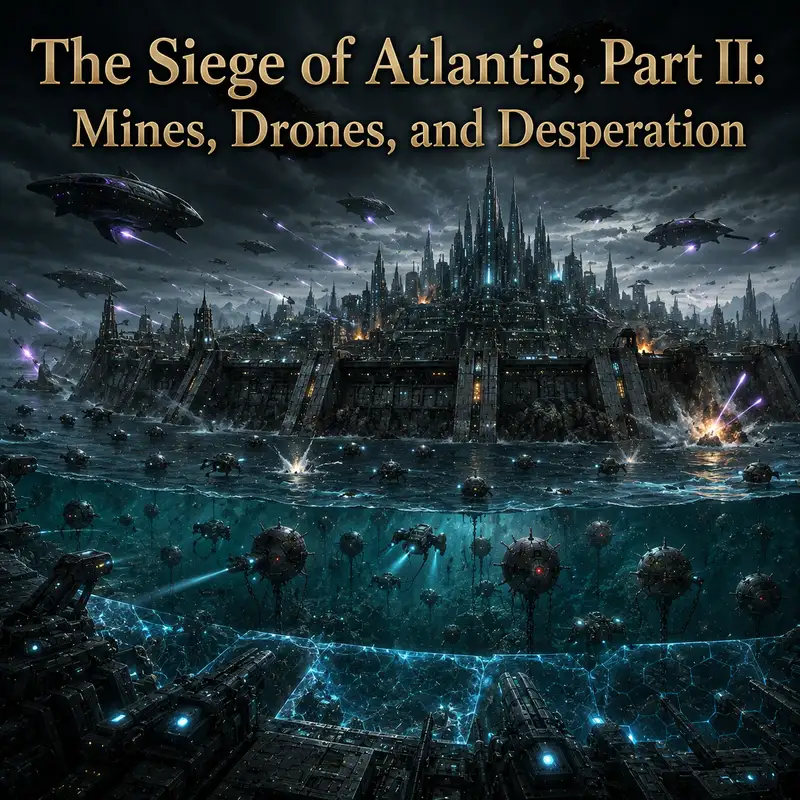
The Siege of Atlantis, Part II: Mines, Drones, and Desperation
The self-destruct clock was already running when an incoming wormhole formed in the Atlantis gate room. Elizabeth Weir had ordered the evacuation, armed explosives throughout the city, and prepared a computer virus to erase the Ancient database before the Wraith could capture it. The last defenders expected to leave through the gate and destroy the base behind them. Then an identification code arrived from Stargate Command. Marines, weapons, and equipment began pouring through the event horizon. Colonel Dillon Everett stepped forward, relieved Weir of command, canceled the evacuation, and ordered Atlantis defended at all costs.
Everett had not arrived with enough force to defeat the Wraith. He had arrived with a deadline. Earth had recovered a zero-point module in Egypt and used it to reopen the intergalactic wormhole. The module could not simply accompany the troops while it was sustaining that connection. Once the gate closed, it was transferred to the new battlecruiser Daedalus, where it could boost the ship’s engines and shorten the journey to Pegasus. Atlantis had to survive for approximately four days. Once the ship arrived, the module could power the city shield. The plan was therefore not victory. It was to keep the base alive until relief crossed the distance between galaxies.
Four days sounded manageable from a briefing room on Earth. In Atlantis, it meant holding an exposed city against two hive ships after the defensive satellite had been destroyed. The city had no active shield, no capital ships, few Ancient drones, limited ammunition, damaged sensors, and a garrison already exhausted by evacuation preparations. Everett brought trained Marines and useful weapons, but his reinforcements were still a platoon-sized force defending a city spread across multiple towers and piers. The difference between a plan and a hope was going to be measured in how many defensive layers failed before the Daedalus arrived.
The first dispute concerned command. Everett carried written authority from General Jack O’Neill and immediately took control of the battle. Weir had commanded Atlantis through isolation, Genii attack, biological emergencies, and the first Wraith advance. Everett initially excluded her from his tactical briefing because she was a civilian. Sheppard warned that removing her from the decision process would alienate the expedition personnel whose cooperation the defense required. Everett relented. The episode was not a ceremonial disagreement over chairs. Atlantis could not be defended by Marines alone. Its weapons, power systems, evacuation routes, scientific staff, Athosian allies, and gate operations all fell within Weir’s established authority.
Everett’s initial defensive plan had three main layers. Six naquadah-enhanced nuclear warheads would be placed in space as mines along the Wraith approach. Railguns intended for a future Prometheus refit would provide high-velocity point defense from Atlantis’s towers. A modified Mark Two naquadah generator would power the Ancient control chair and whatever drones remained in the city arsenal. Four Earth pilots received the Ancient gene therapy and rapid instruction from Sheppard so that Puddle Jumpers could serve as a fighter screen. It was an improvised joint defense using Earth weapons, Ancient aircraft, experimental medicine, and a city nobody fully understood.
The mines were the strongest part of the plan on paper. Each warhead had an enormous yield, emitted little electromagnetic energy, and used a proximity fuse. Cloaked Jumpers placed all six between the hive ships and Atlantis. Sheppard recommended keeping some in reserve. Everett refused because he believed the defenders would receive only one clean opportunity to destroy the approaching formation. His logic was understandable. A mine that remained in storage could not damage a hive. It also removed every reserve option if the enemy found a way around the first pattern.
The Wraith did not fly into the pattern. They harvested more than a hundred asteroids from the local belt, accelerated them toward Lantea, and allowed the rocks to approach first. Atlantis’s long-range system took time to classify the objects as threats because they were natural bodies rather than ships. By the time the defenders understood the tactic, the asteroids were entering the minefield. The proximity fuses worked exactly as designed. All six weapons detonated against rocks while the hive ships remained outside the lethal area.
The result was worse than the loss of six warheads. Radiation from the detonations overwhelmed Atlantis’s sensors and blinded the city for hours. The Wraith had removed the first defensive layer without risking a capital ship and had turned Earth’s weapons into a screen for their next attack. This was not technological superiority. It was tactical adaptation. The mines were powerful, concealed, and inflexible. The Wraith used expendable material from the environment to force them to fire. A defense designed around one irreversible decision had met an enemy willing to test it with rocks.
Everett then asked to see how the Lanteans had lost Atlantis the first time. The city archive showed a century of contraction as protected systems fell and the Wraith closed on Lantea. Ancient fleets and orbital weapons won engagements but could not stop new enemy formations from arriving. Sheppard’s point was not that resistance was useless. It was that surviving one attack did not solve the strategic problem. Everett understood the record, but his immediate mission remained unchanged. The Daedalus was coming. The base had to exist when it arrived.
Their exchange carried a personal burden. Everett had been a close friend of Colonel Marshall Sumner, whom Sheppard had killed to end Wraith feeding during the expedition’s first rescue operation. Everett questioned whether Sheppard had done everything possible. Sheppard had lived with the decision since the day it happened. The argument ended when warning alarms announced inbound Darts. There was no resolution because the siege allowed no private dispute to remain private for long. The officer Everett distrusted was also the only person in Atlantis able to employ the city’s drones with exceptional precision.
The Wraith air attack arrived through the sensor blindness created by the mines. Everett ordered Atlantis darkened and placed damage-control teams throughout the city. Railgun crews and personnel with automatic weapons occupied exposed balconies and firing positions. The darkness complicated visual acquisition, but it could not conceal the city from an enemy already above it. Darts crossed the towers at high speed, fired into defensive positions, and began making apparent suicide runs against critical areas.
The railguns gave Atlantis a real close-defense capability. Their high-velocity rounds could destroy Darts before the craft reached the towers, and their large magazines allowed sustained fire. They were still fixed weapons firing across a complex city. The gunners needed clear lines of sight, stable power, communications, and time to track aircraft maneuvering among Ancient structures. A Dart that survived the approach could cull an entire gun crew in one pass. When one position went silent, Lieutenant Aiden Ford took over the weapon and continued firing alone.
The Wraith assault was more sophisticated than a mass of expendable aircraft. Some Darts made impact runs after their pilots used the culling system in reverse to materialize inside Atlantis. The crash damaged the city and drew defenders toward the impact point. The pilot or accompanying warriors then moved through interior corridors while internal sensors were offline. What looked like a suicide strike was also a covert insertion. The Wraith wanted Atlantis intact enough to exploit, so they used air attack to strip its defenses and ground forces to seize the systems that mattered.
Sheppard entered the control chair while McKay forced the Mark Two generator into a barely controlled overload. The chair opened the city’s drone storage and released the remaining weapons. Ancient drones were designed to destroy warships, but there were too few to attack the hives and too many Darts threatening the city. Sheppard used them as interceptors. They pursued the smaller craft around towers, destroyed Darts attempting escape, and prevented the first wave from overwhelming the exposed positions.
The defense worked, but it spent the entire Ancient reserve. Atlantis had possessed only a few dozen drones, probably the remnants left after the Lanteans’ final war. When the air attack ended, smoke rose from damaged sections, primary systems were down, and the chair had no ammunition. The city had survived one wave by using capital-ship weapons against attack craft. That was tactically effective and strategically ruinous. Every drone had removed an immediate threat. None could be manufactured in time for the next one.
The first assault therefore stripped Atlantis of both its planned outer defense and its most powerful inner defense. The mines were gone. The drone magazine was empty. Long-range and internal sensors were down. Railguns remained, but several positions had been damaged or culled. Everett’s force had prevented a breakthrough, yet the two hive ships were still approaching. A holding action must trade resources for time. Atlantis had traded nearly every irreplaceable resource and gained far less than the four days it needed.
Sheppard proposed attacking the hive ships directly with cloaked Puddle Jumpers. A pilot could enter a launch bay or another opening and detonate a nuclear weapon inside the organic hull. The cloak made approach possible, but the mission would leave no time to escape. McKay and Radek Zelenka therefore attempted to connect the control chair to the Jumper systems and fly the craft remotely. The vehicle would become a guided nuclear weapon controlled from Atlantis rather than a transport carrying a human crew.
The concept required several technologies to cooperate outside their intended roles. The chair had to activate a Jumper without an onboard pilot. Atlantis’s control network had to direct the craft at long range. The cloak had to remain active. The nuclear device had to survive installation and detonate inside the target. The same Mark Two generator that had powered the drone defense would have to power the chair again. In a normal test program, every one of those conditions would have required its own schedule. The Wraith had provided a combined deadline.
Carson Beckett became the test operator because Sheppard was needed elsewhere. Beckett possessed the Ancient gene but had never shown Sheppard’s natural ease with the chair. McKay and Zelenka nevertheless succeeded in activating a Jumper from the control room while Zelenka monitored the craft in the bay. The test proved remote operation was possible. It did not prove the system could launch, maneuver through combat, penetrate a hive, and detonate a weapon while the generator survived. The distinction between proof of concept and operational readiness had become inconveniently theoretical.
The remaining problem was the warhead. The space mines had all been expended, so Weir went to the Genii. This was the same hidden state that had invaded Atlantis during the storm and had every reason to welcome the expedition’s destruction. The Genii had recently survived another Wraith culling by shutting down their underground reactors. Hundreds on the surface had died while thousands beneath remained concealed. Their leaders believed the immediate threat to their world had passed and saw no reason to risk their prototype weapons for Atlantis.
Weir offered C four explosives, technical value, and a chance to test the Genii design against a real hive ship without exposing Genii personnel. She went alone and unarmed because the negotiation itself was the only delivery system available. The Genii initially proposed trading her life for the explosives. Weir answered by making the military value of the test impossible to ignore. The result was not reconciliation. It was a transaction between enemies who shared a larger enemy and understood that one successful detonation would validate years of Genii work.
She returned with two prototype nuclear devices. They were incomplete. McKay estimated that finishing them properly would require about a day, which the defenders no longer possessed. He and Zelenka worked without sleep, using medical stimulants to stay functional while converting unfinished foreign weapons into devices that could be loaded aboard Ancient aircraft and controlled through an improvised neural system. The phrase integrated weapons program usually implies years of testing. Atlantis completed one during an active siege because the alternative was to leave the hives unchallenged.
The ground situation deteriorated at the same time. Teyla sensed Wraith inside Atlantis and forced the command staff to confront the meaning of the Dart attacks. Everett had initially ordered her to remain out of the battle because of concern over her telepathic connection to the enemy. He reversed that decision when it became clear that the city needed every available fighter and that Teyla had detected the infiltration before Earth instruments did. Athosian volunteers received weapons and joined the search.
With internal sensors disabled, the defenders used portable life-signs detectors. The devices could locate people but could not reliably distinguish human from Wraith. Sheppard’s solution was procedural. Expedition personnel were confined to designated zones, and any life sign moving outside those areas became a probable hostile contact. The plan converted an incomplete sensor into useful intelligence by controlling friendly movement. It also showed how quickly a research expedition had become a close-quarters defense network.
The Wraith targeted the city’s generators. Destroying distributed power would blind sensors, isolate sectors, prevent weapons from activating, and disrupt the gate room. Everett, Sheppard, Ford, Teyla, Marines, and Athosians searched separate towers and corridors. They fought enemies capable of telepathic deception, rapid healing, and ambush from spaces the expedition had never fully surveyed. Some Athosians were killed. Atlantis was not merely under orbital attack. It was being contested room by room by forces inserted through the air defense battle.
The infiltrators confirmed the Wraith objective. If destruction alone had been sufficient, the hives could have continued bombardment from orbit. Instead, Darts sacrificed themselves to place warriors near critical systems. The enemy wanted the database, the gate, and the route to Earth. This forced the defenders to fight two opposite missions at once. They had to preserve Atlantis long enough for relief while remaining prepared to destroy it before capture. Every successful repair made the city more defensible and more valuable to the enemy.
Weir’s return with the Genii prototypes briefly restored a path to the hive ships. McKay and Zelenka completed the devices under pressure, loaded them into Jumpers, and prepared the remote-control system. The defenders positioned railguns for another Dart attack. Teyla and the Athosians patrolled the interior. Everett’s teams guarded key sectors. Weir retained authority over evacuation and warned personnel that if the nuclear mission failed, they were to move through the Stargate without hesitation.
The second major wave arrived before the defense had recovered. Dozens of Darts descended from the hive ships while Wraith units remained inside the city. Sheppard took the chair and attempted to activate the nuclear-armed Jumpers. Nothing moved. The Mark Two generator had operated beyond sustainable limits during testing and the first drone engagement. Its output collapsed at the moment the remote-control plan needed it. Atlantis had built a weapon, a delivery platform, and a guidance system, then lost the power source connecting them.
There was no time to install another system or develop a new interface. The Jumpers could still be flown manually. Sheppard left the chair, crossed the control room, and headed for the bay. Weir tried to stop him because the mission had been designed specifically to avoid sacrificing a pilot. Sheppard understood the remaining arithmetic. Two hives were closing, the city was being boarded, the chair was dead, and evacuation had begun. A nuclear weapon inside one hive might force the other to withdraw. Leaving both untouched would guarantee the loss of Atlantis.
Weir allowed him to go, then prepared for the consequence if he failed. The gate opened toward the evacuation site. McKay helped rearm the self-destruct. Carson Beckett moved people through the gate while Wraith materialized in additional sectors. Everett’s teams were being overrun. Ford’s group was surrounded on an exposed platform. Teyla could no longer be reached by radio. The command center watched one friendly signal climb through a sky filled with enemy contacts.
Sheppard cloaked the Jumper as it left Atlantis and headed toward the nearest hive. The Genii weapon was armed. The Wraith had not detected his approach. He warned that if the strike worked, someone might have to repeat it against the second ship. Atlantis had two prototype bombs and no functioning remote-control system. The statement was not gallows humor so much as an operational fact. The first sacrifice would create a requirement for another.
Mines, drones, railguns, gene therapy, Ancient sensors, Genii nuclear science, Athosian fighters, and Earth Marines had all bought pieces of time. None had produced a sustainable defense. The mines became a cloud that blinded their owners. The drones destroyed a wave and emptied the arsenal. The railguns held the sky but could not stop infiltration. The remote weapon worked in testing and failed when its overloaded generator died. Desperation was not one final decision. It was the sequence that consumed every safer option before Sheppard entered the Jumper.
The siege reached its most revealing point before the nuclear weapon detonated. Atlantis remained unconquered, but its defense had contracted from orbital mines to drones, from drones to railguns, from railguns to corridor fighting, and from corridor fighting to one cloaked craft carrying one man and one hurriedly completed bomb. The Wraith had not yet broken the city. They had forced its defenders to wager the city’s survival on a mission with no planned return. There was no reserve beyond him and no certainty that success would leave anyone alive to exploit it. Sheppard approached the hive because every layer behind him had already been spent.