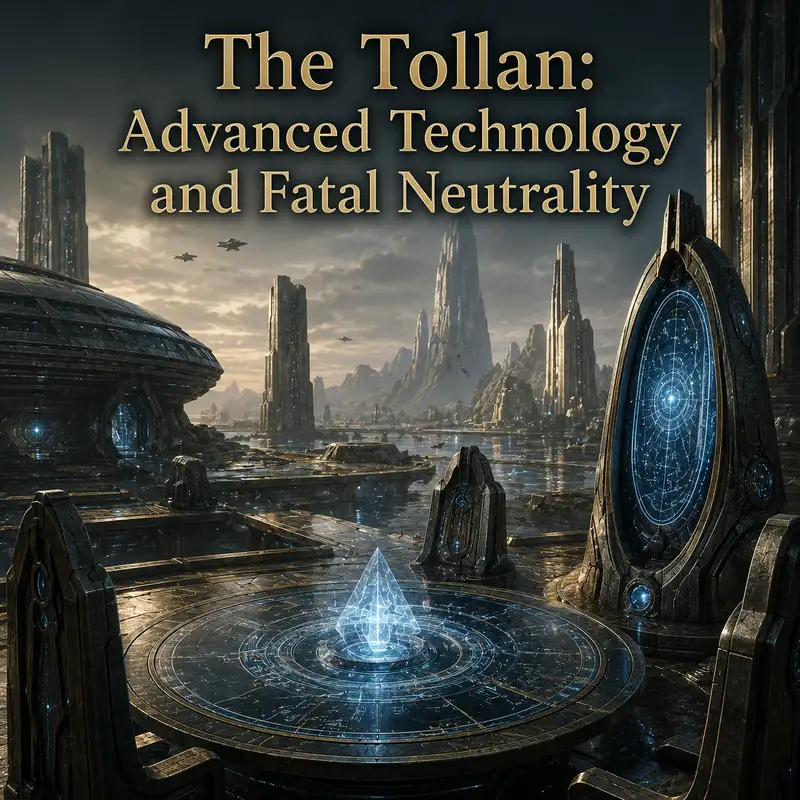
The Tollan: Advanced Technology and Fatal Neutrality
The final transmission from Tollana lasted only seconds. Narim reported that the Stargate had been destroyed, the planetary defenses were failing, and ships attempting to escape were being shot down. Then the signal ended. There was no confirmed casualty report, no organized evacuation through the gate, and no allied fleet approaching the system. One of the most technologically advanced human civilizations in the Milky Way had disappeared behind static.
The contradiction was severe. The Tollans could walk through solid walls, disable weapons automatically, monitor individual health through implanted systems, communicate across interstellar distances, construct their own Stargate, and destroy a Goa’uld mothership with a single ion cannon. Earth could do none of those things when contact began. Yet Earth survived the Goa’uld war, while Tollana was apparently destroyed. The reason was not a simple failure of technology. It was the failure of a security strategy built around technological superiority, political isolation, and the assumption that neutrality could keep a changing war outside the border.
The surviving record of Tollan civilization is limited. Earth encountered a small group of refugees, several public officials, one legal proceeding, and the final crisis on their new homeworld. No complete population count, military organization, industrial survey, or constitutional history survives. What can be reconstructed is a society with advanced science, strong legal institutions, low ordinary crime, civilian political authority, and deep distrust of less developed civilizations. That distrust was not based only on arrogance. It had been purchased through catastrophe.
S G One found the original Tollan world during a volcanic disaster. Ash filled the atmosphere, the surface was becoming uninhabitable, and most of the people near the Stargate were already dead. The survivors had remained behind to prevent travelers from arriving on a dying planet. Their own rescue ship was apparently too distant to reach them in time. Stargate Command evacuated the remaining group to Earth, creating a humanitarian success and an immediate security dispute.
Omoc, the senior Tollan among the survivors, did not respond with gratitude. He demanded that confiscated devices be returned and rejected Earth’s attempts to question or relocate his people. To Stargate personnel, he appeared condescending and unreasonable. From his perspective, an armed society with comparatively primitive technology had taken custody of displaced civilians, inventoried their equipment, and begun asking what could be learned from it. The difference between rescue and detention was becoming uncomfortably narrow.
Narim eventually explained the event that shaped Tollan policy. The Tollans had contacted the people of Serita, a neighboring planet whose development resembled Earth’s. Believing them ready, the Tollans provided a device capable of producing effectively unlimited useful energy. The Seritans turned the gift toward warfare and destroyed their own world in a single planetary rotation. The resulting destruction altered Tollan’s orbit enough to begin the geological instability that later made the Tollan homeworld uninhabitable.
This was more than a failed technology-transfer program. The Tollans had attempted to improve another civilization and had helped create the conditions for two planetary disasters. Their conclusion was severe but understandable. Scientific knowledge could not be separated from political institutions, military competition, and the character of the society receiving it. A peaceful power source could become the foundation of an arsenal. Technical readiness did not guarantee strategic restraint.
The resulting doctrine prohibited transferring advanced technology to civilizations judged incapable of using it responsibly. It also discouraged close political involvement with less developed worlds. Tollan neutrality was therefore partly a nonproliferation policy. Omoc was not merely protecting proprietary science. He was trying to prevent another Serita and another Tollan, even if his manner suggested that diplomacy had not received the same research funding as physics.
Earth’s response confirmed much of his suspicion. Colonel Harry Maybourne arrived with authority to move the Tollans to a secure facility where their knowledge could be studied and exploited for planetary defense. The proposed community had guards, confinement, and no meaningful freedom to refuse cooperation. The distinction between protecting valuable refugees and imprisoning them as strategic assets was largely administrative.
S G One helped the Tollans avoid that outcome by contacting the Nox. Lya offered sanctuary, and the refugees left Earth despite armed efforts to stop them. The Nox later assisted them in reaching a new homeworld. On Tollana, the survivors rebuilt not merely a settlement but an advanced national society. They constructed a Stargate because the planet lay outside the existing network, restored government under the Curia, and established defenses capable of defeating known Goa’uld warships.
The speed and scale of that recovery were remarkable, although the screen record does not explain every logistical step. The Tollans had retained scientific knowledge, technical devices, political leadership, and access to Nox assistance. Their civilization also possessed the industrial capacity to build systems far beyond Earth’s reach. The new planet contained trinium, a material used in several Tollan technologies, and became the physical foundation of their rebuilt state.
Tollan technology was designed as much for control as for power. Phase-shifting devices allowed people and objects to pass through solid barriers. Security systems could deactivate unauthorized weapons while leaving government arms operational. Health implants monitored citizens and could summon medical personnel automatically. Holographic communication preserved personal messages across great distances. Their legal authorities could suppress a Goa’uld symbiote’s ability to silence its host, allowing both minds in one body to testify separately.
The same preference for controlled systems shaped planetary defense. Tollana relied on an ion-cannon network capable of destroying Goa’uld motherships from the surface. The cannons converted advanced energy technology into strategic deterrence. A System Lord approaching the planet could not assume orbital superiority, and a single surviving cannon might be enough to destroy a capital ship. This was an impressive defense against the enemy the Tollans already understood.
It was also a fixed defensive architecture. The cannons protected one world and depended on accurate threat recognition, intact control systems, and weapons effects that remained superior to enemy shields. The Tollans possessed ships, as their final evacuation attempt demonstrated, but no fleet capable of challenging the attacking Goa’uld force is shown. Their national security rested primarily on making Tollana too dangerous to attack, rather than on maintaining mobile forces able to fight elsewhere or recover after the defense grid failed.
Their political institutions reflected similar confidence. The Curia served as the highest governing body, led by High Chancellor Travell. Public records, health monitoring, and strict conduct rules suggested a society in which government legitimacy depended heavily on transparency and law. Serious crime was so uncommon that Narim initially struggled to believe a political murder could occur. A government lie was considered an exceptionally grave offense because trust was built into the operation of the state.
The Triad convened over Skaara and the Goa’uld Klorel displayed the best of that system. Both minds occupied the same body, and each claimed the right to control it. Rather than execute the symbiote or automatically recognize Goa’uld power, the Tollans created a proceeding in which advocates presented both claims before a neutral judge. Their technology allowed Skaara to speak without being suppressed. Their law treated the host as a person whose continued existence could be examined rather than assumed away.
Lya of the Nox cast the deciding judgment in Skaara’s favor. The Tok’ra later removed Klorel without killing him. The outcome combined due process, advanced medicine, and a rejection of involuntary domination. It also showed why neutral institutions can matter during war. The Tollans offered a forum where neither Earth nor the Goa’uld could claim automatic jurisdiction over the body at issue.
Zipacna, representing Klorel, treated the hearing as an intelligence operation. His Jaffa used access to Tollana to locate the ion cannons and sabotage them before an attack. The legal process created movement, observation, and time. The Goa’uld exploited all three. Tollan security assumed that the hearing’s formal protections and the defense grid would remain separate problems. Zipacna combined them.
Tollana survived because Teal’c recognized the deception and persuaded Lya to hide one cannon. When the attack began, the visible weapons had been disabled. The concealed cannon remained operational, destroyed approaching gliders, and then eliminated the Goa’uld mothership. The victory confirmed the weapon’s power. It should also have exposed the system’s fragility. One infiltrated delegation had nearly neutralized the entire defense network without first defeating it in battle.
The Tollans drew at least part of the lesson. Their gratitude toward Earth increased, and diplomatic relations continued. Their fundamental policy did not change. They still refused to transfer military technology, and their reasons remained credible. Earth had already produced officials willing to confine Tollan refugees. Later, a rogue National Intelligence Department operation stole technology from the Tollans and other allies. A covert Stargate Command operation eventually dismantled that network, but the theft proved that Earth’s institutions did not always control their own appetite for alien weapons.
The Tollans were therefore not dealing with a simple choice between generous alliance and selfish isolation. Sharing ion cannons with Earth could protect a planet from the Goa’uld. It could also place weapons of extraordinary power inside a divided international system whose public did not know the Stargate existed. The Seritan precedent warned against transfer. Maybourne’s operations demonstrated that the warning still applied.
Their mistake was subtler. The Tollans treated technology transfer, political alignment, intelligence sharing, and collective defense as though they were versions of the same risk. Refusing to hand Earth an ion cannon did not require refusing deeper strategic coordination. They could have retained control of their technology while building warning networks, evacuation plans, mutual intelligence procedures, or contingency agreements. The surviving record shows cordial relations and occasional cooperation, but not an integrated alliance prepared to defend Tollana.
That absence mattered when Omoc died. S G One returned to Tollana for his memorial and encountered a government behaving unlike itself. Chancellor Travell announced that the Curia was reconsidering its isolationist policy and offered Earth an ion cannon in exchange for trinium. Earth planners calculated that thirty-eight cannons would be required for a full planetary defense network. Travell accepted even that expanded proposal with surprising ease.
The offer appeared to be a diplomatic breakthrough. In reality, it was an intelligence indicator. The Tollans were willing to export the weapon on which their own security rested because they had learned it no longer worked against the threat they feared. The trinium exchange provided a public explanation, while the promised cannons gave Earth something desirable enough to discourage careful questions. Fortunately, S G One had developed a professional suspicion of gifts arriving without several inconvenient conditions.
Narim’s concerns began with Omoc’s death. Every Tollan carried a health implant connected to a central monitoring system. Medical assistance should have responded immediately to a cardiac emergency, yet Omoc died without the expected intervention. Curia records also contained missing sections. Neither fact proved murder conclusively, but together they suggested that a senior opponent of the new policy had been removed and the official record altered.
The investigation uncovered an unreported engagement. A Goa’uld mothership had entered orbit, and the ion cannons had fired without effect. The vessel’s shields had resisted weapons that had previously destroyed Goa’uld capital ships. It then withdrew without conquering the planet. This was not mercy. It was a demonstration. The attacker had shown the Curia that the foundation of Tollan security had become obsolete and then allowed the government time to understand the message.
The Goa’uld intermediary was Tanith, now serving a master whose identity he refused to reveal. Later events identify the larger threat as Anubis, a returned Goa’uld with access to knowledge beyond that of the System Lords. His shield technology changed the balance without requiring a fleet battle. Tollana’s deterrent did not have to be destroyed immediately. It only had to be shown incapable of imposing costs.
The Curia responded by making a secret bargain. In exchange for the planet’s temporary survival, the Tollans would manufacture weapons for the Goa’uld. These were powerful explosives enclosed in systems using Tollan phase-shift technology. The weapons could pass through solid matter before detonation. Trinium was required for the phase-shifting assembly, which explained the sudden trade proposal to Earth.
The first test target was Earth. Because Earth was protected by treaty, the Goa’uld could not openly attack without risking Asgard retaliation. A Tollan device could be sent through the Stargate, pass through the iris, and detonate inside the planet’s principal gate facility. The plan used Tollan technology to bypass both a physical defense and a diplomatic guarantee. It was coercion engineered into plausible deniability.
The bargain reversed every principle the Tollans had claimed to defend. A civilization that refused to share technology for fear it would be weaponized was now building weapons of mass destruction for an imperial power. A government that treated official deception as a profound crime concealed the project from its own citizens. A society committed to neutral law prepared to attack an ally in order to purchase time for itself.
Travell’s decision was still not simple cowardice. She believed the alternative was the destruction of her people. The Goa’uld had demonstrated that Tollana’s defenses were ineffective, and no allied force was visibly prepared to intervene. Narim demanded resistance, but even he hesitated when confronted with the immediate cost. It is easier to reject collaboration when someone else is signing the planetary casualty report.
The Curia’s deeper failure had occurred before the ultimatum. The government had allowed a single defensive technology to become a national strategy. It had not built enough political depth to call for collective action without surrendering control. It had not prepared its population for the possibility that neutrality might fail. When the ion cannons became obsolete, the Curia believed the available choices had narrowed to collaboration or annihilation.
S G One and Narim reopened a third option, though not a safe one. They exposed the project, prevented the test attack on Earth, and created a chance to destroy the weapons before delivery. Narim used an ion cannon against the production facility. The act denied Anubis a stockpile that could bypass solid defenses and treaty restrictions. It also ended the bargain protecting Tollana.
This was a tactical success with catastrophic strategic consequences. The weapons were destroyed, Earth escaped attack, and the Goa’uld lost the immediate product of Tollan science. Tollana then faced the military situation the Curia had feared. Enemy forces attacked. The Stargate was destroyed, eliminating the fastest route for reinforcement and evacuation. Planetary defenses failed. Tollan ships attempting to escape were shot down.
Some people may have escaped, and the surviving record does not establish the death of every Tollan. It does establish the effective destruction of Tollana as a functioning state. No later fleet arrived bearing survivors. No rebuilt Curia resumed diplomatic relations. The civilization that had once recovered from the loss of its first homeworld did not visibly recover from the loss of its second.
Technology did not fail because the Tollans lacked scientific intelligence. It failed because every defense exists against a particular set of assumptions. The ion cannons were devastating against normal Goa’uld shields. Anubis changed the shields. Tollan phase technology defeated solid barriers. Anubis turned that capability into a coercive weapons program. Health monitoring supported public safety. Political conspirators manipulated the system and hid the truth. A Stargate offered strategic mobility until the enemy destroyed it.
Their neutrality created a similar trap. It reduced the chance that Tollan weapons would destabilize younger societies and kept Tollana outside many Goa’uld conflicts. It also limited the relationships from which warning, reinforcement, and strategic depth might have emerged. The Tollans possessed friends. They did not possess a coalition whose forces, intelligence, and contingency plans were tied to their survival.
This judgment should not become victim blaming. Anubis and his agents chose coercion, demanded weapons, targeted Earth, and destroyed Tollana when the bargain failed. The Tollans were the victims of aggression. Their earlier caution was supported by evidence, including the destruction of Serita and the repeated efforts of Earth officials to steal advanced technology. A more generous transfer policy might have created additional dangers without saving Tollana.
The fatal element was not refusal to arm Earth. It was the belief that moral restraint and technical superiority could substitute for adaptive strategy. Nonproliferation became isolation. Deterrence became dependence on one weapons system. Legal confidence became vulnerability to an opponent willing to use diplomacy as cover. Neutrality became a promise that Tollana would not shape the war until the war arrived under someone else’s terms.
The Tollans were not pacifists. They built ion cannons, maintained armed security, and used force in planetary defense. Their neutrality was political and strategic. They sought to avoid entanglement, preserve technological control, and judge disputes through law rather than alliance loyalty. That system worked while enemies respected the cost of attacking. It collapsed when an enemy arrived with better shields, better intelligence, and no interest in preserving the existing rules.
The civilian cost remains easy to lose inside the strategic analysis. Tollan citizens had already survived the destruction of one planetary home caused by another society’s war. They rebuilt on Tollana, created institutions based on trust, and believed their technology could prevent a second displacement. In the final attack, those citizens encountered the consequences of decisions made secretly by the Curia and coercively by the Goa’uld. Their ships became evacuation targets, and their Stargate became wreckage.
Whether a stronger alliance with Earth, the Nox, the Tok’ra, or the Asgard could have saved Tollana remains uncertain. Earth had no fleet capable of defeating Anubis at that time. The Asgard were constrained by another war and treaty obligations. The Nox rejected killing. The Tok’ra lacked conventional military strength. Coordination might have improved warning or evacuation without changing the final balance. The screen record does not provide a guaranteed alternative victory.
It does provide a clear strategic warning. An advanced civilization can mistake control of technology for control of events. It can confuse a powerful defense with a complete defense, and political distance with security. The Tollans survived their first catastrophe by preserving their knowledge and finding another world. They did not survive the second because the threat did not attack their science first. It attacked the assumptions that told them their science was enough.
Narim’s final transmission did not describe a primitive society overwhelmed by superior weapons. It described an advanced society discovering, in real time, that its gate, cannons, ships, and political bargains had all failed together. Tollana was not destroyed because neutrality lacked moral value. It was destroyed because neutrality without alliances, redundancy, and adaptation left no position to fall back to when the enemy crossed the line.