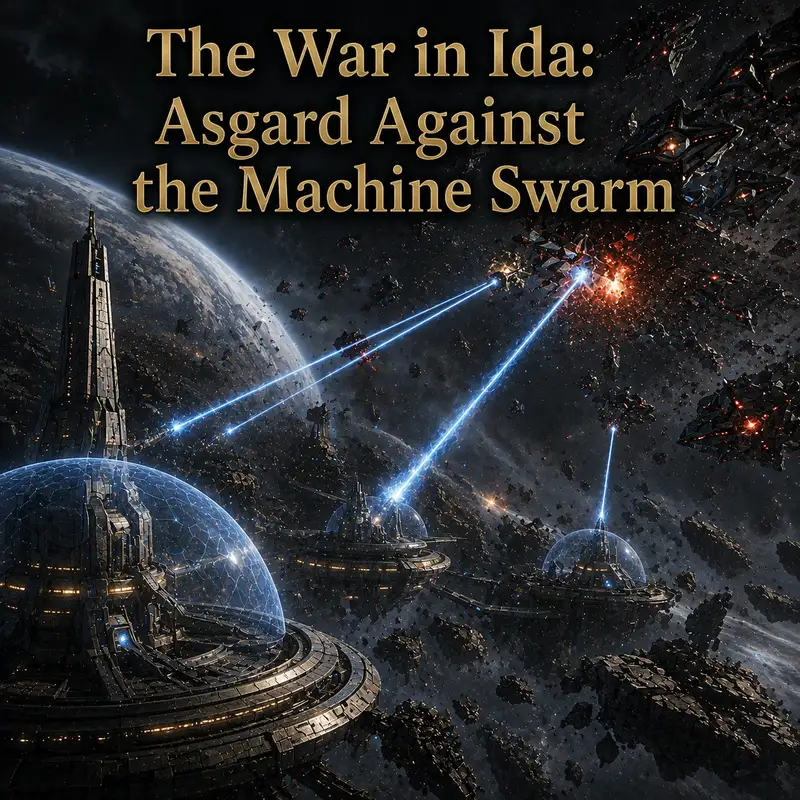
The War in Ida: Asgard Against the Machine Swarm
Five Asgard warships disappeared from the tactical display one after another. Three vessels controlled by Replicators continued toward the Asgard homeworld, while the most advanced attack ship the Asgard had ever built remained unfinished nearby. Samantha Carter had been brought to Ida because Thor wanted a less sophisticated way of thinking. She arrived in time to watch sophisticated Asgard doctrine fail.
The War in Ida was not a contest between equal fleets. It was a struggle between a civilization that concentrated knowledge inside exquisite machines and an enemy that turned those machines into raw material, intelligence, and reinforcements. The Asgard possessed faster ships, stronger shields, precise transporters, and scientific capabilities Earth barely understood. The Replicators made every one of those advantages dangerous to use.
The surviving campaign record is incomplete. Earth never received a full Asgard order of battle, casualty list, industrial survey, or map of the worlds consumed during the war. Even the exact duration of several phases is uncertain. What is established is enough to explain the strategic outcome. The Asgard discovered the machines, underestimated them, lost control of their own technology, evacuated major worlds, and repeatedly required Tau’ri assistance to prevent defeat.
Ida was also difficult for Earth to reach independently. The first Tau’ri contact with an Asgard world required O’Neill to use Ancient knowledge and an improvised power source to establish an intergalactic Stargate connection. That was not a routine reinforcement route. During the war, Asgard ships had to move human personnel and the Prometheus into the theater. Earth could contribute ideas and small teams, but it could not send a fleet, sustain a base, or evacuate an Asgard population through its own gate network.
The first mistake was scientific rather than military. An Asgard expedition found mechanical organisms on an isolated planet in the home galaxy. Their creators were absent, probably destroyed by what they had made. The Asgard brought specimens aboard a ship for study before understanding the danger. Thor later admitted that confidence in Asgard technology had been their undoing. The assessment was unusually direct and entirely deserved.
A mechanical Replicator was built from small interlocking blocks able to assemble into mobile forms, separate, and reconfigure. It consumed available material and used that material to manufacture more machines. A single infestation therefore carried its own production system. It needed energy and matter, but it did not need food, sleep, medical support, morale, or a conventional supply train.
The campaign was therefore fought over technology more than territory. The Replicators did not need to hold a planet after consuming what made it useful. They could strip ships, factories, and energy systems, then move on aboard captured vessels. Retaking an emptied world offered the Asgard little compensation for the industrial capacity already converted into enemy mass. A battlefield victory could recover coordinates and ruins while leaving the machines stronger somewhere else.
Each machine could act independently while sharing the collective purpose of replication. Once aboard an Asgard vessel, the first operational priority was often to disable the sensors able to detect Replicators. The machines then moved through walls, conduits, control systems, and power networks. An Asgard ship could remain intact from the outside while its navigation, weapons, medical systems, and transporters were being taken away from the crew inside.
That created a form of warfare for which Asgard naval superiority was poorly suited. Their ships were highly automated, enormously powerful, and packed with valuable materials. A captured vessel was not merely an enemy prize. It became transport, factory, intelligence archive, and combat platform. The more advanced the ship, the more useful it was to the force consuming it.
The normal arms race therefore ran in the wrong direction. Building stronger hulls gave the Replicators stronger bodies once they reached the metal. Installing more capable computers gave them better systems to seize. Deploying a new weapon risked teaching the enemy how it worked. The Asgard could destroy individual machines and even entire infested vessels, but every incomplete victory carried the possibility that surviving blocks would return with improved capabilities.
The war also exposed the limits of a civilization whose population was already constrained. The Asgard preserved individual minds through cloned bodies and consciousness transfer, but their genetic foundation was deteriorating. The Replicator war did not create that crisis, and the screen record does not provide a reliable total of Asgard dead. It did force a shrinking civilization to defend worlds, fleets, laboratories, and the systems required to preserve its remaining people.
Thor’s ship, the Biliskner, demonstrated how quickly one engagement could become a civilizational threat. Called into battle under his command, the vessel became infested. Thor transported the crew away and destroyed the outbound transport system to prevent the machines from escaping. He remained aboard, trying to stop them from using the ship’s database and navigation.
The Replicators found Earth in the computer records and set course for it. They were not making a political decision about the Tau’ri. Earth represented raw material on a planetary scale. Thor could no longer trust the automated medical system because the machines might have altered it. He could not use normal sensors to locate them. His own ship had become hostile terrain controlled by an enemy hiding inside the infrastructure.
S G One destroyed the Biliskner by forcing it into an uncontrolled atmospheric entry. The plan required regaining enough control to alter the descent, placing an explosive outside the hull, moving Earth’s Stargate onto the ship for extraction, and accepting that the vessel itself could not be recovered. The operation saved Earth because the team treated the Asgard warship as contaminated material rather than a strategic trophy.
At least one Replicator survived the destruction and reached a Russian submarine. That incident reinforced the denial problem. Salvage, wreckage recovery, and specimen collection could preserve the seed of another swarm. The Asgard had begun the war by taking machines aboard for study. Earth’s first serious lesson was that some discoveries should be destroyed before the research proposal reaches the second page.
Thor then came to Stargate Command with a request that revealed the scale of the crisis. Five Asgard ships were engaging three Replicator-controlled vessels approaching the homeworld. He wanted Carter because Asgard commanders had concluded that their own technical habits were no longer producing solutions. O’Neill, Daniel Jackson, and Teal’c remained to contain the submarine infestation. Carter went to Ida.
The five defending ships were lost before Thor and Carter reached the battle. The Replicator vessels continued toward the planet. The machines had another operational advantage that appeared almost trivial until it shaped a campaign. They did not need rest. Asgard crews and commanders did. A force that can maintain pressure without fatigue can turn time itself into a weapon.
The unfinished O’Neill-class vessel represented the Asgard answer to the naval problem. Thor described it as the most advanced Asgard creation yet and the first vessel designed solely for war against the Replicators. Its hull used a newly developed alloy of naquadah, trinium, and carbon. It could enter hyperspace, but it was not ready for combat. The last great hope had reached the familiar procurement phase known as almost operational.
Carter recognized that completing the ship would not matter if the homeworld fell first. She proposed using the O’Neill as bait. Its advanced materials and technology would attract the Replicators. An autopilot would lead the three captured vessels into hyperspace, where shields and weapons could not be used normally. The O’Neill would then self-destruct and destroy the pursuing ships.
Thor initially rejected the proposal because it risked giving the enemy the most advanced vessel the Asgard had ever produced. Carter agreed that the risk was severe. Her argument was that the Asgard had summoned her specifically to suggest a method they would not consider. They kept building superior technology, and the Replicators kept learning from it. The decisive feature of her plan was not firepower. It was the willingness to destroy the prize.
The deception worked. The Replicator ships pursued the O’Neill into hyperspace and were destroyed with it. The homeworld survived, and the Asgard recovered a temporary freedom of action. Thor correctly called the result a small victory. Five defending ships and the newest attack vessel had been lost to destroy three enemy platforms. The exchange was acceptable only because the alternative was planetary defeat.
The operation changed Asgard thinking. It showed that Replicator behavior could be predicted through resource attraction and that machines optimized for acquisition could be manipulated by denying them the expected reward. It also showed the value of an ally whose equipment, doctrine, and strategic habits had developed at a lower technological level. Earth officers were accustomed to destroying a bridge, ship, or base when holding it would help the enemy more than losing it would hurt them.
That did not provide a sustainable campaign plan. The Asgard could not preserve their civilization by sacrificing a premier vessel every time Replicators captured older ships. They needed a theater-wide solution able to concentrate or contain the entire machine force. The opportunity came from Reese, the android whose childlike fear had produced the first Replicators in the Milky Way.
The Asgard could not repair Reese after her death at Stargate Command. They did recover a command embedded in her neural network and amplify it across subspace. The instruction was simple: come forth. Replicator forces throughout known space were summoned toward Hala, the first world settled by the Asgard. Instead of hunting a swarm across countless systems, the Asgard attempted to make the swarm assemble itself.
Hala became the site of the most ambitious operation of the war. The Asgard built a time-dilation device inside an ancient structure and protected it with a neutronium shell. The field extended across a radius of point one six light-years. It was intended to slow time inside by a factor of ten thousand. One Replicator year would pass while roughly ten thousand years passed outside.
The objective was containment rather than immediate destruction. The machines would experience only a brief imprisonment while the Asgard gained millennia to research a permanent answer. The plan also required evacuation of the civilization before activation. Most Asgard escaped, though not all, and the evacuation fleet waited in the space between galaxies for confirmation that the trap had worked.
Nothing happened when the device was supposed to activate. The Replicators had reached the protected mechanism despite the Asgard’s safety margin. Worse, they reversed its effect. Time inside Hala accelerated by a factor of one hundred. In a single hour outside the field, the machines experienced about four days. Depending on when the reversal occurred, they may have gained centuries of protected development.
A strategic prison had become a research laboratory for the prisoner. The Replicators consumed the planet until the surface itself was covered in dormant blocks conserving energy. They studied Reese’s architecture and produced human-form Replicators made from microscopic cells held together by cohesive energy. These new beings could alter shape, absorb conventional fire, enter minds, and exercise individual judgment.
The failure represented the central pattern of the Ida war. The Asgard designed a technically elegant solution around expected machine behavior. The Replicators reached the system, understood it, and turned it into an advantage. Superior engineering created a larger failure because the enemy was able to learn inside the defender’s design.
Thor again turned to S G One. The Asgard believed Earth’s first large interstellar vessel, the X three-oh-three Prometheus, might cross Replicator-controlled space without attracting the same attention as an Asgard ship. Carter built a replacement control interface from Earth materials because authentic Asgard technology would draw the machines toward the team. The mission depended on being technologically uninteresting.
The Prometheus reached Hala after Asgard upgrades pushed its engines and structural systems beyond their normal performance. The surface appeared almost empty until S G One realized that the ground itself consisted of Replicator blocks, possibly extending for miles. The machines had converted an Asgard world into stored industrial mass and then waited for energy or new material to arrive.
The human-form Replicators captured the team and searched their memories. Fifth, the least aggressive of the group, helped Carter restore the original time-dilation effect. O’Neill ordered the Prometheus to depart before Fifth could board, despite Carter’s promise that he would be taken with them. The trap activated, and the Replicators appeared to freeze inside slowed time.
From an operational perspective, Hala was finally contained. From a longer strategic perspective, the mission created an enemy with a personal reason to study Carter and the Tau’ri. Fifth’s eventual escape was not caused only by resentment, but the betrayal shaped what he became. The Ida campaign had moved from fighting machines with predictable resource behavior to fighting artificial persons capable of revenge.
The pause allowed the Asgard to rebuild on Orilla. The planet was rich in neutronium, a material essential to Asgard technology and to the construction of human-form Replicators. That made Orilla both refuge and target. A good industrial base attracts allies, supports fleets, and simplifies logistics. It also saves the enemy the inconvenience of searching for raw material elsewhere.
The Replicators escaped Hala, constructed an interstellar vessel, and headed directly for Orilla. Thor pursued, but Fifth captured Carter during the movement. An Asgard force destroyed the approaching Replicator ship before it could fully defend itself. The apparent space victory scattered countless blocks across the planet below. A destroyed enemy transport became an airborne insertion system.
The infestation spread through Orilla’s technical infrastructure. This was especially dangerous because the Asgard had moved many of their people by storing consciousnesses in computer systems and later placing those minds into cloned bodies. Replicator penetration threatened the systems needed to repeat that process. The population could not simply be uploaded and evacuated again. The machines had attacked the logistics of Asgard survival, not merely the buildings around them.
Thor, Penegal of the High Council, and Commander Aegir faced a combined naval, ground, and continuity-of-government crisis. The fleet could engage ships in orbit, but blocks were already inside the colony. Evacuating bodies required transport capacity and secure data systems. Destroying infested infrastructure risked killing the minds or people dependent on it. Orilla had become a battlefield where the industrial base, civilian population, and enemy occupied the same systems.
The solution again came from outside normal Asgard development. Jack O’Neill carried Ancient knowledge in his mind and was connected to Thor’s ship, the Daniel Jackson. Using that knowledge, he designed a handheld weapon able to disrupt the cohesive communication among Replicator cells. A human-form machine struck by the device separated into inert components instead of repairing itself.
Thor reproduced the design and scaled it into a larger system able to broadcast across Orilla. S G One went to the surface to recover Carter while the shipboard weapon charged. Fifth threatened to kill her and escaped aboard a Replicator vessel. Thor activated the broad disruption wave and destroyed the machines remaining on the planet. Orilla survived, but the machine leadership and part of the force escaped.
That was the closest the Asgard came to a conventional campaign victory in Ida. Their new homeworld remained available, their population survived, and a weapon now existed that attacked the organizing principle of the swarm rather than the strength of each body. The result still depended on Ancient knowledge temporarily held by a human and on Asgard manufacturing capable of reproducing a design O’Neill himself could not later explain.
The war did not end cleanly at the edge of the Ida theater. Fifth and the Carter duplicate carried the conflict toward the Milky Way. Replicator Carter later learned how to resist the disruptor and launched a full assault against the Goa’uld. The final destruction of the machine force came through the Ancient device at Dakara, calibrated by Carter and Jacob Selmak and transmitted through the Milky Way Stargate network with Ba’al’s technical assistance.
The Asgard had not defeated the swarm through a decisive fleet engagement. Their campaign had preserved enough civilization, knowledge, and alliance capacity for a larger coalition to finish the war elsewhere. The O’Neill deception, the command recovered from Reese, the time-dilation operations, and the Orilla disruptor all contributed. None was sufficient alone.
The War in Ida also explains why Asgard intervention in the Milky Way was often limited. Their ships could overwhelm ordinary Goa’uld forces, but the fleet and scientific establishment were committed to an enemy threatening the Asgard home civilization directly. Protected planets saw only the available portion of Asgard power. Technological superiority did not create ships in two galaxies at once.
The conflict accelerated Asgard losses without causing their eventual extinction by itself. Their genetic decline remained the final biological crisis. The war consumed ships, worlds, industrial capacity, and strategic attention while the population had little room to absorb failure. A younger civilization might replace commanders and rebuild shipyards over generations. The Asgard were already running out of generations.
They survived Ida because they eventually stopped treating advanced technology as a guarantee of control. Thor accepted the destruction of the O’Neill. The High Council accepted a plan built around evacuation and containment. Asgard commanders trusted projectile-armed humans inside machine-controlled territory. Thor reproduced an Ancient weapon designed through O’Neill’s borrowed knowledge. Each success required the Asgard to surrender part of the confidence that had begun the disaster.
The Replicators nearly destroyed the Asgard because they made the enemy’s greatest strength feed the war against them. Every ship could become a factory. Every computer could become intelligence. Every technical solution could become an adaptation problem. In Ida, victory did not belong to the civilization with the most advanced vessel. It belonged to the coalition willing to destroy that vessel before the machines learned how to build another one from it.